White House Names FHFA Chief Pulte Acting DNI
Synopsis
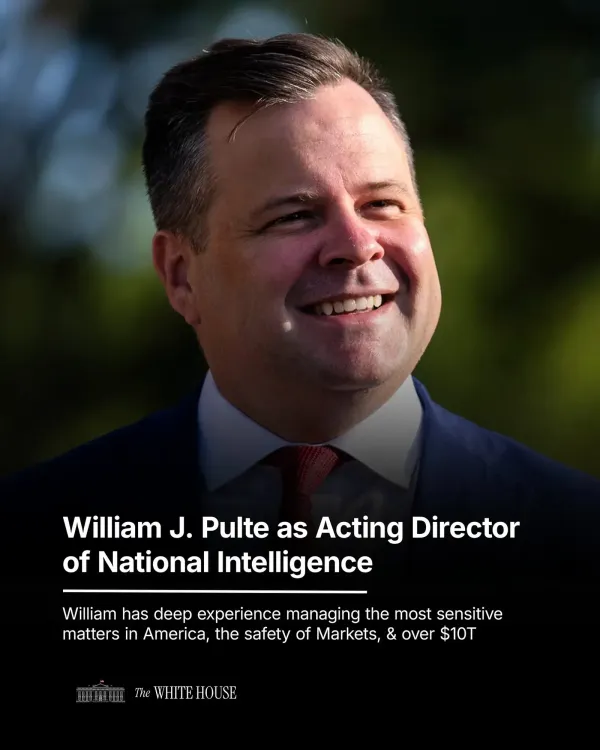
The White House announced that President Donald J. Trump has appointed Federal Housing Finance Agency Director and Fannie Mae/Freddie Mac Chairman William J. Pulte as Acting Director of National Intelligence, placing a housing-finance executive atop the U.S. intelligence community pending any future permanent nomination and Senate process.
Key Takeaways
President Trump has named William J.
Pulte as Acting Director of National Intelligence.
Pulte concurrently serves as FHFA Director and chairman of Fannie Mae and Freddie Mac.
The DNI office, created in 2004, coordinates the U.S. intelligence community's 18 agencies.
Acting designations allow immediate appointment without Senate confirmation.
Indian security planners will track continuity in India-U.S. intelligence cooperation.
The White House on Wednesday announced that President Donald J. Trump has named William J. Pulte, the sitting Director of the Federal Housing Finance Agency and chairman of Fannie Mae and Freddie Mac, as Acting Director of National Intelligence. The cross-portfolio appointment installs a housing-finance executive at the helm of the agency that coordinates the United States' 18-member intelligence community.
In the post, the White House quoted the President directly: 'I am appointing the Director of the Federal Housing Finance Agency, and Chairman of Fannie Mae/Freddie Mac, William J. Pulte, to serve as Acting Director of National Intelligence.' The communication closed with 'Congratulations to Director Pulte!' alongside a United States flag emoji.
Context
The Office of the Director of National Intelligence is a cabinet-level post created in 2004 through the Intelligence Reform and Terrorism Prevention Act, enacted in the wake of the 9/11 Commission report. The DNI sits atop the U.S. intelligence community, coordinating agencies that include the Central Intelligence Agency, the National Security Agency and military intelligence arms.
By designating Mr Pulte in an acting capacity, the President can fill the vacancy immediately without waiting for Senate confirmation. Acting designations are a recognised legal device that has been used by successive administrations to preserve operational continuity at the top of the intelligence community between confirmed appointees.
Policy backdrop
Mr Pulte, a business executive, was previously placed at the Federal Housing Finance Agency, the independent regulator established in 2008 to supervise the government-sponsored enterprises that underpin the U.S. mortgage market. As FHFA Director he also serves as chairman of Fannie Mae and Freddie Mac, two congressionally chartered entities that backstop a substantial share of American home loans.
His move to the intelligence portfolio marks a sharp cross-domain shift from financial regulation to national security coordination. Such transitions are not unprecedented; presidents across parties have at times tapped officials from outside the traditional intelligence career stream to align the office with executive priorities.
Stakeholders and impact
The Acting DNI oversees the National Intelligence Program budget and chairs the integration of analytic products such as the President's Daily Brief. The role also serves as the principal intelligence interlocutor for allied services, including those of India, the United Kingdom, Australia and other partners in counter-terrorism, cyber and maritime domains.
For New Delhi, leadership changes at the top of the U.S. intelligence community are watched closely given the deepening defence and intelligence-sharing track under the India-U.S. Comprehensive Global Strategic Partnership. Continuity in counter-terror cooperation and Indo-Pacific assessments will be a near-term concern for Indian security planners.
Within Washington, the appointment is likely to draw scrutiny from the Senate Select Committee on Intelligence, which oversees the DNI office and traditionally evaluates the credentials of intelligence community leaders. The committee's posture will be a key indicator of how durable an acting arrangement can be.
What's next
Attention now turns to whether the President will forward a formal nominee for a permanent Director of National Intelligence and, if so, the timeline for confirmation hearings. The duration of Mr Pulte's acting tenure, and whether he will simultaneously retain his FHFA responsibilities, will also shape the early reception of the appointment.
For allied capitals, including New Delhi, the immediate task will be to map continuity in liaison channels and joint working groups while the transition unfolds.
Point of View
Often via acting authority that bypasses immediate Senate scrutiny. Pulte's cross-jump from housing finance to intelligence coordination is striking, and it signals that loyalty and executive alignment are weighing heavily in this White House's personnel calculus. For partner services, including India's, the operational question is continuity rather than ideology. The durability of this arrangement will hinge on whether a permanent nominee follows soon.
NationPress
17 Oct 2026
Frequently Asked Questions
Who is William J. Pulte?
William J. Pulte is a U.S. business executive who has been serving as Director of the Federal Housing Finance Agency and chairman of the government-sponsored enterprises Fannie Mae and Freddie Mac.
What does the Director of National Intelligence do?
The Director of National Intelligence leads the U.S. intelligence community, coordinating 18 agencies, overseeing the National Intelligence Program budget and serving as the President's principal intelligence adviser.
Why was an acting director appointed instead of a permanent one?
Acting appointments allow a president to fill a senior vacancy immediately without waiting for Senate confirmation, a mechanism used by multiple administrations to maintain continuity at the top of the intelligence community.
How does this affect India-U.S. intelligence cooperation?
Leadership transitions at the DNI office are closely watched in New Delhi because the DNI is a key interlocutor for allied services on counter-terrorism, cyber and Indo-Pacific assessments under the India-U.S. strategic partnership.
When was the Office of the Director of National Intelligence created?
It was established in 2004 by the Intelligence Reform and Terrorism Prevention Act, following recommendations of the 9/11 Commission.