White House Thanks Tulsi Gabbard as She Exits DNI Role
Synopsis
The White House on 27 May 2026 announced President Trump's 'tremendous gratitude' to Tulsi Gabbard as she steps down as Director of National Intelligence. Her departure marks a significant leadership transition at the top of the 18-member U.S. Intelligence Community, with a successor yet to be named.
Key Takeaways
The White House posted on 27 May 2026 that President Trump expressed 'tremendous gratitude' to outgoing DNI Tulsi Gabbard .
Gabbard was nominated as Director of National Intelligence in November 2024 and confirmed by the Senate in 2025 .
She is a former Democratic U.S.
Representative from Hawaii who endorsed Trump ahead of the 2024 election.
The ODNI coordinates the work of 18 U.S. intelligence agencies and advises the President on national security matters.
No successor has been publicly named; the Senate Intelligence Committee will oversee any confirmation process.
The transition may influence U.S. intelligence priorities and allied security partnerships heading into the FY2027 cycle.
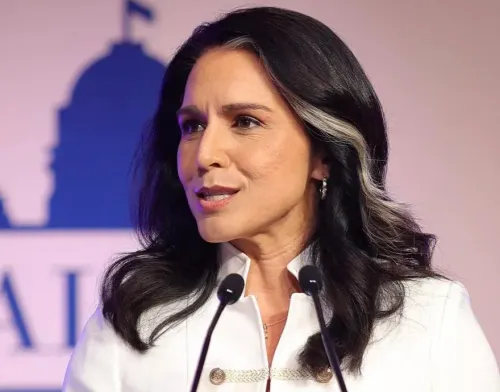
The White House on Wednesday, 27 May 2026 expressed 'tremendous gratitude' from President Donald Trump to Tulsi Gabbard as she departs from her position as Director of the Office of the Director of National Intelligence (ODNI), marking a significant leadership transition at the helm of the United States intelligence community.
Context
Tulsi Gabbard, a former Democratic U.S. Representative from Hawaii who served from 2013 to 2021, made a notable political journey before joining the Trump administration. She had run for the Democratic presidential nomination in 2020 before publicly endorsing Trump ahead of the 2024 presidential election. Trump nominated her as DNI in November 2024, and she was confirmed by the Senate in 2025.
The ODNI was established under the Intelligence Reform and Terrorism Prevention Act of 2004 and serves as the lead coordinating body for the 18-member U.S. Intelligence Community. The Director of National Intelligence advises the President and the National Security Council on intelligence matters and oversees the integration of intelligence across federal agencies.
Policy Backdrop
Personnel shifts at the ODNI have historically signalled broader realignments in intelligence priorities and inter-agency coordination. Previous directors under recent administrations include John Ratcliffe (2020–2021) during Trump's first term and Avril Haines (2021–2025) under the Biden administration.
Gabbard's tenure was closely watched as a test of the second Trump administration's approach to aligning intelligence leadership with executive priorities. Her background as a military veteran and her cross-party political trajectory made her a distinctive figure at the agency. The exact circumstances and timing of her departure have not been officially detailed beyond the White House's expression of gratitude.
Stakeholders and Impact
The transition at the top of the ODNI has immediate implications for the broader U.S. Intelligence Community, including the CIA, NSA, DIA, and 14 other member agencies that fall under its coordination umbrella. Senior national security officials and the Senate Intelligence Committee will be closely monitoring the succession process.
For India, which maintains deep intelligence-sharing and defence cooperation ties with the United States, leadership continuity or change at the ODNI can have downstream effects on bilateral security frameworks and information-sharing arrangements. Any shift in analytic emphasis at the agency may also influence how Washington assesses regional threats relevant to South Asia.
What's Next
Attention now turns to the Senate Intelligence Committee and any successor nomination President Trump may put forward to lead the ODNI. The confirmation process for a new director will be a key indicator of the administration's evolving national security priorities heading into the FY2027 budget cycle.
The transition also raises questions about potential adjustments to intelligence community budget requests and analytic priorities. Whoever assumes the role will inherit an agency navigating complex global threat landscapes, making the choice of successor a closely watched decision in both Washington and allied capitals worldwide.
Point of View
Amicable departure rather than a dismissal, preserving the administration's public narrative of loyalty and gratitude. Gabbard's brief tenure at the ODNI was always politically freighted — her cross-party background made her both a symbol of the Trump coalition's breadth and a lightning rod for intelligence community scepticism. The timing of the announcement, without naming a successor, suggests the administration is deliberate about its next pick, likely seeking someone who can consolidate the executive-alignment agenda Gabbard was appointed to advance. For U.S. allies, including India, the identity of the next DNI will be a significant signal about Washington's intelligence priorities in a turbulent geopolitical moment.
NationPress
19 Sept 2026
Frequently Asked Questions
Why is Tulsi Gabbard leaving as Director of National Intelligence?
The White House has not stated specific reasons for her departure, only that President Trump expressed 'tremendous gratitude' to her as she exits the role. The exact circumstances remain officially undetailed.
When was Tulsi Gabbard appointed as DNI?
President Trump nominated Tulsi Gabbard as Director of National Intelligence in November 2024, and she was confirmed by the U.S. Senate in 2025.
Who will replace Tulsi Gabbard as DNI?
No successor has been publicly named as of 27 May 2026. The Senate Intelligence Committee will oversee any confirmation process for a new Director of National Intelligence.
What does the Director of National Intelligence do?
The DNI leads and coordinates the 18-member U.S. Intelligence Community, advises the President and the National Security Council on intelligence matters, and oversees inter-agency information sharing and analysis.
How does the ODNI leadership change affect India?
India and the U.S. maintain close intelligence-sharing and defence cooperation ties, so a shift in ODNI leadership can influence bilateral security frameworks and how Washington assesses regional threats relevant to South Asia.