CM Dhami on Good Governance: Benefits Must Reach Last Person
Synopsis
Chief Minister Pushkar Singh Dhami's office on 10 July 2026 reaffirmed that good governance hinges on delivering scheme benefits to every citizen simply and transparently, citing public convenience and empowerment as its core principles.
Key Takeaways
CM Pushkar Singh Dhami stated that government schemes succeed only when benefits reach the last person in a simple, transparent, and effective manner.
He defined good governance through two principles: jansuvidha (public convenience) and janashaktikaran (public empowerment).
The statement aligns with India's Direct Benefit Transfer framework, in place since 2013 , which links welfare payments to Aadhaar-verified accounts to reduce leakage.
Uttarakhand's mountainous geography makes last-mile delivery especially critical, with many beneficiaries located in remote hill villages.
No specific scheme or event was cited; the statement articulates the broader governance philosophy of the Dhami administration .
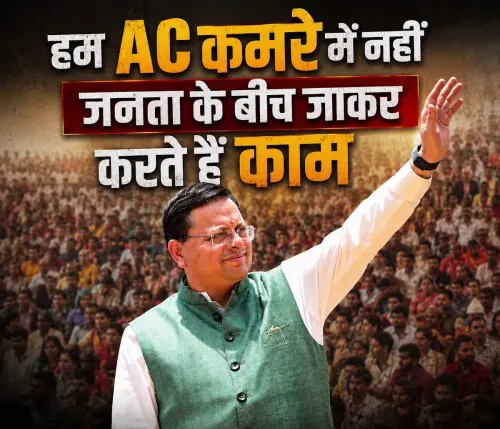
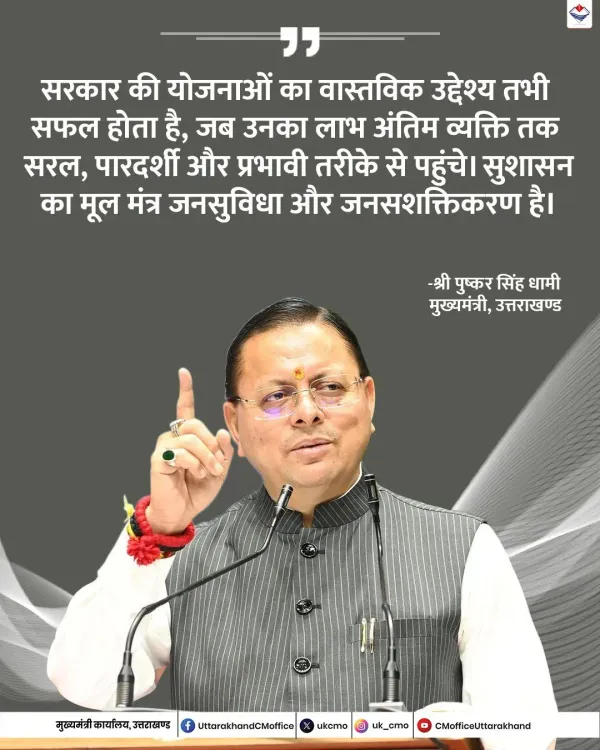
The Chief Minister's Office of Uttarakhand, on behalf of Chief Minister Pushkar Singh Dhami, shared a governance statement on Friday, 10 July 2026, underscoring that the true purpose of government schemes is fulfilled only when their benefits reach every citizen through simple, transparent, and effective delivery.
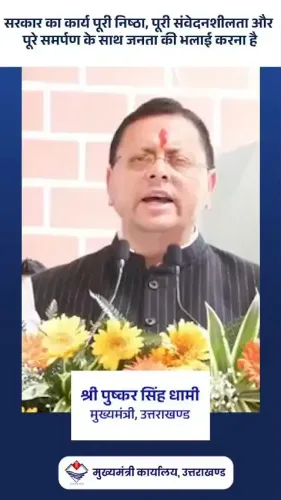
Quoting CM Dhami directly, the post stated: 'Sarkaar ki yojnaon ka vastavik uddeshya tabhi safal hota hai, jab unka laabh antim vyakti tak saral, paardarshi aur prabhavi tarike se pahunche. Sushasan ka mool mantra jansuvidha aur janashaktikaran hai.' In English: 'The true purpose of government schemes succeeds only when their benefits reach the last person in a simple, transparent, and effective manner. The fundamental principle of good governance is public convenience and public empowerment.'
Context
CM Pushkar Singh Dhami, who has led Uttarakhand since 2021, has consistently positioned last-mile delivery and administrative accountability as pillars of his government's agenda. The statement does not reference a specific scheme or event but articulates the overarching governance philosophy his administration has championed. It reflects a recurring emphasis on ensuring that welfare infrastructure translates into tangible outcomes for ordinary citizens, particularly those in remote hill districts.
Policy Backdrop
India's push for leakage-free welfare delivery gained national momentum with the rollout of Direct Benefit Transfer (DBT) from 2013 onward, linking subsidies and entitlements directly to Aadhaar-verified bank accounts. BJP-led state governments, including Uttarakhand, have built on this framework by integrating digital monitoring tools, real-time grievance redressal platforms, and scheme-tracking dashboards. The twin objectives cited by CM Dhami — jansuvidha (public convenience) and janashaktikaran (public empowerment) — map closely onto the language used across these reform initiatives.
Stakeholders and Impact
The primary beneficiaries of this governance approach are Uttarakhand's scheme recipients, including rural and semi-urban households that depend on state welfare programmes for food security, housing, healthcare, and livelihood support. The state's challenging terrain — spanning high-altitude villages with limited connectivity — makes last-mile delivery a particularly acute administrative challenge. Transparent and simplified delivery mechanisms are therefore not merely aspirational but operationally critical for a significant share of the population.
What's Next
Observers will watch for concrete policy announcements in upcoming Uttarakhand budget sessions or administrative reviews that operationalise this stated philosophy. State-level audits of welfare scheme implementation, expansion of digital grievance platforms, and any new beneficiary-identification drives will be key indicators of whether this governance vision translates into measurable reform. The statement also sets a rhetorical benchmark against which the administration's delivery record will likely be assessed in the lead-up to future electoral cycles.
Point of View
The Chief Minister signals alignment with the Centre's DBT-driven welfare architecture while projecting a distinct state-level identity around administrative accountability. The timing, outside any specific scheme launch or budget event, suggests an effort to reinforce governance credentials ahead of potential policy announcements. How this philosophy is operationalised in Uttarakhand's next budget cycle will determine whether it moves beyond messaging into measurable impact.
NationPress
9 Oct 2026
Frequently Asked Questions
What did CM Pushkar Singh Dhami say about good governance?
CM Dhami stated that the true purpose of government schemes is achieved only when benefits reach the last person simply, transparently, and effectively, and that the core of good governance is public convenience and public empowerment.
What is 'janashaktikaran' as used by CM Dhami?
'Janashaktikaran' translates to 'public empowerment' and refers to enabling citizens — especially the most marginalised — to access government benefits and services as active participants rather than passive recipients.
What is Direct Benefit Transfer and how does it relate to this statement?
Direct Benefit Transfer, launched nationally in 2013 , channels subsidies and welfare payments directly into Aadhaar-linked bank accounts to reduce leakage. CM Dhami's emphasis on transparent, last-mile delivery aligns closely with the DBT framework.
Why is last-mile delivery a challenge in Uttarakhand?
Uttarakhand's mountainous terrain and dispersed hill villages make physical access to welfare services difficult, making digital and simplified delivery mechanisms especially important for reaching all intended beneficiaries.
Was this statement linked to a specific scheme launch in Uttarakhand?
No specific scheme or event was mentioned in the post. The statement reflects the general governance philosophy of the Dhami administration rather than announcing a new initiative.