CM Dhami Slams Rahul Gandhi Over 'Anti-National' Remarks
Synopsis
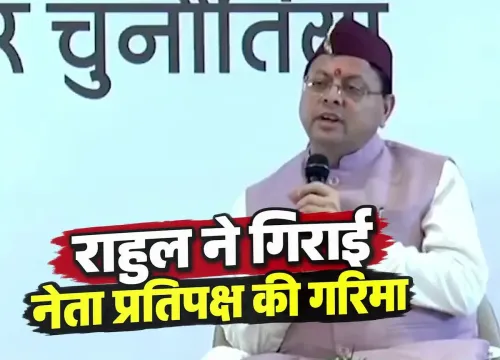
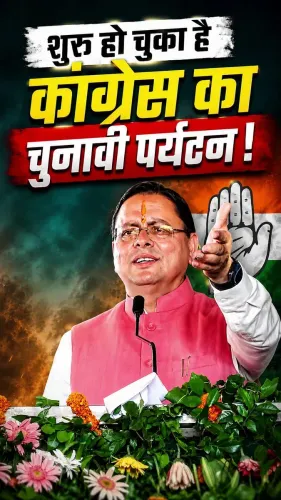
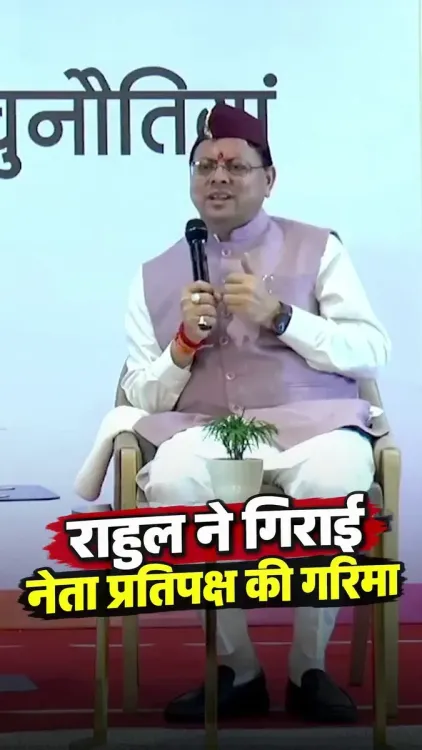
Uttarakhand CM Pushkar Singh Dhami accused Leader of the Opposition Rahul Gandhi of harbouring 'anti-national' thinking and neglecting constitutional responsibilities, extending BJP's sustained criticism of Congress's political conduct.
Key Takeaways
Uttarakhand CM Pushkar Singh Dhami publicly accused Rahul Gandhi of being 'completely consumed by anti-national thinking' in a post on September 26, 2026 .
Dhami charged Gandhi with failing to discharge the constitutional obligations attached to the office of Leader of the Opposition.
Gandhi has formally held the Leader of the Opposition role since the 2024 Lok Sabha elections — the first formal occupant of the post in a decade.
The attack extended beyond Gandhi personally to the Indian National Congress party's broader 'political culture and thinking.' BJP leaders targeting Congress figures on nationalism grounds is a pattern established since 2014 , with state-level CMs increasingly amplifying such messaging on social media.
The political temperature between India's ruling establishment and its principal opposition sharpened sharply on Saturday, September 26, 2026, as Uttarakhand Chief Minister Pushkar Singh Dhami launched a pointed broadside against Leader of the Opposition Rahul Gandhi, accusing him of abandoning his constitutional duties in favour of what Dhami called relentless, baseless rhetoric.
Posting in Hindi on X, Dhami wrote that Gandhi's mindset has become 'completely consumed by anti-national thinking' — 'राष्ट्रविरोधी सोच से पूरी तरह ग्रस्त' — and that rather than discharging the constitutional obligations that come with the office of Leader of the Opposition, Gandhi is 'continuously indulging in senseless raving' — 'अनर्गल प्रलाप'. The post went on to argue that Gandhi's statements expose not just a 'distorted mindset' but the broader political culture and thinking of the Indian National Congress.
The Weight of the Office Dhami Invokes
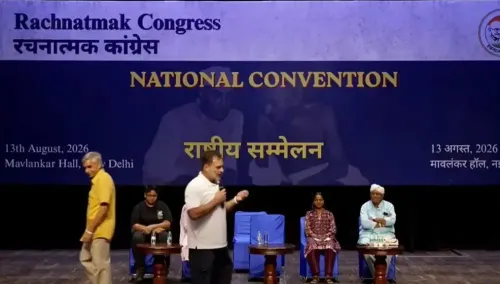
The post's rhetorical engine is the phrase 'constitutional obligations.' Following the 2024 Lok Sabha elections, Gandhi was formally recognised as Leader of the Opposition — a post that carries statutory privileges, a cabinet-rank salary, and well-defined parliamentary responsibilities. It is the first time the role had a formal occupant in a decade. By invoking the constitutional weight of that office, Dhami frames his attack not merely as partisan sniping but as a question of institutional conduct.
The BJP's criticism of Gandhi on grounds of nationalism and constitutional propriety is not new; it has been a recurring feature of inter-party exchanges since 2014. What Dhami's post adds is the explicit framing of the entire Congress party's 'political culture' as complicit — widening the target from one individual to an organisation.
A Pattern of BJP-Congress Friction
State-level BJP leaders weighing in on national opposition figures has itself become a familiar political mode. Chief Ministers and senior party functionaries routinely use social media to amplify central-party messaging, keeping pressure on Congress between parliamentary sessions. Dhami, as one of the BJP's more visible state executives, has done so before. The post's timing — a Saturday evening, outside any scheduled parliamentary business — suggests it is responding to a specific trigger, though the exact statement by Gandhi that prompted it has not been specified in the post itself.
With the next parliamentary session likely to bring fresh confrontations over the government's legislative agenda, exchanges like this one serve as advance positioning — each side staking out the terms on which future debates will be fought. Whether Gandhi responds, and in what register, will set the tone for the weeks ahead.
Point of View
The attack is dressed in institutional language rather than pure partisanship, making it harder to dismiss. Broadening the charge from Gandhi to Congress's 'political culture' signals an attempt to keep the entire party on the defensive ahead of the next parliamentary session. The pattern — state CMs amplifying national-level messaging — reflects a coordinated multi-tier communication structure that the BJP has refined since 2014. Gandhi's response, if any, will reveal whether Congress chooses to fight on Dhami's chosen terrain of nationalism or pivot to a policy counter-offensive.
NationPress
26 Sept 2026
Frequently Asked Questions
What did Pushkar Singh Dhami say about Rahul Gandhi?
Dhami said Rahul Gandhi's mindset is 'completely consumed by anti-national thinking' and that Gandhi is neglecting the constitutional duties of the Leader of the Opposition by indulging in 'senseless raving' instead.
Why is Rahul Gandhi called Leader of the Opposition?
Rahul Gandhi was formally recognised as Leader of the Opposition in the Lok Sabha following the 2024 general elections, the first time the post had a formal occupant in a decade, given Congress had lacked the required seat threshold before that.
What are the constitutional duties of the Leader of the Opposition in India?
The Leader of the Opposition holds a statutory post with cabinet-rank privileges and parliamentary responsibilities including scrutinising government legislation, holding the executive accountable, and participating in key constitutional appointments.
Is BJP criticism of Rahul Gandhi on nationalism a new development?
No. BJP leaders at both central and state levels have regularly criticised Rahul Gandhi on grounds of nationalism and constitutional conduct since at least 2014, making this a recurring pattern in Indian inter-party politics.
What did Dhami's post say about the Congress party?
Dhami argued that Gandhi's statements expose not just his personal 'distorted mindset' but also the 'political culture and thinking' of the Indian National Congress as an organisation.