CM Dhami targets Rahul Gandhi over women's respect claims
Synopsis
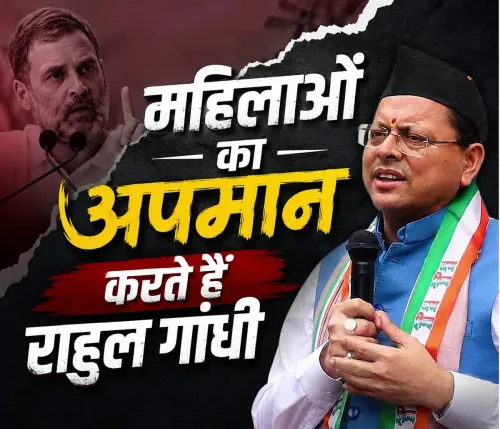
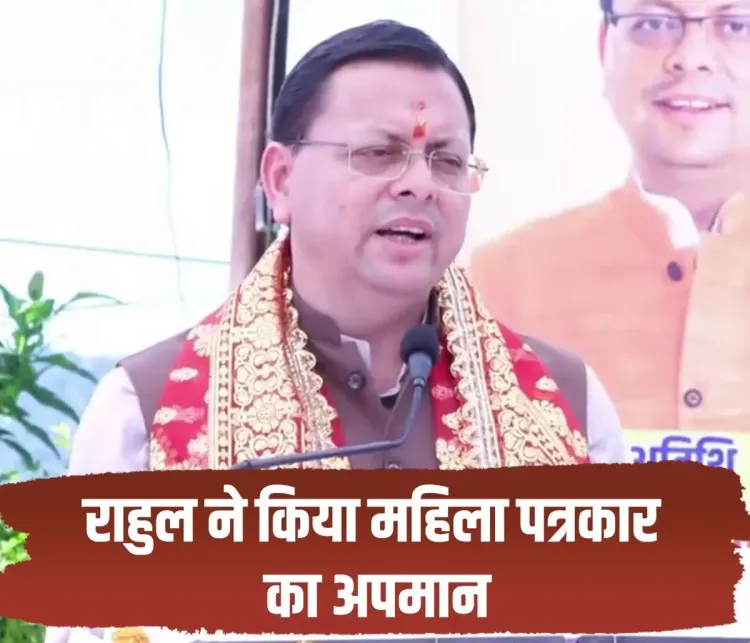
Uttarakhand CM Pushkar Singh Dhami publicly challenged Rahul Gandhi's moral authority on women's rights on 18 October 2026, citing an alleged journalist incident and demanding Congress answer for its own leaders' conduct before delivering lectures on women's dignity.
Key Takeaways
Pushkar Singh Dhami posted on 18 October 2026 targeting Rahul Gandhi over an alleged incident of misbehaviour with a female journalist.
Dhami questioned how Gandhi can speak on women's respect while facing such allegations.
He also referenced Congress MPs being 'under scrutiny' for alleged misconduct towards women, without naming individuals.
The post fits a recurring BJP pattern of countering Congress's gender-rights rhetoric with allegations of internal misconduct.
The specific journalist incident and Congress MP allegations remain unverified; no Congress formal response had been issued at publication time.
Press-freedom advocates and women journalists are an affected constituency beyond the immediate party clash.
A sharp political broadside landed on Sunday afternoon when Uttarakhand Chief Minister Pushkar Singh Dhami took direct aim at Congress leader Rahul Gandhi, questioning his credibility on women's rights after a reported incident involving a female journalist. The post, shared on 18 October 2026, framed the attack as a demand for accountability before moral lecturing.
The charge Dhami levelled
Writing in Hindi, CM Dhami asked pointedly: 'महिला पत्रकार से बदसलूकी करने वाले राहुल गांधी किस मुँह से महिला सम्मान की बात करते हैं?' — 'With what face can Rahul Gandhi, who misbehaved with a female journalist, speak of respect for women?' He went further, noting that Congress MPs themselves are 'in the dock over allegations of misconduct towards women,' and concluded that Congress must answer for its own leaders' conduct before preaching on women's dignity.
BJP's running counter-narrative on gender rhetoric
The broadside is not an isolated moment. BJP state leaders have, in recent years, routinely inverted Congress's gender-rights messaging by spotlighting alleged misconduct within opposition ranks — a tactic that typically escalates around parliamentary sessions or media flashpoints. The pattern reflects a calculated political posture: neutralise an opponent's moral authority on a high-stakes issue by demanding accountability at home first. It rarely produces formal inquiries but almost always dominates the news cycle for several days.
Congress has consistently denied similar counter-charges and has positioned Rahul Gandhi as a champion of women's safety and constitutional rights, making him a natural target whenever BJP leaders seek to puncture that image.
What remains unresolved — and why it matters
The specific incident with the female journalist that Dhami references, as well as the Congress MP allegations he alludes to, are contested claims whose factual details have not been independently established. That ambiguity is itself politically useful: it keeps the question alive without requiring either side to face definitive judgment. For women journalists and press-freedom advocates, however, any episode of alleged harassment by a political figure — regardless of party — carries real professional stakes that extend well beyond a Twitter spat.
Congress spokespersons had not issued a formal response at the time of publishing. Their answer, when it comes, will likely determine how long this exchange dominates the political conversation.
In Indian politics, the weaponisation of women's dignity rhetoric has become a bipartisan reflex — the question is whether any party converts the outrage into legislation. So far, neither side has blinked first on that front.
Point of View
State-level BJP leaders deflect by pointing to alleged misconduct within the opposition's own ranks. The tactic is designed to neutralise moral authority rather than advance policy. What makes this moment notable is the direct naming of Rahul Gandhi — typically a move reserved for moments when the BJP senses political advantage from the specific incident in question. Until the underlying facts are independently established, the exchange will function primarily as noise that crowds out substantive debate on women's safety legislation.
NationPress
18 Oct 2026
Frequently Asked Questions
What did CM Dhami say about Rahul Gandhi and the female journalist?
CM Dhami posted on X questioning how Rahul Gandhi, who he alleged misbehaved with a female journalist, can speak about respect for women. He also said Congress must answer for its own MPs' conduct before lecturing on women's dignity.
Which incident involving a female journalist is Dhami referring to?
Dhami's post alludes to an incident in which Rahul Gandhi allegedly misbehaved with a female journalist, but the specific details of this incident have not been independently verified at the time of publication.
How has Congress responded to Dhami's post?
Congress had not issued a formal response to CM Dhami's post at the time of publishing. A reply from Congress spokespersons is expected in the coming days.
Is this the first time BJP leaders have raised such allegations against Congress?
No. BJP leaders — particularly at the state level — have routinely used allegations of internal Congress misconduct to counter the opposition's gender-rights messaging, especially during politically charged periods like parliamentary sessions or media controversies.
What is the broader political significance of this exchange?
The exchange highlights how women's safety and dignity have become contested political terrain in India, with both major parties accusing the other of hypocrisy rather than pushing concrete legislative solutions.