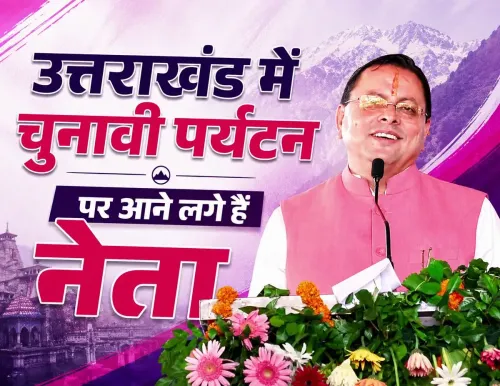
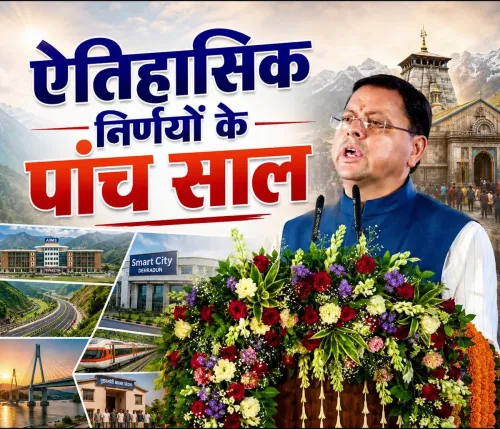
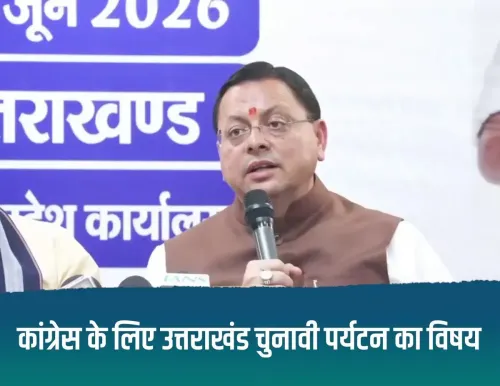
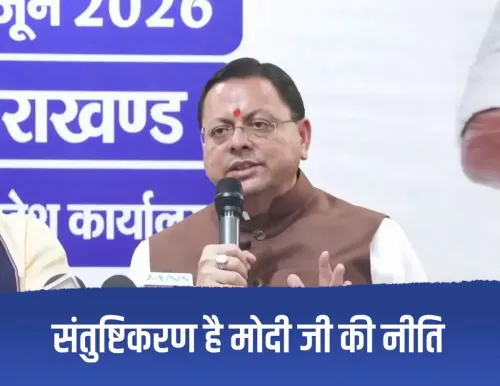
CM Dhami Accuses Congress of Prioritising Vote-Bank Politics
Synopsis
Uttarakhand Chief Minister Pushkar Singh Dhami on 13 June 2026 accused Congress of never centering national interest or public welfare in its politics, saying the party has always placed vote-bank calculations above all else — a charge that signals sharpening BJP rhetoric ahead of the 2027 state polls.
Key Takeaways
CM Pushkar Singh Dhami posted on 13 June 2026 accusing Congress of keeping vote-bank politics supreme over national interest.
The statement was made in Hindi and directly targets Congress 's governance philosophy.
BJP has built its political identity since 2014 around contrasting 'Sabka Saath, Sabka Vikas' with Congress-era identity-based welfare.
Dhami 's Uttarakhand government has pursued policies such as the Uniform Civil Code to reinforce a non-discriminatory governance narrative.
The rhetoric is expected to intensify as the 2027 Uttarakhand assembly elections approach.
Congress is expected to rebut the charges by pointing to its own broad-based welfare legislation record.
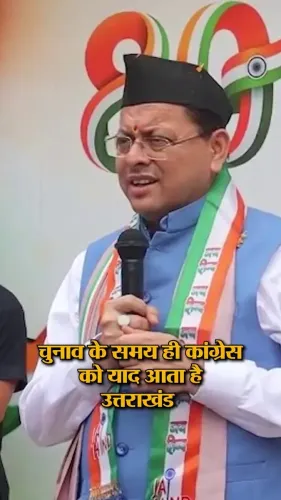
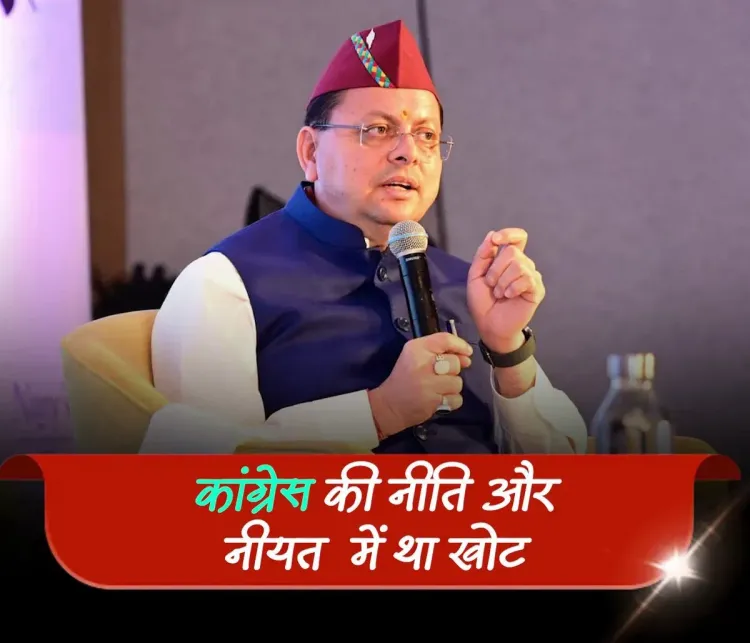
Uttarakhand Chief Minister Pushkar Singh Dhami launched a sharp political broadside against the Indian National Congress on Saturday, 13 June 2026, accusing the party of never placing national interest or public welfare at the centre of its politics.
In a post on X, CM Dhami wrote in Hindi: 'कांग्रेस की सोच में राष्ट्रहित और जनकल्याण कभी केंद्र में नहीं रहे, उसने हमेशा वोट बैंक की राजनीति को ही सर्वोपरि रखा।' ('National interest and public welfare were never central to Congress's thinking; it always kept vote-bank politics supreme.')
Context
Dhami, who has led the BJP government in Uttarakhand since 2021, has consistently positioned his administration as one focused on uniform development and governance rooted in national interest. The post reflects a well-established line of attack that BJP leaders at both the central and state levels have deployed against Congress — framing the opposition as a party that governs for electoral blocs rather than citizens at large.
The statement comes with the 2027 Uttarakhand assembly elections on the horizon, a period during which political messaging from both camps is expected to intensify.
Policy Backdrop
BJP's national political identity since its landmark 2014 general election victory has been built around the slogan 'Sabka Saath, Sabka Vikas' ('Together with all, development for all') — a direct contrast to what the party characterises as Congress's identity-based and community-targeted welfare approach.
At the state level, Dhami's government has pursued policies presented as non-discriminatory, including active movement on a Uniform Civil Code for Uttarakhand, which the administration describes as a step toward equal treatment of all citizens regardless of religion or community. These moves have reinforced the BJP's broader counter-narrative to Congress-era governance.
Stakeholders and Impact
The accusation of vote-bank politics is aimed squarely at Congress's voter-outreach strategies, which BJP leaders argue have historically favoured specific minority or caste groups over the general public interest. For ordinary voters in Uttarakhand — a state with a significant rural population, a large ex-servicemen community, and active pilgrim economy — such messaging is calibrated to resonate with aspirations for uniform development.
Congress, as the principal opposition, is expected to rebut these charges, likely by pointing to its own welfare legacy, including rural employment guarantees and food security legislation, as evidence of broad-based public interest governance.
What's Next
With the 2027 Uttarakhand assembly polls drawing closer, political exchanges of this nature are likely to sharpen. CM Dhami's government is expected to roll out welfare and infrastructure announcements that reinforce the BJP's 'development without discrimination' framing, while Congress will seek to counter by highlighting local governance gaps. The ideological contest over who truly serves the national interest — and who serves electoral arithmetic — is set to define the run-up to the next state election.
Point of View
Dhami keeps the attack evergreen and broadly applicable, making it useful campaign currency well ahead of 2027. The timing, roughly a year before assembly elections, suggests the party is seeding its ideological ground early. Whether Congress can mount a credible counter-narrative in Uttarakhand — a state it has not governed since 2017 — remains the central political question in the state.
NationPress
23 Sept 2026
Frequently Asked Questions
What did Uttarakhand CM Dhami say about Congress?
CM Pushkar Singh Dhami said that national interest and public welfare were never central to Congress's thinking and that the party has always placed vote-bank politics above everything else.
Why is CM Dhami attacking Congress now?
While no specific trigger has been confirmed, the statement aligns with BJP's long-standing counter-narrative against Congress and comes roughly a year ahead of the 2027 Uttarakhand assembly elections, a period when political messaging typically intensifies.
What is vote-bank politics in India?
Vote-bank politics refers to the practice of targeting welfare schemes, policy announcements, or rhetoric at specific caste, religious, or community groups to secure their votes, rather than pursuing uniform national development.
What is BJP's alternative to Congress's approach according to Dhami?
BJP, including CM Dhami's Uttarakhand government, positions itself around 'Sabka Saath, Sabka Vikas' — development for all without discrimination — contrasting it with what it calls Congress's identity-based or community-targeted governance.
When are the next Uttarakhand assembly elections?
The next Uttarakhand assembly elections are due in 2027, and political activity in the state is expected to ramp up significantly in the months ahead.