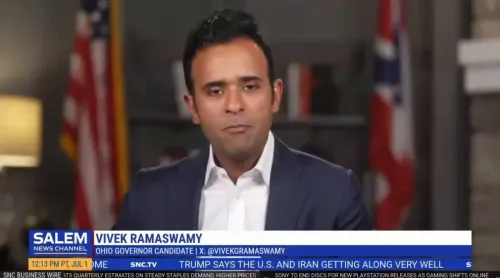
Ramaswamy Lays Out Three-Pillar Cost Plan Ahead of DOGE Push

Synopsis
Entrepreneur Vivek Ramaswamy announced a three-point cost-reduction agenda — property taxes via efficiency, energy bills via production, healthcare via transparency — teasing an imminent DOGE operational push with 'Our work begins on Wednesday morning.'
Key Takeaways
Vivek Ramaswamy posted a three-point household-cost reduction plan on 2 November 2026 .
The plan targets lower property taxes through government efficiency, lower electricity bills through expanded energy production, and lower healthcare costs through price transparency.
DOGE was established by President-elect Donald Trump in late 2024 with a stated target of $2 trillion in federal spending reductions.
Ramaswamy co-led DOGE alongside Elon Musk as an advisory body focused on spending cuts and regulatory rollback.
The 'Wednesday morning' language signals an imminent operational milestone, though the specific date and DOGE's current status could not be independently verified.
All three policy themes — deregulation, energy expansion, and price transparency — echo Republican priorities stretching back to the 2017 Tax Cuts and Jobs Act era.
Three promises, three kitchen-table costs — and a countdown. Entrepreneur Vivek Ramaswamy, founder of Strive Asset Management and former co-lead of the US Department of Government Efficiency (DOGE), posted on X on Monday, 2 November 2026, laying out a sharp three-point agenda: lower property taxes through government efficiency, lower electricity bills through energy production, and lower healthcare costs through price transparency — signing off with the line 'Our work begins on Wednesday morning.'
Three Costs, One Argument
The post is deceptively compact, but each line carries a distinct policy mechanism. On property taxes, Ramaswamy's argument tracks a familiar logic: leaner government overhead reduces the fiscal pressure on municipalities that drives levies upward. On energy, the case is supply-side — produce more, prices fall. On healthcare, the lever is market transparency: when patients can see prices, providers compete, and costs compress.
Together, the three points form a coherent household-budget frame — not an abstract ideological platform, but a monthly-bill argument aimed squarely at working and middle-class Americans.
DOGE's Origins and the $2 Trillion Target
The reference to 'Wednesday morning' points to DOGE's operational calendar. DOGE was established by President-elect Donald Trump in late 2024 as an advisory body tasked with identifying federal spending cuts, regulatory reductions, and efficiency improvements. Its co-leads were Ramaswamy and Elon Musk, and the headline ambition set at launch was a staggering $2 trillion in federal spending reductions.
The initiative drew immediate attention — and immediate scepticism — for the scale of its stated ambition. A $2 trillion cut would represent roughly a third of annual US federal discretionary and mandatory outlays combined, a target most budget analysts considered politically and arithmetically steep.
Republican Cost-Cutting in a Long Line
None of these three themes arrived fully formed in 2024. The broader pattern Ramaswamy is working within stretches back through the 2017 Tax Cuts and Jobs Act, energy deregulation pushes across multiple administrations, and pharmaceutical price-transparency executive orders. What DOGE represented was an attempt to consolidate those threads into a single, high-velocity institutional effort rather than piecemeal agency rulemaking.
Healthcare price transparency, in particular, had been gaining bipartisan traction — hospital and insurer price disclosure rules were progressively tightened in the early 2020s, with enforcement ramping up through the mid-decade. DOGE's framing slots into that momentum rather than breaking from it.
What the 'Wednesday' Clock Means
The closing line — 'Our work begins on Wednesday morning' — is the post's sharpest detail, and also its least verifiable. The specific Wednesday, and the precise operational status of DOGE at this stage, cannot be independently confirmed. What the line does signal is intent: Ramaswamy is framing this as a launch moment, not a policy discussion. The countdown language is deliberate. Announcements follow.
Whether DOGE's efficiency recommendations translate into concrete state-level property-tax relief, utility-rate reform, or hospital price mandates will be the real test — and that test, by Ramaswamy's own framing, is about to begin.
Point of View
He anchors it in three costs every American household feels monthly. That pivot from 'government efficiency' as bureaucratic jargon to 'your property tax, your electric bill, your doctor visit' is strategically significant — it attempts to build popular ownership of a process that critics have dismissed as elite-driven austerity. The 'Wednesday morning' countdown adds urgency and accountability in equal measure, making the announcement a self-imposed public deadline. Whether the institutional machinery behind DOGE can deliver on even one of the three promises will define how the broader deregulation-and-efficiency agenda is remembered.
NationPress
2 Nov 2026
Frequently Asked Questions
What is DOGE and who leads it?
DOGE, the Department of Government Efficiency, is a US advisory body established in late 2024 to identify federal spending cuts and regulatory reductions. It was co-led by Vivek Ramaswamy and Elon Musk after President-elect Donald Trump announced its creation with a target of $2 trillion in savings.
What did Vivek Ramaswamy post on November 2, 2026?
Ramaswamy posted a three-point agenda on X: lowering property taxes through government efficiency, cutting electricity bills by producing more energy, and reducing healthcare costs through price transparency, adding that 'our work begins on Wednesday morning.'
How does government efficiency lower property taxes?
The argument is that leaner government overhead reduces the fiscal pressure on municipalities, which in turn reduces the need to raise property tax levies to fund public services — a supply-side logic applied to local government finance.
What is Vivek Ramaswamy's role now?
Ramaswamy is the founder and executive chairman of Strive Asset Management. He was also a 2024 Republican presidential candidate and formerly co-led the DOGE advisory effort alongside Elon Musk.
What is the $2 trillion DOGE target about?
When DOGE was announced in late 2024, its stated ambition was to find $2 trillion in federal spending reductions through efficiency improvements, spending cuts, and regulatory rollbacks — a figure widely described by budget analysts as historically ambitious.