Ramaswamy Vows to End Soft Bail Policies in Ohio
Synopsis
Entrepreneur Vivek Ramaswamy has pledged to end minimal-bail releases of repeat violent offenders in Ohio, blaming 'left-wing activist judges' and promising law enforcement stronger political backing once he takes office. The statement signals a state-level electoral push ahead of Ohio's 2026 elections.
Key Takeaways
Ramaswamy posted on June 7, 2026 , pledging to restore the rule of law in Ohio cities.
He accused 'left-wing activist judges' of releasing repeat violent offenders on minimal bail, endangering Ohioans.
He praised Ohio law enforcement officers but argued they lack adequate support from political leaders.
The statement aligns with his 2024 presidential campaign themes of law and order and criticism of progressive criminal justice policies.
Ohio's 2026 statewide elections are the implied electoral context for the pledge.
Bail statutes and judicial discretion over repeat offenders are active legislative debates in the Ohio General Assembly .
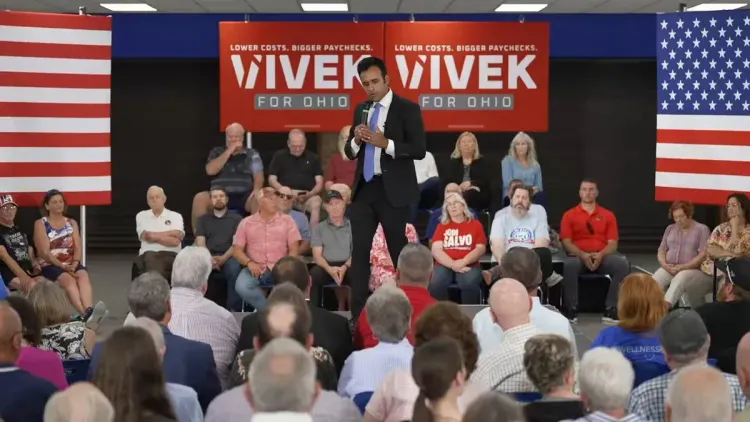
Entrepreneur and former 2024 Republican presidential candidate Vivek Ramaswamy pledged on Sunday, June 7, 2026, to crack down on what he called lenient judicial bail decisions in Ohio, vowing to stop 'left-wing activist judges' from releasing repeat violent offenders on minimal bail once he takes office.
Context
In the post, Ramaswamy wrote: 'We need to restore the rule of law in our cities and I'll be the one to get it done.' He accused unnamed judges of releasing 'repeat violent offenders back on the street for minimal bail, only to watch those criminals hurt more innocent Ohioans,' adding that the pattern 'happens too often and it'll end when I take office.'
Ramaswamy praised law enforcement officers, stating they are 'doing their best' but 'deserve better from leaders at the top' — framing the problem as one of political will rather than policing capacity.
Policy Backdrop
The statement fits squarely within a sustained national debate that intensified after 2020 over bail reform, progressive prosecutors, and recidivism in American cities. Republican candidates across the country have frequently pledged to reverse what they characterise as judicial leniency toward repeat offenders.
Ramaswamy's 2024 presidential campaign similarly centred on restoring law and order and criticising progressive criminal justice policies. His pivot to Ohio-specific rhetoric signals a state-level electoral focus, with Ohio's 2026 statewide elections on the horizon.
Bail statutes and the degree of judicial discretion over repeat offenders have been recurring legislative flashpoints in the Ohio General Assembly, where Republican majorities have periodically sought to tighten pre-trial detention rules.
Stakeholders and Impact
Ohio residents and local law enforcement officers are the constituencies Ramaswamy is directly addressing. By positioning officers as under-supported by political leadership, he is appealing both to police unions and to voters who feel urban safety has deteriorated.
Judges and district attorneys associated with bail-reform philosophies are the implicit targets of his criticism. Progressive legal advocates, on the other hand, argue that high pre-trial detention rates disproportionately harm low-income defendants who pose no flight risk and have not been convicted of any offence.
The broader debate has real consequences: research on recidivism and bail policy remains contested, with competing studies cited by both sides to support their positions on whether stricter pre-trial detention reduces violent crime.
What's Next
All eyes will be on Ohio's 2026 statewide election cycle to see whether Ramaswamy formally enters a race — and for which office — and how his law-and-order platform shapes the Republican primary conversation in the state.
Should he enter the race, legislative proposals to amend Ohio's bail statutes or curtail judicial discretion on repeat offenders are likely to become central campaign issues. His entry could also pressure other candidates in the field to sharpen their own public-safety positions.
Point of View
Designed to consolidate Republican base support in Ohio ahead of a likely 2026 statewide bid. By framing the issue as judicial activism rather than a policing failure, he insulates law enforcement as an ally while making the judiciary and progressive legal philosophy the political adversary. The rhetoric echoes a national Republican playbook that has proven electorally effective in suburban and exurban districts where perceptions of rising crime outpace statistical trends. Whether it translates into a durable policy agenda will depend on which office he seeks and whether the Ohio legislature moves in parallel on bail reform.
NationPress
22 Oct 2026
Frequently Asked Questions
Is Vivek Ramaswamy running for office in Ohio in 2026?
Ramaswamy has not formally announced a specific 2026 Ohio candidacy as of this post, but his language — 'when I take office' — strongly implies an active electoral campaign is underway or imminent in Ohio.
What is Vivek Ramaswamy's position on bail reform?
Ramaswamy opposes minimal-bail releases for repeat violent offenders, arguing that 'left-wing activist judges' endanger the public by returning such individuals to the streets, and has pledged to end the practice once in office.
What is the bail reform debate in Ohio about?
The debate centres on how much judicial discretion should exist in setting pre-trial bail for repeat offenders, with Republicans generally favouring stricter detention rules and progressive advocates arguing current bail systems unfairly penalise low-income defendants.
What offices did Vivek Ramaswamy previously seek or hold?
Ramaswamy ran for the 2024 Republican presidential nomination and subsequently co-led the advisory effort for the US Department of Government Efficiency (DOGE) ; he is the founder and executive chairman of Strive Asset Management .
Why does Ramaswamy mention Ohio specifically?
Ohio is Ramaswamy's home state and the apparent focus of his current political ambitions, making its residents and law enforcement the direct audience for his public-safety messaging ahead of the 2026 election cycle.