Russia's Arctic tourism push: North Pole voyages, ₹38 lakh tickets, 1.5 mn visits in 2025
Synopsis
Russia is the only country running regular tourist voyages to the geographic North Pole aboard nuclear icebreakers — tickets cost up to US $79,539, sell out every season, and only around 200 people worldwide get access per year. With 1.5 million Arctic visits in 2025 and US $760 million in infrastructure investment underway, Moscow is betting the frozen north becomes its next great tourism brand. The catch: climate change, geopolitical tensions, and fragile ecosystems are all pushing back.
Key Takeaways
Russia's nuclear icebreaker 50 Let Pobedy launched the 2026 polar expedition season from Murmansk in early July 2026 , carrying over 100 tourists to the geographic North Pole.
North Pole berths cost between US $46,184 and US $79,539 ; only around 200 tourists can make the journey per year under current scheduling.
Russia's Arctic regions recorded 1.5 million tourist visits in 2025 , up 6 per cent year on year ; the government targets a doubling by 2030 .
Murmansk Oblast alone welcomed over 800,000 visitors in 2025 , including approximately 53,000 foreign tourists from China, Belarus, India, Thailand, and Turkey.
Around 150 infrastructure projects are in the pipeline with total investment of 59 billion rubles (approximately US $760 million ).
A February 2026 snowstorm stranded more than 300 foreign tourists for over 40 hours near Teriberka, highlighting the sector's extreme weather risk.
Russia is mounting an ambitious campaign to turn its vast Arctic territory into a global tourism destination, offering the world's only regular nuclear-powered icebreaker voyages to the geographic North Pole — and betting that extreme exclusivity, immersive wilderness, and state-backed infrastructure investment can build a signature polar brand. The push comes as global interest in polar travel accelerates, even as environmental scientists and geopolitical analysts flag mounting risks.
Nuclear Icebreakers: The Crown Jewel
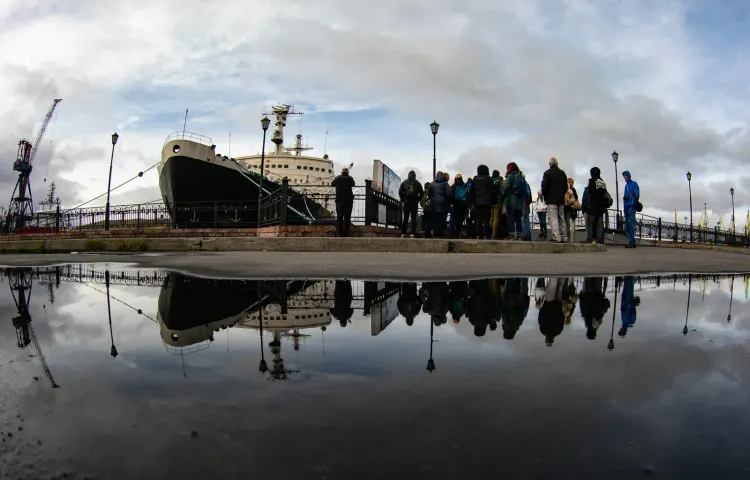
In early July 2026, the nuclear-powered icebreaker 50 Let Pobedy (50 Years of Victory) departed from Murmansk — Russia's largest ice-free port — bound for the geographic North Pole with more than 100 tourists on board, marking the official start of Russia's 2026 polar expedition season. The two-week voyage traverses drifting sea ice under the midnight sun, past vast glaciers and towering icebergs.
For over three decades, these icebreaker expeditions have been the centrepiece of Russia's Arctic tourism industry. No other Arctic nation offers comparable direct access to the North Pole; rivals rely on cruise ships or helicopters. One travel blogger who completed the journey described standing at the Pole as a moment where 'every step is south' — spinning in place, the blogger wrote, was like 'travelling around the world,' surrounded by endless ice and profound silence.
The exclusivity carries a steep price. According to Russian travel agencies, tickets for the 2026 season range from 3.6 million rubles (approximately US $46,184) for standard cabins to 6.2 million rubles (approximately US $79,539) for premium accommodation. Despite the cost, berths routinely sell out. Strict safety regulations and navigational constraints limit the season to just two departures in 2026, allowing only around 200 tourists worldwide to reach the Pole by this route. In 2025, 248 tourists completed the journey.
Broader Arctic Portfolio Takes Shape
Russia's ambitions extend well beyond the North Pole run. Under an Arctic development strategy signed by President Vladimir Putin, Moscow is accelerating infrastructure upgrades across nine federal regions, encouraging diversified local attractions and longer visitor stays. The strategy gained urgency after the 2021 launch of the French polar vessel Le Commandant Charcot challenged Russia's long-held dominance in the niche market.
Murmansk Oblast, marketed as Russia's 'Gateway to the Arctic' and home to the largest city above the Arctic Circle, welcomed over 800,000 visitors in 2025 — up 5.1 per cent year on year. Foreign arrivals totalled approximately 53,000, with visitors coming primarily from China, Belarus, India, Thailand, and Turkey. The region draws travellers with Aurora Borealis viewing, Barents Sea coastal tours, whale and seal watching, and immersive experiences with the Indigenous Nenets people and their traditional reindeer-herding lifestyle.
Further afield, Russia's Arctic itineraries extend to Oymyakon — the coldest permanently inhabited settlement on Earth — and Cape Dezhnev on the Chukchi Peninsula, the easternmost point of the Eurasian continent. Regional five-day Arctic tours in Murmansk are priced between 65,000 and 95,000 rubles (approximately US $833 to US $1,217), making them significantly more accessible than the icebreaker expeditions.
Investment Surge and Growth Targets
State support is driving a capital surge into Arctic tourism infrastructure. Around 150 projects are currently in the pipeline — spanning hotels, resorts, and campgrounds — with total committed investment reaching 59 billion rubles (approximately US $760 million). Russia's Arctic regions recorded 1.5 million tourist visits in 2025, up 6 per cent year on year. Russia's Ministry for the Development of the Russian Far East and Arctic projects that figure to double by 2030, accounting for 7 to 8 per cent of all tourist visits in the country.
Environmental and Safety Risks
Scientists have long cautioned that Arctic ecosystems recover slowly from human disturbance. Growing cruise ship, helicopter, and small-boat traffic risks displacing polar bears, seals, and seabirds from feeding and breeding grounds, while foot traffic and vehicles can damage fragile tundra vegetation, expose permafrost, and accelerate erosion. Vehicle emissions, wastewater, and plastic waste add further pressure to one of the planet's most ecologically sensitive environments.
To mitigate these impacts, Russia has introduced strict environmental regulations: tourists must maintain a minimum distance of 150 metres on land and 500 metres at sea when observing walruses; helicopter operations near bird nesting areas are tightly restricted in several Arctic regions; and visitors are required to carry out all waste, including plastics and packaging.
Extreme weather remains the most immediate operational risk. Climate change is making Arctic conditions increasingly unpredictable — severe cold, dense fog, and violent snowstorms regularly disrupt travel. In February 2026, a powerful snowstorm severed the road between Murmansk and the aurora-viewing village of Teriberka, stranding more than 300 foreign tourists for over 40 hours and causing many to miss international flights.
Geopolitical Uncertainty Clouds the Horizon
Military activity in the Arctic has intensified in recent years, with NATO expanding exercises and surveillance operations across the region while Russia has stepped up aerospace patrols and naval exercises in Arctic waters. Periodic navigation restrictions, temporary airspace closures, and cruise delays linked to security considerations have become factors travellers must increasingly weigh when booking polar itineraries.
How Russia navigates the intersection of commercial ambition, environmental stewardship, and geopolitical friction will determine whether its Arctic tourism drive becomes a durable global brand or remains a high-priced niche constrained by the very conditions that make it extraordinary.
Point of View
But the 2030 doubling target sits uncomfortably alongside the February 2026 Teriberka incident, which exposed how thin the safety infrastructure remains for mass polar tourism. Environmental regulations exist on paper, but independent enforcement in one of the world's most remote and politically sensitive territories is another matter entirely. The entry of Le Commandant Charcot in 2021 rattled Moscow enough to trigger a strategic pivot — which suggests that if Western operators scale up, Russia's nuclear-icebreaker monopoly may prove less durable than it appears.
NationPress
28 Oct 2026
Frequently Asked Questions
How much does a North Pole icebreaker voyage from Russia cost?
According to Russian travel agencies, tickets for the 2026 season range from 3.6 million rubles (approximately US $46,184) for standard cabins to 6.2 million rubles (approximately US $79,539) for premium accommodation. Despite the high cost, berths routinely sell out, with only around 200 spots available per year across two scheduled departures.
Why is Russia the only country offering nuclear icebreaker trips to the North Pole?
Russia operates the world's largest nuclear-powered icebreaker fleet, which gives it unique capability to navigate directly to the geographic North Pole. Other Arctic nations rely on conventional cruise ships or helicopters, which cannot match the ice-breaking capacity required for a direct Pole transit.
How many tourists visited Russia's Arctic regions in 2025?
Russia's Arctic regions recorded 1.5 million tourist visits in 2025, up 6 per cent year on year. Murmansk Oblast alone welcomed over 800,000 visitors, including approximately 53,000 foreign tourists from countries including China, Belarus, India, Thailand, and Turkey.
What environmental risks does Arctic tourism pose?
Scientists warn that Arctic ecosystems recover slowly from human disturbance. Increased cruise ship, helicopter, and boat traffic can displace polar bears, seals, and seabirds, while foot traffic damages fragile tundra and exposes permafrost. Russia has introduced regulations including minimum wildlife-viewing distances and mandatory waste removal, but enforcement in remote Arctic terrain remains a concern.
How is geopolitical tension affecting Arctic tourism?
Military activity in the Arctic has intensified, with NATO expanding exercises and Russia stepping up aerospace and naval patrols. This has led to periodic navigation restrictions, temporary airspace closures, and cruise delays that travellers must factor into polar itinerary planning.