Sacks Backs Nadella on AI Sovereignty and Data Leakage Risk

Synopsis
White House AI and Crypto Czar David Sacks amplified Microsoft CEO Satya Nadella's 'Reverse Information Paradox' on 13 July 2026, warning that enterprises pay for frontier AI twice — in money and in proprietary knowledge that compounds inside the model provider, not the customer.
Key Takeaways
White House AI and Crypto Czar David Sacks endorsed Satya Nadella 's 'Reverse Information Paradox' framework on 13 July 2026 .
The framework argues enterprises pay for frontier AI twice: once in money, and again by surrendering proprietary knowledge, corrections, traces, and evaluation data to model providers.
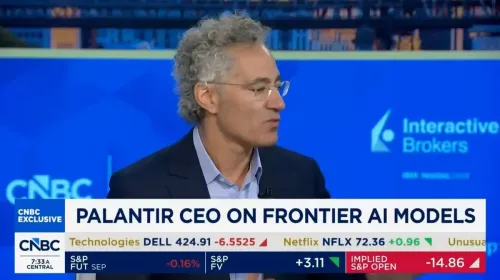
Alex Karp of Palantir Technologies had earlier diagnosed the same problem as enterprises wanting to 'own the means of production' rather than cede it.
Nadella's prescribed remedy includes private evaluation frameworks, tenant-isolated learning loops, decoupled orchestration, and the explicit right to fine-tune on one's own outputs.
Sacks's endorsement signals that enterprise AI data sovereignty may increasingly shape federal AI procurement policy under the current administration.
Both Microsoft and Palantir are commercially positioned to serve enterprises seeking sovereign, air-gapped AI deployments.
White House AI and Crypto Czar David Sacks on Monday, 13 July 2026, amplified a framework coined by Microsoft Chairman and CEO Satya Nadella that warns enterprises they are unknowingly surrendering their most valuable institutional knowledge every time they interact with frontier AI models — a structural problem Nadella calls the 'Reverse Information Paradox.'
Context
Sacks described Nadella's post as 'a fascinating' extension of an argument first raised by Palantir Technologies co-founder and CEO Alex Karp. Karp had argued that serious enterprise and government customers do not merely want access to AI — they want control over their compute, model weights, data stack, and what he termed their 'alpha,' meaning the proprietary edge that sets them apart. Sacks summarised Karp's diagnosis as the desire 'to own the means of production rather than have it transferred.'
Nadella's 'Reverse Information Paradox' builds on that argument by naming the precise mechanism of value transfer: enterprises pay for frontier AI intelligence twice — once in money, and again by feeding those models their proprietary knowledge, corrections, execution traces, and evaluation data. That institutional know-how then compounds inside the model provider's systems rather than inside the enterprise itself.
Policy Backdrop
The debate sits within a broader policy arc that has been building since the CHIPS and Science Act of 2022 directed federal investment toward domestic semiconductor supply chains and technology resilience. A subsequent executive order on safe and trustworthy AI development in 2023 set federal standards for AI risk management and data practices, signalling Washington's awareness that data custody is a national-interest question, not merely a commercial one.
Sacks, in his role as the Trump administration's AI and Crypto Czar, has been a consistent voice for American technological competitiveness. His endorsement of Nadella's framing carries institutional weight, suggesting that enterprise data sovereignty could increasingly inform federal AI procurement guidelines.
Stakeholders and Impact
The immediate audience is the global enterprise technology market — corporations in finance, healthcare, defence, and manufacturing that are rapidly integrating frontier AI into their workflows. For these customers, the risk Nadella identifies is concrete: every prompt, correction, and evaluation they submit to a shared frontier model potentially enriches the model provider's next training run, not the enterprise's own capabilities.
Sacks laid out Nadella's prescribed remedy in precise terms: enterprises must establish 'a real trust boundary' through private evaluations, proprietary learning loops isolated within their own tenant environment, decoupled orchestration layers, and an explicit contractual right to fine-tune AI models on their own outputs. The goal, as Sacks put it, is to ensure 'your alpha compounds for you instead of leaking to the model layer.'
Microsoft and Palantir Technologies are both positioned to benefit commercially from enterprise demand for exactly these features — tenant-isolated fine-tuning, private eval frameworks, and sovereign data pipelines. Palantir has built its commercial identity around secure, air-gapped AI deployments; Microsoft has invested heavily in enterprise-grade Azure AI infrastructure.
What's Next
Industry observers will watch whether major cloud and AI platforms move to formalise the contractual protections Nadella described — particularly the right to fine-tune on one's own outputs without that data flowing back into shared foundation models. Federal AI procurement policy under the current administration may also reflect these concerns, given Sacks's visible alignment with the sovereignty argument.
The convergence of Karp's political advocacy, Nadella's technical framing, and Sacks's White House platform suggests that enterprise AI data sovereignty is transitioning from a niche contractual concern into a mainstream policy and commercial priority — one that could reshape how frontier AI is licensed, deployed, and governed across both the private sector and the federal government.
Point of View
Nadella's structural diagnosis, and Sacks's amplification suggests a rare convergence of commercial interest and executive-branch ideology around the idea that AI value must not be allowed to migrate silently from customer to provider. For Indian enterprises and governments evaluating frontier AI adoption, this debate has direct relevance: the same structural risk applies to any organisation feeding proprietary data into externally hosted models. The policy arc points toward tighter data-residency requirements and sovereign fine-tuning rights becoming standard terms in major AI procurement agreements globally.
NationPress
12 Oct 2026
Frequently Asked Questions
What is the Reverse Information Paradox in AI?
The Reverse Information Paradox, a term used by Microsoft CEO Satya Nadella, describes how enterprises pay for AI intelligence twice — first with money, and then by feeding frontier models their proprietary knowledge, corrections, and evaluation data, which compounds inside the model provider rather than benefiting the enterprise itself.
Why did David Sacks comment on Satya Nadella's AI post?
White House AI and Crypto Czar David Sacks shared and endorsed Nadella's post on 13 July 2026 because it extended an argument by Palantir CEO Alex Karp about enterprise data sovereignty — a topic central to Sacks's role shaping US AI policy.
What did Alex Karp say about AI and enterprise data control?
Palantir co-founder and CEO Alex Karp argued that serious enterprise and government customers want to own and control their compute, AI models, data stack, and proprietary edge — rather than have that control transferred to external AI providers.
How can enterprises protect their data when using AI models?
According to the framework endorsed by Sacks and Nadella, enterprises should establish private evaluation frameworks, proprietary learning loops within their own tenant environment, decoupled orchestration, and secure the contractual right to fine-tune AI models on their own outputs without that data flowing back to the provider.
What does AI sovereignty mean for Indian companies using frontier AI?
For Indian enterprises, AI sovereignty means ensuring that proprietary business knowledge, customer data, and operational insights fed into AI systems remain under the company's control and do not enrich external model providers — a concern relevant to cloud AI contracts with any global platform.