NCC expansion a shared national duty, says VP Radhakrishnan; 3-5 Sainik Schools per state urged
Synopsis
Vice President Radhakrishnan has put a concrete ask on the table: every state should have three to five Sainik Schools, and NCC land and infrastructure gaps must be closed through active Centre-state coordination. With the NCC now spanning 750+ districts and 20 lakh cadets — up 6 lakh since 2014 — the push signals a deliberate effort to deepen military-civic youth culture across India.
Key Takeaways
Radhakrishnan declared strengthening the NCC a shared national responsibility on 13 July .
He urged every state to establish three to five Sainik Schools to meet growing student demand.
The briefing was led by Minister of State for Defence Sanjay Seth and senior Ministry of Defence officers.
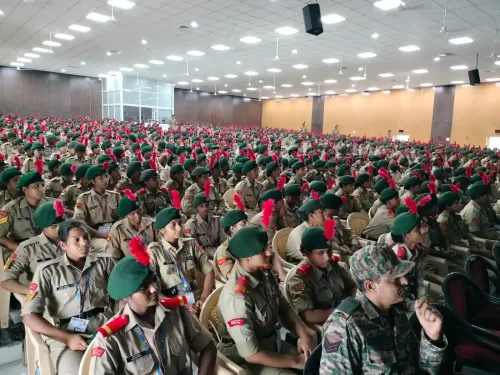
NCC has grown from 20,000 cadets in 1948 to over 20 lakh cadets today, now active in 750+ districts .
The organisation added 6 lakh cadets between 2014 and 2025 .
Radhakrishnan also proposed increasing intake capacity of existing Sainik Schools and welcomed the new NCC Alumni Association .
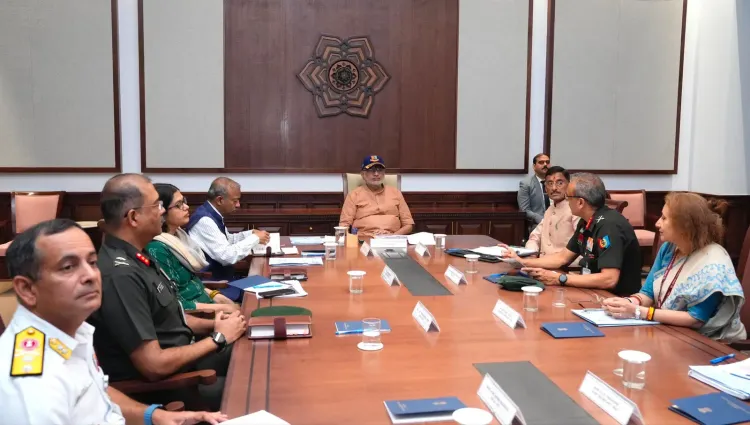
Vice President C. P. Radhakrishnan on Monday, 13 July declared that strengthening the National Cadet Corps (NCC) is a shared national responsibility, and called on every state to establish between three and five Sainik Schools to meet rising demand from students and parents. His remarks came during a dedicated briefing at New Delhi, where he was apprised of the NCC's growth trajectory and the expansion roadmap for Sainik Schools across India.
Key Developments from the Briefing
The session was conducted by Minister of State for Defence Sanjay Seth, alongside senior officers of the Ministry of Defence. Presentations covered the NCC's evolution into a nearly 20-lakh-strong youth organisation, its training programmes, and its nation-building initiatives. The briefing also addressed the functioning of Sainik Schools under both existing and Public-Private Partnership (PPP) models, as well as a roadmap for expanding the network nationwide.
What the Vice President Said
Radhakrishnan assured all possible support in facilitating Centre-state coordination on critical issues such as land allocation and training infrastructure for the NCC. He specifically lauded the Ek Bharat Shreshtha Bharat Camps as an excellent initiative for national integration, and commended the NCC's community outreach programmes — including the Nasha Mukt Bharat Abhiyan and the Swachh Bharat Abhiyan. He also welcomed the establishment of the NCC Alumni Association as a positive institutional development.
Sainik Schools: Expansion on the Agenda
On the Sainik Schools front, the Vice President observed that each state could realistically aim for three to five such institutions, given the growing demand. He further proposed exploring an increase in the intake capacity of existing Sainik Schools to bridge the gap between supply and aspiration. Both PPP and government-run models were discussed as viable pathways for accelerating this expansion.
NCC's Growth: From 20,000 to 20 Lakh
Established in 1948 with an initial strength of just 20,000 cadets, the NCC has grown into the world's largest uniformed youth organisation, now counting over 20 lakh cadets. Between 2014 and 2025, the organisation added 6 lakh cadets and is currently active in more than 750 districts across the country. This expansion reflects a sustained policy push to deepen the NCC's footprint in semi-urban and rural India.
With the Vice President's backing and a clear state-level target now articulated, the focus shifts to whether state governments will move swiftly on land and infrastructure commitments — the two factors officials identified as the primary bottlenecks to further NCC growth.
Point of View
And the NCC's own expansion has been bottlenecked by exactly this issue. The addition of 6 lakh cadets over eleven years sounds impressive until you note that India adds roughly 20 million young people to the eligible age cohort every year — meaning the NCC's penetration rate remains thin. The PPP model for Sainik Schools could accelerate numbers, but private partners will chase urban catchments, potentially leaving rural districts — where the NCC's nation-building impact is arguably greatest — underserved.
NationPress
12 Oct 2026
Frequently Asked Questions
What did Vice President Radhakrishnan say about the NCC?
Vice President C. P. Radhakrishnan stated that strengthening the NCC is a shared national responsibility and called for greater infrastructure development and enhanced coordination between the Centre and state governments on land and training facilities. He made these remarks during a briefing by the Ministry of Defence on 13 July.
How many Sainik Schools did the Vice President recommend per state?
Radhakrishnan suggested that each state aim to have between three and five Sainik Schools, citing growing demand from students and parents. He also proposed exploring an increase in the intake capacity of existing Sainik Schools.
How large is the NCC today?
The NCC currently has over 20 lakh cadets and is active in more than 750 districts across India, making it the world's largest uniformed youth organisation. It was founded in 1948 with just 20,000 cadets.
How much has the NCC grown since 2014?
The NCC added 6 lakh cadets between 2014 and 2025, reflecting a sustained expansion of its footprint into semi-urban and rural districts. The organisation now operates across more than 750 districts nationwide.
What is the PPP model for Sainik Schools?
The Public-Private Partnership model allows private entities to partner with the government in establishing and running Sainik Schools, offering an alternative to fully government-funded institutions. It was discussed at the briefing as a key pathway for accelerating the expansion of Sainik Schools across India.