Puri Hails Indian Students' Gold at IPhO 2026
Synopsis
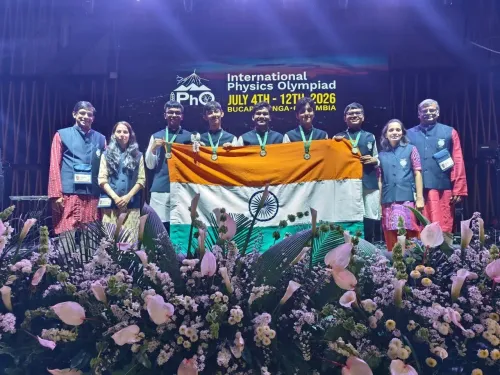
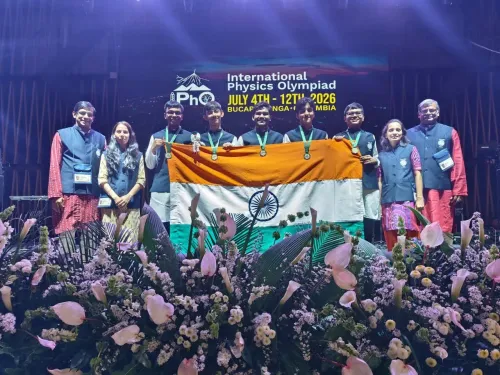
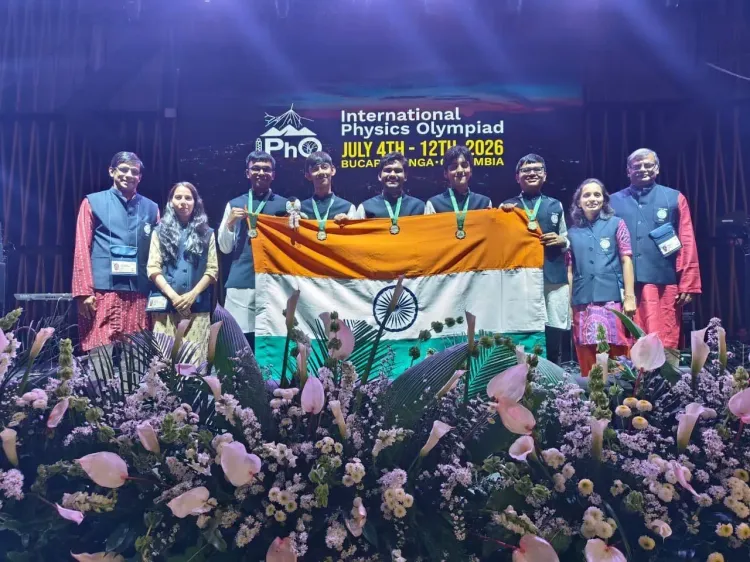
Union Petroleum Minister Hardeep Singh Puri on 13 July 2026 congratulated Kanishk Jain, Riddhesh Anant Bendale, Rishit Garg, Shreshth Suraiya, and Swarit Joshi for winning gold at the 56th International Physics Olympiad, framing the feat as proof of India's growing scientific prowess under PM Modi.
Key Takeaways
Union Petroleum Minister Hardeep Singh Puri congratulated five Indian students on winning gold medals at the 56th International Physics Olympiad 2026 on 13 July 2026 .
The five gold medallists named are Kanishk Jain , Riddhesh Anant Bendale , Rishit Garg , Shreshth Suraiya , and Swarit Joshi .
Puri described the achievement as proof of India's scientific capacity and its potential to 'show the world a new direction.' The post explicitly credits PM Narendra Modi 's leadership for fostering an innovation-led India, consistent with the government's broader 'Viksit Bharat 2047' messaging.
India has participated in the International Physics Olympiad since 1989 , with the government expanding support through programmes such as Atal Tinkering Labs and olympiad training camps under NEP 2020 .
Union Petroleum Minister Hardeep Singh Puri on Monday, 13 July 2026 congratulated five Indian students who won gold medals at the 56th International Physics Olympiad (IPhO) 2026, calling their achievement proof of India's rising scientific capacity and a source of national pride.
Posting in Hindi, Puri wrote: 'जब युवा सपने देखते हैं, उसे पूरा करने के लिए कड़ी मेहनत करते हैं तो राष्ट्र नई ऊँचाइयाँ छूता है' — 'When the young dare to dream and work hard to fulfil those dreams, the nation reaches new heights.' He extended warm congratulations to Kanishk Jain, Riddhesh Anant Bendale, Rishit Garg, Shreshth Suraiya, and Swarit Joshi for their gold medals.
Context
The International Physics Olympiad is an annual global competition for secondary-school students, regarded as one of the most prestigious science contests in the world. India has participated in the event since 1989 and has recorded a steadily improving medal tally over successive editions. A clean sweep of five gold medals — one for each team member — would mark a landmark performance for the country at this level.
Puri described the achievement as evidence of 'भारत की वैज्ञानिक क्षमता' — India's scientific capacity — that 'holds the power to show the world a new direction in the times to come.' He also linked the success to what he called an innovation-led India developing under PM Narendra Modi's leadership, calling it 'a new flight that will fill every citizen with pride.'
Policy Backdrop
The congratulatory message sits within a broader government push on science and technology education. The National Education Policy 2020 mandated greater emphasis on scientific temper, hands-on learning, and early research exposure, with Olympiad training programmes receiving expanded central support alongside initiatives such as Atal Tinkering Labs and national science talent schemes.
Official messaging from senior ministers has increasingly framed individual student achievements in international competitions as validation of the government's education and innovation agenda. The pattern aligns with the stated objective of positioning India among the world's top scientific nations by 2047, the centenary of independence.
Stakeholders and Impact
The five gold medallists — Kanishk Jain, Riddhesh Anant Bendale, Rishit Garg, Shreshth Suraiya, and Swarit Joshi — represent the apex of India's school-level physics talent pipeline. Their performance is expected to inspire participation in competitive science programmes across the country and may bolster the case for increased budgetary allocation to olympiad coaching and STEM infrastructure in the next Union Budget.
The broader scientific community and educators who run olympiad training camps stand to benefit from the heightened visibility that ministerial recognition brings to such programmes.
What's Next
Attention will now turn to whether the government formalises recognition for the five students — through felicitation ceremonies or scholarship announcements — and to any policy announcements on science education in the upcoming parliamentary session or budget cycle. India's performance at the 2027 International Physics Olympiad will be the next benchmark for assessing whether the current momentum in school-level scientific achievement is sustained.
Point of View
Reinforcing the 'Viksit Bharat 2047' narrative at every opportunity. Puri's post is notable for explicitly linking a school-level competition to PM Modi's leadership, a framing that doubles as both genuine congratulation and political messaging. The move reflects how science diplomacy and educational milestones are being woven into the BJP's broader innovation-India brand. Whether this translates into concrete policy follow-through — higher olympiad training budgets, better institutional support — will be the real test of the government's stated commitment to scientific temper.
NationPress
13 Jul 2026
Frequently Asked Questions
Who won gold at the International Physics Olympiad 2026 from India?
Five Indian students — Kanishk Jain, Riddhesh Anant Bendale, Rishit Garg, Shreshth Suraiya, and Swarit Joshi — won gold medals at the 56th International Physics Olympiad 2026, as acknowledged by Union Minister Hardeep Singh Puri.
What is the International Physics Olympiad?
The International Physics Olympiad (IPhO) is an annual global science competition for secondary-school students. India has participated since 1989 and has steadily improved its medal tally over the years.
What did Hardeep Singh Puri say about IPhO 2026?
Hardeep Singh Puri posted in Hindi congratulating the five gold medallists, calling their success proof of India's scientific capacity and linking it to the innovation-led development underway under PM Narendra Modi's leadership.
How does India prepare students for the Physics Olympiad?
India runs structured olympiad training programmes with central government support, complemented by initiatives like Atal Tinkering Labs and national science talent schemes mandated under the National Education Policy 2020.
Why is India's performance at IPhO 2026 significant?
A five-gold-medal haul at the 56th IPhO would represent a landmark result for India at the school-level physics competition and is seen as evidence of the country's growing scientific talent pipeline ahead of its 2047 development goals.