Sacks Hails Sriram Krishnan's Exit From White House AI Role

Synopsis
White House AI and Crypto Czar David Sacks bid farewell to adviser Sriram Krishnan after 18 months, listing joint achievements including the AI Action Plan, the National AI Policy Framework, AI Acceleration Partnerships, and diplomatic engagement at summits in France and India. Krishnan will continue as an outside adviser.
Key Takeaways
Sriram Krishnan is departing the White House after approximately 18 months as an internal AI policy adviser, transitioning to an outside advisory role.
David Sacks credited Krishnan with co-authoring the administration's AI Action Plan , the comprehensive U.S. strategy for global AI leadership.
The National AI Policy Framework — an executive order and policy document — is now positioned as the basis for Congressional discussions on federal AI regulation to replace fragmented state rules.
Krishnan represented U.S. interests at AI Summits in France and India and during state visits to the UK and the Middle East .
The 'Preventing Woke AI in the Federal Government' executive order, which Krishnan helped deliver, mandates that federally procured AI systems prioritise neutrality over ideological bias.
No replacement for Krishnan's internal role has been announced; Congressional engagement on the AI framework is expected to intensify.
White House AI and Crypto Czar David Sacks publicly thanked departing administration AI adviser Sriram Krishnan on Saturday, June 7, 2026, calling his roughly 18-month tenure a 'huge loss' for the administration while confirming Krishnan will continue as an outside adviser. Sacks used the farewell post to catalogue what he described as landmark AI policy achievements delivered under the Trump administration.
Context
Sriram Krishnan, a prominent Silicon Valley technologist and policy expert, served inside the White House for approximately 18 months, working across AI strategy, international diplomacy, and executive policy development. Sacks described him as possessing 'a rare combination of deep technical fluency in AI, sharp policy instincts, exceptional strategic thinking, and true diplomatic talent.' The departure marks one of the more prominent personnel transitions in the administration's technology policy apparatus.
Krishnan's exit comes as the Trump administration has been accelerating its push to establish the United States as the dominant global force in artificial intelligence, a priority that has spanned executive orders, international summits, and bilateral state visits.
Policy Backdrop
Sacks credited Krishnan with co-authoring the administration's AI Action Plan, described as the comprehensive national strategy for winning the global AI race. Krishnan also played a central role in developing the National AI Policy Framework — an executive order and accompanying policy document — which Sacks said is now 'the foundation for discussions with Congress on a national approach to AI regulation instead of a chaotic patchwork of state rules.'
A separate executive order, described by Sacks as 'Preventing Woke AI in the Federal Government,' was cited as ensuring that federally procured AI systems 'prioritize neutrality and truth-seeking over ideological bias.' Krishnan also helped drive what Sacks called the AI Acceleration Partnerships, aimed at positioning the American AI technology stack to compete globally.
The administration's approach follows a pattern established in earlier U.S. technology competition strategies — centralising federal standards to prevent fragmented state-level regulation, while using trade and diplomatic channels to align allied nations around American technology frameworks. A comparable playbook was deployed during earlier U.S. efforts on semiconductors and 5G infrastructure.
International Dimension
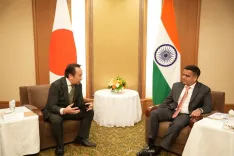
Sacks highlighted Krishnan's direct engagement at the AI Summits in France and India, as well as state visits to the United Kingdom, the Middle East, and other regions. These engagements were framed as advancing American interests in shaping global AI governance norms and export frameworks. For India in particular, Krishnan's participation at the AI Summit represents a significant bilateral touchpoint, given the depth of India-U.S. technology cooperation in recent years.
Sacks also acknowledged the broader team behind these achievements, naming White House Chief of Staff Susie Wiles, NEC Director Kevin Hassett, OSTP Director Michael Kratsios, Secretary Rubio, Secretary Bessent, and Secretary Lutnick as key collaborators.
What's Next
Krishnan is expected to continue contributing as an outside adviser, suggesting a degree of policy continuity even as the formal personnel transition takes effect. The administration has not announced a replacement for his internal role. Congressional engagement on the National AI Policy Framework is expected to intensify, with the framework now positioned as the basis for federal preemption of state-level AI regulation — a legislative effort that will test the administration's ability to build bipartisan support on Capitol Hill.
The departure also raises questions about the pace of follow-on AI Acceleration Partnership agreements and whether the diplomatic momentum built through bilateral and multilateral AI forums will be sustained at the same intensity under new personnel.
Point of View
He is effectively framing the administration's AI record ahead of expected Congressional scrutiny of the National AI Policy Framework. The emphasis on replacing a 'chaotic patchwork of state rules' with a single federal standard signals that the administration's next major legislative push on AI is imminent. Krishnan's retention as an outside adviser is a deliberate continuity signal, suggesting the White House is wary of losing institutional knowledge at a critical juncture. For India, the explicit mention of the AI Summit in New Delhi underscores how central the India-U.S. technology partnership has become to Washington's global AI strategy.
NationPress
21 Oct 2026
Frequently Asked Questions
Who is Sriram Krishnan and why is he leaving the White House?
Sriram Krishnan is a Silicon Valley technologist who served as an AI policy adviser inside the White House for approximately 18 months . He is departing his internal role but will continue advising the administration from outside, according to David Sacks 's post.
What is the US AI Action Plan mentioned by David Sacks?
The AI Action Plan is described by Sacks as the Trump administration 's comprehensive national strategy for winning the global AI race. Sriram Krishnan is credited as a co-author of the plan.
What is the National AI Policy Framework and how does it affect states?
The National AI Policy Framework is an executive order and accompanying policy document that Sacks says is now the foundation for Congressional discussions on a uniform federal approach to AI regulation, intended to replace what he called a 'chaotic patchwork of state rules.'
What role did Sriram Krishnan play at the AI Summit in India?
Sriram Krishnan represented U.S. interests at the AI Summit in India , as well as at a parallel summit in France , and participated in state visits to the UK and the Middle East to advance American AI policy goals internationally.
What is the 'Preventing Woke AI' executive order?
The 'Preventing Woke AI in the Federal Government' executive order, which Krishnan helped deliver, requires that AI systems procured by the federal government prioritise neutrality and truth-seeking rather than what the administration describes as ideological bias.