Sacks Warns US Risks Losing AI Race to China
Synopsis
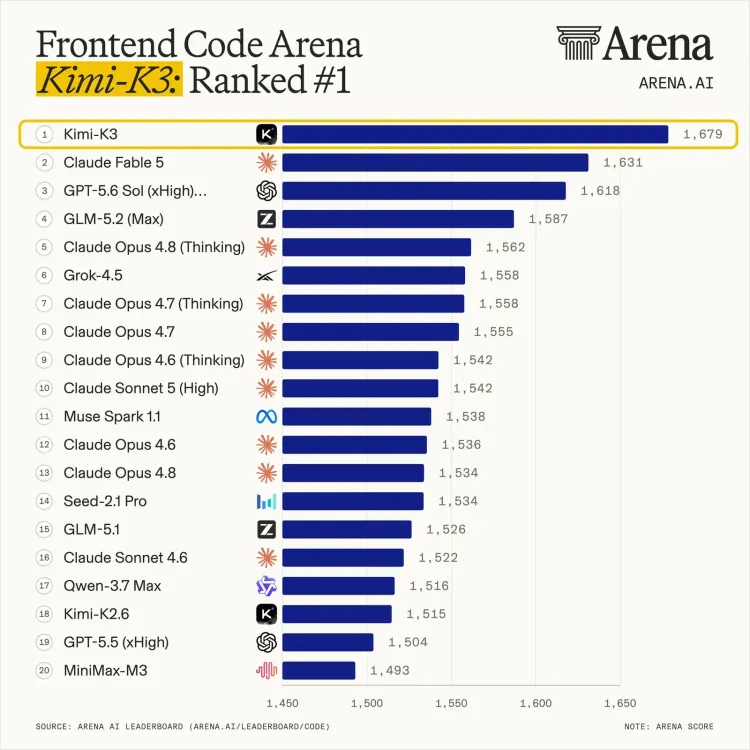
White House AI and Crypto Czar David Sacks warned on July 17, 2026 that US data-center bans, state regulations, and proposed federal pre-approval rules are handing China an opening in the AI race, citing Chinese model Kimi K3 reaching number one on the Frontend Code Arena benchmark for the first time.
Key Takeaways
Kimi K3 , a Chinese AI model, has taken the number-one spot on the Frontend Code Arena benchmark — the first time a Chinese model has led that leaderboard.
White House AI and Crypto Czar David Sacks called the development 'concerning' and linked it directly to US domestic regulatory overreach.
Sacks criticised moves to ban new data centers , impose state-level AI regulations , and create federal agencies to pre-approve frontier models .
He argued that 'permissionless innovation' drove US dominance of the internet era and must be applied to AI to preserve America's technological lead.
Sacks acknowledged risks exist but called for 'targeted' rather than blanket pre-market regulation.
Congressional votes on a federal AI licensing framework and state data-center moratoriums are expected in late 2026 .
White House AI and Crypto Czar David Sacks issued a stark warning on Friday, July 17, 2026, cautioning that regulatory overreach inside the United States is threatening the country's lead in artificial intelligence just as a Chinese model has climbed to the top of a major public benchmark for the first time.
Context
Sacks flagged that Kimi K3, a model developed by Chinese AI lab Moonshot AI, has claimed the number-one position on the Frontend Code Arena — a public leaderboard that evaluates large language models on frontend software-engineering tasks — and is 'scoring at or near the frontier on other benchmarks.' The post marks the first time a Chinese model has topped that particular leaderboard, a milestone Sacks called 'concerning.'
The Frontend Code Arena is one of several open benchmarks the global AI research community uses to compare model capability across coding, reasoning, and language tasks. A Chinese model reaching its summit signals that the gap between US and Chinese frontier AI systems is narrowing in at least one measurable dimension.
Policy Backdrop
Sacks directed his criticism at a specific cluster of domestic policy moves: politicians and bureaucrats 'banning new data centers, piling on state regulations, and pushing for new federal agencies to pre-approve frontier models.' Between 2024 and 2025, states including California, New York, and Texas advanced bills imposing additional permitting and environmental reviews on data-center construction and AI development.
At the federal level, Executive Order 14110, issued in October 2023, established reporting and safety requirements for advanced AI models, while the CHIPS and Science Act of 2022 directed funding toward domestic semiconductor capacity. Sacks's post suggests he views the regulatory trajectory since then as having drifted from industrial support toward pre-market gatekeeping — a distinction he frames as existential for US competitiveness.
Congressional votes on a proposed federal AI licensing framework and state-level data-center moratoriums are expected in late 2026, making the timing of Sacks's intervention pointed.
Stakeholders and Impact
US AI labs — including those building frontier models — stand to be most directly affected by any pre-approval regime, which could slow release cycles and raise compliance costs. Data-center operators face the immediate burden of state-level permitting delays that constrain the compute infrastructure AI development requires.
For Chinese AI developers, a lighter domestic regulatory environment has allowed faster iteration. Sacks invoked the history of the commercial internet, arguing that early US restraint on infrastructure and content rules allowed American platforms to scale globally — a model he believes should be replicated for AI. 'Permissionless innovation is how America won the internet and became the technological envy of the world,' he wrote.
What's Next
Sacks stopped short of endorsing zero regulation, explicitly allowing for 'addressing risks in a targeted way.' The phrase signals that the administration's preferred framework is risk-proportionate and sector-specific rather than a blanket pre-approval gate. Whether that position translates into concrete White House guidance or legislative language will be closely watched by both the AI industry and Capitol Hill.
The broader US-China technology competition — already intense across semiconductors and 5G — has now visibly extended to foundation models. With benchmark leadership shifting and regulatory debates unresolved, Sacks's warning frames the next legislative cycle as a decisive moment: 'We can do it again with AI — or we'll watch our lead evaporate.'
Point of View
Hard-to-dismiss evidence. By invoking the internet-era 'permissionless innovation' doctrine, he is attempting to set the ideological frame for the coming Congressional debate, casting regulation as national-security risk rather than prudent oversight. The caveat about 'targeted' risk-addressing leaves room for a White House-backed alternative framework, suggesting this may be the opening move in a broader policy negotiation. For India and other nations watching the US-China AI contest, the outcome of that negotiation will shape the global AI governance landscape for the decade ahead.
NationPress
17 Jul 2026
Frequently Asked Questions
What is the Frontend Code Arena and why does it matter?
The Frontend Code Arena is a public benchmark that ranks large language models on their ability to write and reason about frontend software code. It matters because open leaderboards are one of the few objective, real-time measures of where different countries' AI models stand relative to each other.
What is Kimi K3 and who made it?
Kimi K3 is a large language model developed by Chinese AI startup Moonshot AI. According to David Sacks's post, it has reached the number-one position on the Frontend Code Arena, marking the first time a Chinese model has topped that benchmark.
Why is David Sacks warning about US AI regulation?
Sacks, the White House AI and Crypto Czar, argues that bans on new data centers, state-level AI rules, and proposals for federal pre-approval of frontier models are slowing American AI development at precisely the moment China is catching up on key benchmarks.
What is 'permissionless innovation' in the context of AI?
Permissionless innovation refers to a policy posture in which developers can build and deploy technology without seeking prior government approval. Sacks credits this approach with enabling the US to dominate the commercial internet era and is calling for it to be applied to AI development.
What US laws already regulate AI development?
At the federal level, Executive Order 14110 from October 2023 set reporting and safety requirements for advanced AI models, while the CHIPS and Science Act of 2022 funded domestic semiconductor and AI research infrastructure. Several US states have also advanced bills adding permitting and environmental review requirements for data centers and AI systems.