US senators move to block Trump's Saudi nuclear deal over arms race fears
Synopsis
Two Democratic senators have put the Trump administration on notice: the US-Saudi civilian nuclear deal, as currently structured, could be the starting gun for a Middle East arms race. With a Senate vote now triggered before 29 November, the absence of uranium enrichment bans and IAEA Additional Protocol requirements is set to become a defining test of US non-proliferation credibility — and a rare bipartisan flashpoint on nuclear diplomacy.
Key Takeaways
Senators Jeff Merkley and Edward Markey introduced a joint resolution of disapproval on 16 October 2026 to block the US-Saudi civilian nuclear cooperation agreement .
A Senate vote must occur before 29 November to prevent the deal from entering into force under the 90-day congressional review period.
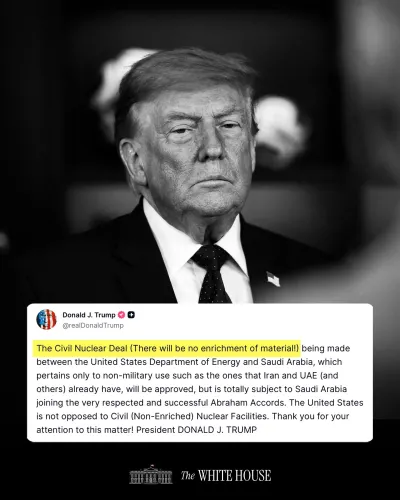
The senators argue the deal lacks the 'gold standard' non-enrichment commitment and IAEA Additional Protocol safeguards.
Markey warned the deal is 'the starting gun for a Middle East nuclear arms race .' The UAE 's stricter nuclear cooperation deal with Washington is cited as the benchmark the Saudi agreement fails to meet.
Two classified side letters accompanying the agreement remain inaccessible to lawmakers, compounding transparency concerns.
Two Democratic US senators have introduced a joint resolution of disapproval aimed at blocking President Donald Trump's civilian nuclear cooperation agreement with Saudi Arabia, warning that the deal lacks critical safeguards to prevent a nuclear arms race in the Middle East. The resolution, filed on 16 October 2026, sets the stage for a Senate vote before the agreement can take effect after 29 November.
Who Filed the Resolution and What It Seeks
Senator Jeff Merkley of Oregon and Senator Edward Markey of Massachusetts — both senior Democratic voices on foreign policy — introduced the measure under the congressional review process established by Section 123 of the US Atomic Energy Act. Under federal law, Congress holds a 90-day review period to scrutinise civilian nuclear cooperation agreements. If no blocking resolution is adopted within that window, the agreement enters into force automatically.
Merkley, a senior member of the Senate Foreign Relations Committee, was direct in his opposition. 'Giving Saudi Arabia access to US civilian nuclear energy technology without ironclad protections to make sure it doesn't provide a foundation for a nuclear bomb is unacceptable,' he said. 'We can't sleepwalk into a decision this consequential,' he added, underscoring what he described as Congress's constitutional responsibility to scrutinise such agreements.
What the Senators Say Is Missing
The senators contend the deal fails to incorporate two safeguards they consider non-negotiable. The first is the so-called gold standard for civilian nuclear cooperation, under which a recipient country commits not to enrich uranium or reprocess spent nuclear fuel — processes that, while having legitimate civilian applications, can also contribute to the production of weapons-grade nuclear material.
The second is Saudi Arabia's adherence to the International Atomic Energy Agency (IAEA)'s Additional Protocol, which grants inspectors broader access and information to detect undeclared nuclear activities. According to the senators, the absence of these conditions risks incentivising other regional powers to demand equivalent concessions.
The Regional Proliferation Risk
Markey went further in his warnings, framing the deal in stark terms. 'The US-Saudi nuclear deal is about megatons, not megawatts,' he said. He accused the administration of pursuing an arrangement that falls short of established non-proliferation standards, particularly by permitting uranium enrichment without requiring the strongest international inspections. 'This deal is the starting gun for a Middle East nuclear arms race. Congress must reject it,' Markey said.
The senators specifically cited the United Arab Emirates (UAE), whose nuclear cooperation agreement with Washington incorporated stronger restrictions on sensitive nuclear activities, as a benchmark. They warned that offering Saudi Arabia more favourable terms could encourage the UAE to reconsider its existing commitments. Separately, they expressed concern that Iran could resist future restrictions on its own nuclear programme if Riyadh were permitted to pursue capabilities denied to Tehran.
Classified Side Letters and Transparency Concerns
The resolution follows earlier congressional demands for greater transparency over the proposed agreement. Lawmakers have sought access to two accompanying side letters that the Trump administration has classified, raising further concerns about the scope and terms of what is being offered to Riyadh. The introduction of the resolution does not suspend the agreement or constitute a formal congressional rejection — it merely initiates the procedural path toward a Senate vote.
What Happens Next
A Senate vote on the resolution must occur before 29 November if Congress is to block the agreement from entering into force. The outcome will test whether opposition to the deal extends beyond the Democratic caucus and whether the administration can defend its non-proliferation credentials to a sceptical chamber. This marks one of the most significant congressional challenges yet to the Trump administration's nuclear diplomacy in the Middle East.
Point of View
The entire architecture of gold-standard agreements risks unravelling. The classified side letters are the real red flag: transparency is the minimum expectation for agreements with this magnitude of consequence. If the administration cannot defend the deal's terms in open session, that is itself an answer about what the terms contain.
NationPress
16 Oct 2026
Frequently Asked Questions
What is the US-Saudi civilian nuclear cooperation agreement?
It is a proposed agreement under Section 123 of the US Atomic Energy Act that would establish a legal framework for transferring specified nuclear materials, equipment, and technology from the United States to Saudi Arabia. Critics argue it lacks key non-proliferation safeguards, including a ban on uranium enrichment and adherence to the IAEA Additional Protocol.
Why are the senators seeking to block the deal?
Senators Merkley and Markey argue the deal omits the 'gold standard' non-enrichment commitment and does not require Saudi Arabia to adopt the IAEA Additional Protocol, which enables broader inspections. They warn these omissions could trigger a nuclear arms race across the Middle East.
What is the congressional timeline for blocking the agreement?
Under federal law, Congress has a 90-day review period. A Senate vote on the resolution of disapproval must occur before 29 November 2026 to prevent the agreement from automatically entering into force.
How does the UAE nuclear deal compare to the proposed Saudi agreement?
The UAE's civilian nuclear cooperation agreement with Washington incorporated stronger restrictions on sensitive nuclear activities, including a commitment not to enrich uranium. The senators warn that offering Saudi Arabia more favourable terms could prompt the UAE to revisit its existing commitments.
What are the classified side letters and why do they matter?
Two side letters accompanying the US-Saudi nuclear agreement have been classified by the Trump administration, preventing full congressional review. Lawmakers argue that access to these documents is essential for proper oversight of an agreement with significant national security and non-proliferation implications.