US reconsidering West Asia strategy after Iran setbacks, Saudi nuclear deal
Synopsis
Facing what analysts call a losing confrontation with Iran and a restless Gulf, the US has signed a landmark nuclear cooperation deal with Saudi Arabia — one that leaves enrichment options open and skirts full IAEA oversight. The move signals Washington's willingness to take significant risks to prevent Arab allies from drifting toward alternative power centres.
Key Takeaways
The US is reconsidering its West Asia strategy amid serious security credibility setbacks and Iran's growing regional influence, according to an India Narrative report.
US Secretary of Energy Chris Wright and Saudi Minister of Energy Prince Abdulaziz bin Salman signed a '123 Agreement' on 22 July , enabling American companies to build nuclear infrastructure in Saudi Arabia .
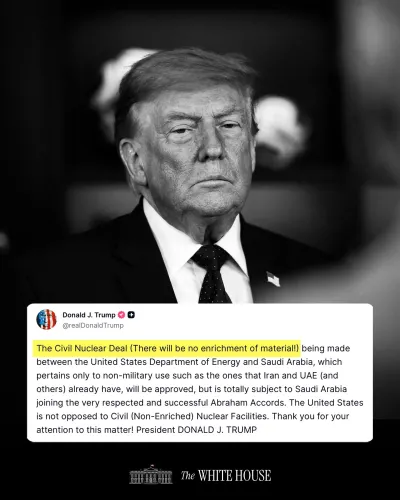
The deal leaves open the possibility of domestic uranium enrichment in Saudi Arabia, subject to a future joint review — without requiring a permanent enrichment ban.
The agreement does not mandate full IAEA monitoring, instead allowing Saudi Arabia to implement the Additional Protocol for enhanced inspection.
Analyst Srijan Sharma warns that Arab allies' 'strategic autonomy spin' — particularly by Saudi Arabia and the UAE — poses a deeper long-term challenge to US influence in the region.
The United States is actively reconsidering its strategic options to recalibrate influence and power balance in West Asia, according to a report by India Narrative, as Washington grapples with serious security credibility challenges and the rising regional clout of Iran. The reassessment comes amid what analysts describe as the US being on the losing end of its prolonged confrontation with Tehran.
The Saudi Nuclear Deal at the Centre
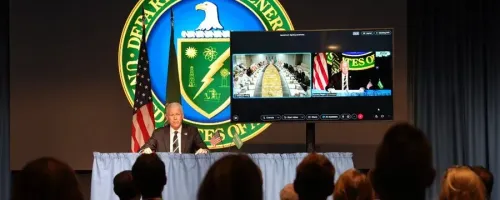
On 22 July, US Secretary of Energy Chris Wright and Saudi Minister of Energy Prince Abdulaziz bin Salman signed a peaceful nuclear cooperation agreement — formally known as a '123 Agreement' — alongside an accompanying bilateral safeguards agreement. The US government's approval of the pact allows American companies to develop nuclear infrastructure in Saudi Arabia, laying what the US Department of Energy described as the legal foundation for a 'decades-long, multi-billion-dollar partnership.'
The agreement carries significant economic weight but has also triggered regional concern. Notably, the deal leaves open the possibility of domestic uranium enrichment within Saudi Arabia, subject to a future joint US-Saudi review — rather than requiring Riyadh to permanently renounce enrichment. Critics have flagged that the pact does not mandate the stringent monitoring framework of the International Atomic Energy Agency (IAEA), instead permitting Saudi Arabia to implement the IAEA's Additional Protocol for enhanced facility inspection.
What Analysts Are Saying
Srijan Sharma, a national security analyst specialising in intelligence and security analysis, wrote in the India Narrative report: 'After being at the losing end of the war with Iran, the US is reconsidering its approaches to recalibrate its influence and power balance in the Middle East after facing serious security credibility issues and Iran's rise. However, there is a much larger question that is bothering the US: the region's strategic autonomy spin, which the US currently fears, and the pivoting mood of Arab allies, especially Saudi Arabia and the UAE.'
Sharma further noted: 'Distrust in Arab allies is core damage to US influence that it cannot afford, especially in the current global order where alternative power and pivoting is a favoured strategy to cut dependencies and readjust to fulfil one's national interests. The US has taken risks that even have dangerous precedents to secure allies' trust, and now the US is again doing it by signing a nuclear deal with Saudi Arabia.'
Washington's Brinkmanship Play
The nuclear agreement is being read as part of a broader US brinkmanship strategy in West Asia, shaped by the rapidly evolving regional politics — particularly the sustained friction between Washington and Tehran. The US appears to have calculated that cementing ties with Saudi Arabia and the UAE is essential to prevent a strategic drift of Arab allies toward alternative power centres.
Secretary Wright, in a statement following the signing, said these agreements 'reflect the shared commitment of the US and Saudi Arabia to strengthen commercial ties, delivering prosperity at home and security to allies abroad.' He added: 'Rest assured, these agreements uphold the highest standards of nuclear safety and nonproliferation, while relying on the world's best nuclear technology and scientists, designed right here in the United States. Thanks to President Donald Trump, the American nuclear renaissance is underway and will deliver long-term benefits to the American and Saudi people.'
The Larger Stakes: Arab Strategic Autonomy
Beyond the nuclear deal itself, the report points to a more structural challenge for Washington — the growing appetite among Arab states for strategic autonomy. Saudi Arabia and the UAE have in recent years demonstrated a willingness to engage with multiple global powers, a trend that directly undermines the US's traditional hub-and-spoke alliance architecture in the region. The question of which way these pivotal Gulf states lean — and whether the nuclear agreement is sufficient to anchor their alignment — remains open.
With Iran's regional influence continuing to expand and US credibility under strain, the coming months will test whether Washington's recalibration strategy can translate into durable influence or merely deepen the region's strategic complexity.
Point of View
A bilateral nuclear deal is at best a short-term anchor. The US is essentially paying a high non-proliferation price to solve a confidence deficit — and there is no guarantee the price is sufficient.
NationPress
26 Oct 2026
Frequently Asked Questions
Why is the US reconsidering its West Asia strategy?
The US is reconsidering its approach to West Asia because it faces serious security credibility challenges and the expanding regional influence of Iran, which analysts describe as leaving Washington on the losing end of its confrontation with Tehran. Simultaneously, Arab allies such as Saudi Arabia and the UAE are showing growing appetite for strategic autonomy, threatening the US's traditional alliance architecture in the region.
What is the US-Saudi Arabia '123 Agreement' signed on 22 July?
The '123 Agreement' is a peaceful nuclear cooperation pact signed on 22 July by US Secretary of Energy Chris Wright and Saudi Minister of Energy Prince Abdulaziz bin Salman. It allows American companies to develop nuclear infrastructure in Saudi Arabia and forms the legal basis for a decades-long, multi-billion-dollar partnership covering nuclear nonproliferation and commercial energy objectives.
Does the deal allow Saudi Arabia to enrich uranium?
The agreement does not require Saudi Arabia to permanently renounce uranium enrichment; instead, the possibility of domestic enrichment is subject to a future joint US-Saudi review. Critics note this falls short of the so-called 'gold standard' applied to some other nuclear cooperation agreements.
What are the concerns about IAEA oversight in the deal?
According to the India Narrative report, the agreement does not mandate the stringent monitoring framework of the International Atomic Energy Agency (IAEA). Saudi Arabia is permitted to implement the IAEA's Additional Protocol for enhanced facility inspection, which analysts argue is a weaker safeguard than full IAEA oversight.
Who is Srijan Sharma and what did he say about the deal?
Srijan Sharma is a national security analyst specialising in intelligence and security analysis who authored the India Narrative report. He argued that distrust among Arab allies represents 'core damage' to US influence that Washington cannot afford, and that the nuclear deal with Saudi Arabia reflects the US taking significant risks — with dangerous precedents — to shore up allied confidence.