Shehbaz Sharif's UNGA speech: rhetoric vs reality on India, water war
Synopsis
At the UN, Pakistan's Prime Minister Shehbaz Sharif praised his own military chief and warned India of 'war' over water — but 16 months of inaction since India suspended the Indus Waters Treaty, combined with zero evidence of actual diversion, has left analysts questioning whether either claim carries any weight internationally.
Key Takeaways
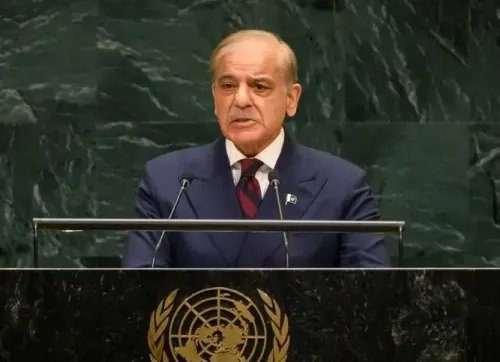
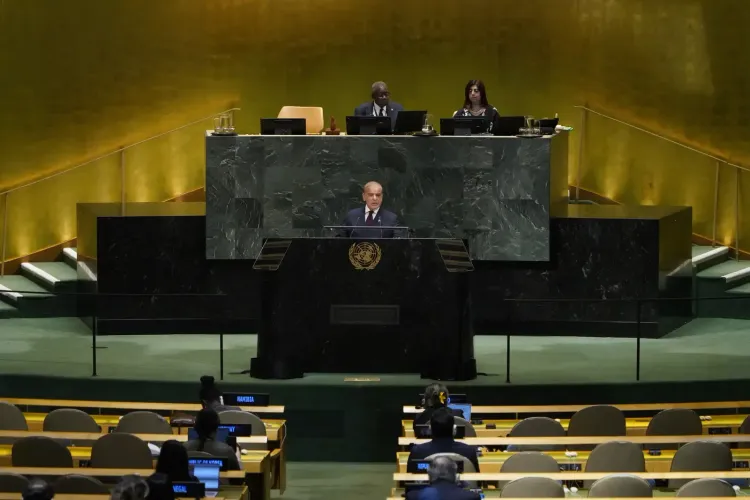
Shehbaz Sharif addressed the 81st UNGA Session in New York , praising Field Marshal Asim Munir for the May 2025 border clashes following India's response to the Pahalgam attack that killed 26 civilians .
Sharif warned that any attempt to divert Pakistan's share of Indus waters would be treated as 'an act of war' — a claim analysts say is undermined by 16 months of inaction since India suspended the Indus Waters Treaty (IWT) in April 2025 .
Critics argue the speech exposed Pakistan's civil-military imbalance , with the civilian government functioning as an executor of military policy rather than an independent authority.
The 26th and 27th Constitutional Amendments have reportedly undermined judicial independence and consolidated military authority within Pakistan's governance structure.
Imran Khan remains imprisoned under a 14-year sentence that independent monitors widely describe as politically motivated, while the federal government reportedly seeks to impose Governor's Rule in Khyber Pakhtunkhwa (KP) .
Pakistan's economic crisis — including high inflation and fiscal distress — continues to erode the credibility of its international diplomatic messaging, according to analysts.
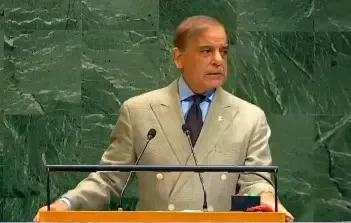
Pakistani Prime Minister Shehbaz Sharif's address to the 81st Session of the United Nations General Assembly (UNGA) in New York followed what analysts describe as a now-familiar script: sweeping declarations aimed at international audiences that sit in sharp contradiction with conditions on the ground in Pakistan. Critics argue the speech exposed, rather than concealed, the deep fault lines within Islamabad's civil-military power structure.
Military Allegiance on a Global Stage
Analysts note that Sharif used the UNGA podium — a forum ostensibly reserved for projecting national integrity and engaging global challenges — to publicly praise Pakistan's military chief. Referring to the May 2025 border clashes that followed India's military response to the Pahalgam terror attack, which claimed the lives of 26 civilians, Sharif stated: 'Our brave and valiant armed forces, under the courageous leadership of Field Marshal Asim Munir, responded with precision and professionalism.'
According to analysts, this pattern of civilian deference to military authority has been a defining feature of the Sharif administration. The alliance between the ruling Pakistan Muslim League-Nawaz (PML-N)-led coalition and the military establishment reportedly solidified after the military ensured that Imran Khan's Pakistan Tehreek-e-Insaf (PTI) was sidelined from power. Sharif had also personally called Field Marshal Asim Munir on Eid to offer greetings — a gesture critics say underscores the civilian government's subordinate position.
The Water War Warning: Contradictions Unpacked
Sharif's declaration at the UN — that 'any attempt to stop, impede or divert Pakistan's share of the waters will be treated as an act of war' — drew scrutiny from observers who point to several internal contradictions.
First, India has not threatened to weaponise water as a punitive measure in response to cross-border terrorism. Second, the Indus Waters Treaty (IWT) has been placed in abeyance, not formally terminated, since April 2025 — a distinction Islamabad has reportedly not acknowledged clearly in its international messaging. Third, analysts note that 16 months have elapsed since India suspended the treaty, and Pakistan has presented no empirical evidence of actual water diversion, despite repeatedly calling such a move a definitive red line.
According to independent observers, this contradiction weakens Islamabad's position on the world stage: if India had genuinely weaponised water and Pakistan chose not to act militarily, it either means Pakistan's claims lack substantiation or that its military leadership has concluded it cannot match India's capabilities — or both.
Diplomacy Abroad, Repression at Home
Critics argue that Sharif's calls for dialogue and peaceful resolution at the UN stand in stark contrast to the ruling alliance's domestic conduct. An editorial in the Pakistani daily The Express Tribune supported Sharif's UN position, arguing that 'the PM's insistence that dialogue must retain primacy is both prudent and consistent with Pakistan's own interests.'
However, observers point out that at home, the regime has reportedly suppressed political opposition, dismantled judicial checks through the sweeping 26th and 27th Constitutional Amendments, and incarcerated Imran Khan — Pakistan's most popular political leader, according to multiple polls — under a 14-year prison sentence that independent monitors widely describe as based on fabricated charges.
Simultaneously, the federal government is reportedly engineering a campaign to impose Governor's Rule — or a state of emergency — in Khyber Pakhtunkhwa (KP), the only province outside the ruling coalition's control. Critics argue this move is framed around a surge in regional militancy, but that framing itself raises questions: the military has for years claimed to have eradicated these very networks through high-profile operations.
The Structural Reality: A Military-Dominated Polity
Analysts describe Pakistan's current political landscape as one where elected civilian leaders have been reduced to what critics call 'obedient functionaries.' The military has, according to this analysis, leveraged three simultaneous crises — Imran Khan's surging public support, a deteriorating security environment, and the civilian government's inability to stabilise the economy — to instil existential fear within traditional political parties like the PML-N and the Pakistan Peoples Party (PPP).
The result, critics argue, is a Faustian bargain: parties that entered a coalition to secure power have found themselves with little autonomy. Pakistan's strategic policies, in this reading, reflect the institutional priorities of General Headquarters (GHQ) rather than the preferences of elected leaders or the aspirations of ordinary citizens.
What This Means Going Forward
Pakistan's economic crisis — marked by skyrocketing inflation and an economy described by observers as being in 'shambles' — continues to constrain Islamabad's diplomatic leverage. No amount of international posturing, analysts argue, can substitute for domestic political stability or economic credibility. As long as the civil-military imbalance persists and the Indus Waters dispute remains unresolved, Pakistan's UN rhetoric is likely to find few takers on the global stage.
Point of View
The gap becomes the story. The water-war warning is perhaps the starkest example — 16 months of inaction since the IWT suspension makes the threat self-defeating, signalling either a lack of evidence or a lack of capability, neither of which serves Pakistan's interests. What mainstream coverage often underweights is the structural dimension: the civilian government's public praise of its own military chief at a UN podium is not a diplomatic quirk but a symptom of a polity where elected authority has been hollowed out. Until that structural reality changes, Pakistan's international posture will continue to be shaped by GHQ's institutional calculus rather than any civilian foreign policy vision.
NationPress
3 Oct 2026
Frequently Asked Questions
What did Shehbaz Sharif say at the UNGA about India and water?
Sharif warned at the 81st UNGA Session that any attempt to stop, impede, or divert Pakistan's share of Indus waters would be treated as an act of war. Critics note this warning is contradicted by 16 months of inaction since India suspended the Indus Waters Treaty in April 2025, with Islamabad presenting no empirical evidence of actual water diversion.
Why did Sharif praise Field Marshal Asim Munir at the UN?
Sharif publicly praised Pakistan's Chief of Defence Forces, Field Marshal Asim Munir, during his UNGA address, crediting the military's response to the May 2025 border clashes with India. Analysts argue this reflects the civilian government's structural subordination to the military establishment, a pattern they say has defined the Sharif administration.
What is the current status of the Indus Waters Treaty?
India placed the Indus Waters Treaty in abeyance in April 2025 following the Pahalgam terror attack that killed 26 civilians. The treaty has not been formally terminated. Pakistan has repeatedly described any water diversion as a red line but has not presented documented evidence of diversion in the 16 months since the suspension.
What is the political situation inside Pakistan that critics say Sharif's speech ignored?
Critics point to the incarceration of former Prime Minister Imran Khan under a 14-year sentence that independent monitors widely describe as politically motivated, the passage of the 26th and 27th Constitutional Amendments that reportedly weakened judicial independence, and a reported push to impose Governor's Rule in Khyber Pakhtunkhwa. They argue these developments contradict Sharif's international calls for dialogue and democratic norms.
How has Pakistan's economic situation affected its international standing?
Pakistan's economy is under severe strain, with high inflation and fiscal distress limiting Islamabad's diplomatic credibility. Analysts argue that no international platform can substitute for domestic political stability and economic performance, making Pakistan's rhetorical posture at forums like the UN increasingly difficult to sustain before a sceptical global audience.