Singapore ASEAN Chairmanship 2026: New openings for India as equal regional partner
Synopsis
Singapore's turn as ASEAN Chair next year is more than a rotating presidency — it is, according to a CRF panel in New Delhi, a concrete opening for India to step into multilateral Indo-Pacific architecture as an equal stakeholder rather than a peripheral partner. With bilateral trade tripled since CECA and a Comprehensive Strategic Partnership now in place, the question is whether both sides can convert strategic depth into scalable regional outcomes.
Key Takeaways
A Chintan Research Foundation (CRF) panel in New Delhi on 28 August identified Singapore's upcoming ASEAN Chairmanship as a key opportunity for India to engage as an equal regional stakeholder.
Bilateral trade between India and Singapore has roughly tripled since the 2005 CECA ; Singapore remains a leading source of foreign investment into India.
The partnership was upgraded to a Comprehensive Strategic Partnership in 2024 , covering defence, technology, maritime security, digital connectivity and more.
Priority sectors for the next phase include semiconductors , AI , green infrastructure , critical minerals , advanced manufacturing and Indian Ocean security .
The National Centre of Excellence for Advanced Manufacturing in Chennai and the India-Singapore Green and Digital Shipping Corridor are among concrete initiatives already underway.
Panellists stressed the need for sustained institutional follow-through and stronger private-sector participation to convert strategic ambition into durable outcomes.
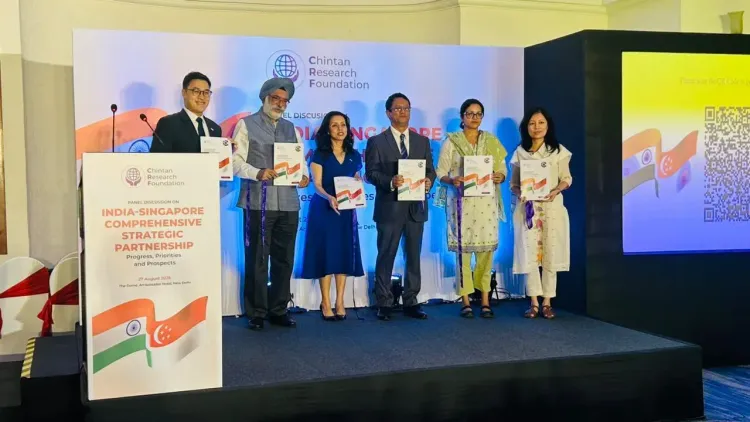
Singapore's upcoming ASEAN Chairmanship could open fresh pathways for India to participate as an equal stakeholder in trilateral, plurilateral and multilateral regional cooperation formats, according to a panel discussion hosted by the Chintan Research Foundation (CRF) in New Delhi on 28 August. The event coincided with the release of a CRF report titled India-Singapore Comprehensive Strategic Partnership: Progress, Priorities and Prospects.
What the Discussion Covered
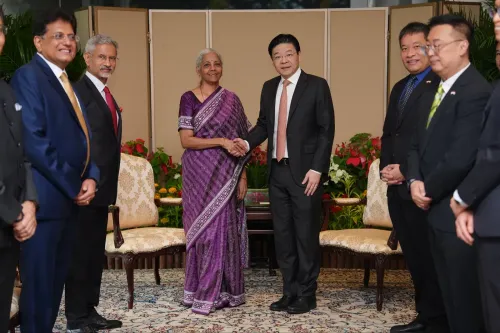
Convened a week after the fourth India-Singapore Ministerial Roundtable (ISMR) held in Singapore, the panel brought together the Deputy High Commissioner of Singapore to India alongside senior voices from policy, academia, think tanks and the strategic community in both countries. The discussion examined the evolution of bilateral ties, areas of complementarity, and prospects for deepening the Comprehensive Strategic Partnership amid shifting geopolitical, geoeconomic and technological currents across the Indo-Pacific.
Key Milestones in India-Singapore Relations
Panellists traced the partnership's trajectory through three landmark moments: the 2005 Comprehensive Economic Cooperation Agreement (CECA), the elevation to a Strategic Partnership in 2015, and the upgrade to a Comprehensive Strategic Partnership in 2024. Bilateral trade has roughly tripled since the CECA was concluded approximately two decades ago, while Singapore has remained a leading source of foreign direct investment into India.
The relationship, panellists noted, has moved well beyond its traditional foundations in trade and investment. It now spans defence, technology, digital connectivity, maritime security, infrastructure, education, skills development and regional cooperation — making it one of India's most substantive partnerships in the Indo-Pacific.
Priority Sectors for the Next Phase
Participants identified a broad cluster of sectors for the next phase of bilateral cooperation: green infrastructure, semiconductors, artificial intelligence, digital governance, smart and green ports, critical minerals, deep-sea cooperation, multimodal logistics, advanced manufacturing and undersea connectivity. Concrete initiatives already underway include new skilling centres, the forthcoming National Centre of Excellence for Advanced Manufacturing in Chennai, and the India-Singapore Green and Digital Shipping Corridor.
The discussion also flagged the potential for stronger engagement between Singapore and Indian states — particularly manufacturing and technology hubs in southern India — as a way to translate national-level strategic convergence into commercially viable partnerships and deeper economic linkages.
Singapore's ASEAN Chair and India's Regional Role
Singapore's ASEAN Chairmanship next year was identified as a particularly significant opportunity. Panellists argued it could serve as a platform to explore scalable partnerships involving ASEAN members and other regional stakeholders, with India participating as an equal partner in delivering practical outcomes. Potential areas include digital public infrastructure, supply-chain resilience, maritime domain awareness, anti-piracy, transnational crime and Indian Ocean security.
The CRF panel underlined that Singapore has emerged as an important economic and strategic gateway for India's engagement with Southeast Asia and the wider Indo-Pacific, reinforcing its significance to India's Act East Policy. The partnership, participants noted, also gives both countries space to preserve strategic autonomy while working toward an open, inclusive and rules-based regional order.
What Comes Next
The discussion concluded that the central challenge now is translating an already ambitious bilateral agenda into visible, scalable and durable outcomes. Sustained institutional follow-through, stronger private-sector participation and effective implementation of initiatives emerging from the ISMR framework were cited as essential to maintaining momentum. The next phase of the Comprehensive Strategic Partnership, panellists said, will be shaped as much by the two countries' ability to leverage their complementarities for broader Indo-Pacific stability as by the depth of bilateral cooperation itself.
Point of View
Not on multilateral ones. Singapore's ASEAN Chairmanship is a narrow but real window — one that expires in a year. The risk is familiar: India has a strong record of signing frameworks and a weaker record of implementing them at speed. The subnational angle — engaging southern Indian manufacturing hubs directly with Singapore — is the most underreported and potentially most productive thread in this discussion, because it bypasses the bureaucratic drag that has historically slowed Centre-level commitments. Whether the ISMR framework can generate that kind of ground-level momentum, rather than another round of joint statements, is the real test.
NationPress
12 Oct 2026
Frequently Asked Questions
What is the Chintan Research Foundation panel discussion on India-Singapore ties about?
The CRF panel, held in New Delhi on 28 August, examined the progress and future of the India-Singapore Comprehensive Strategic Partnership, with a focus on opportunities arising from Singapore's upcoming ASEAN Chairmanship. It was convened alongside the release of a CRF report on the same subject, a week after the fourth India-Singapore Ministerial Roundtable in Singapore.
How could Singapore's ASEAN Chairmanship benefit India?
Singapore's ASEAN Chairmanship next year could provide a platform for India to participate as an equal stakeholder in new trilateral, plurilateral and multilateral cooperation formats. Key areas include digital public infrastructure, semiconductors, supply-chain resilience, maritime domain awareness and Indian Ocean security.
What are the major milestones in the India-Singapore partnership?
The three landmark milestones are the 2005 Comprehensive Economic Cooperation Agreement (CECA), the elevation to a Strategic Partnership in 2015, and the upgrade to a Comprehensive Strategic Partnership in 2024. Bilateral trade has roughly tripled since the CECA was signed.
Which sectors have been identified for the next phase of India-Singapore cooperation?
Panellists identified semiconductors, artificial intelligence, digital governance, green infrastructure, smart ports, critical minerals, deep-sea cooperation, advanced manufacturing, multimodal logistics and undersea connectivity as priority areas for the next phase of the partnership.
What is the India-Singapore Green and Digital Shipping Corridor?
The India-Singapore Green and Digital Shipping Corridor is a bilateral initiative aimed at building greener and digitally enabled maritime trade links between the two countries. It is one of several concrete projects — alongside new skilling centres and the National Centre of Excellence for Advanced Manufacturing in Chennai — that reflect the expanding scope of the partnership.