Has South Africa Launched Its First Local FMD Vaccine in 20 Years?
Synopsis
In a groundbreaking move for the livestock sector, South Africa introduces its first locally manufactured FMD vaccine in 20 years. This proactive approach aims to combat the disease and restore the nation's FMD-free status while reducing dependency on foreign suppliers.
Key Takeaways
First local FMD vaccine in 20 years.
Initial batch of 12,900 doses released.
Production expected to increase to 20,000 doses weekly.
Proactive approach to livestock health management.
Goal to regain FMD-free status.
Johannesburg, Feb 7 (NationPress) — South Africa has officially unveiled its inaugural locally manufactured vaccine for foot-and-mouth disease (FMD) in almost two decades, as confirmed by the country's Department of Agriculture.
During a press conference, Agriculture Minister John Steenhuisen and representatives from the Agricultural Research Council (ARC), the entity responsible for developing and producing the vaccine, declared the introduction of an initial stock of 12,900 doses. Production is projected to increase to 20,000 doses weekly by March.
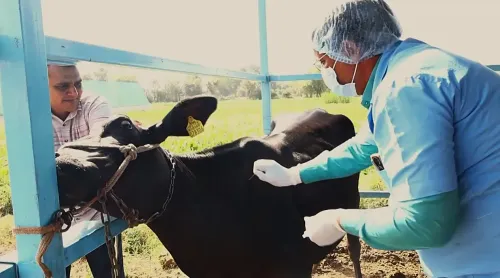
The ARC has initiated plans to distribute the vaccine to livestock herds nationwide.
The department's announcement highlights a significant transition from a largely reactive approach to a more proactive, science-driven initiative aimed at combating FMD, with the goal of regaining South Africa's FMD-free status as recognized by the World Organisation for Animal Health.
Steenhuisen emphasized, “This will bolster our first line of defense against foot-and-mouth disease,” noting the long-term ambition to minimize dependence on international suppliers for the FMD vaccine, as reported by Xinhua.
Foot-and-mouth disease primarily impacts cloven-hoofed livestock, including cattle, pigs, sheep, and goats. Symptoms typically manifest as fever, painful mouth sores, and rashes with blisters on the hands, feet, and buttocks.
This viral disease poses a serious threat to livestock and has considerable economic repercussions.
Cattle, pigs, sheep, and goats, being cloven-hoofed ruminants, are particularly vulnerable. Intensively raised animals are at a higher risk than traditional breeds. While the disease rarely results in fatalities among adults, young animals often suffer high mortality rates due to complications like myocarditis or inadequate milk supply if their mothers are infected.
FMD is characterized by fever and blister-like lesions on the tongue, lips, mouth, teats, and between hooves. The disease leads to substantial production losses, and although most affected animals recover, they often emerge weakened.
All seven serotypes of the virus have been detected in wildlife, with African buffalo being significant carriers of the FMD virus, while other wildlife species appear unable to sustain the virus.
Point of View
This development represents a historic moment for South Africa's agricultural sector, highlighting the country's commitment to innovation and self-sufficiency. By investing in local vaccine production, South Africa is not only addressing current health challenges in livestock but also reinforcing its position in the global agricultural market.
NationPress
24 Sept 2026
Frequently Asked Questions
What is foot-and-mouth disease?
Foot-and-mouth disease (FMD) is a highly contagious viral disease that primarily affects cloven-hoofed animals, causing symptoms like fever and painful sores.
Why is the local production of FMD vaccine important?
Local production of the FMD vaccine reduces dependency on foreign suppliers and enhances the country's ability to manage and control livestock diseases.
How many doses of the vaccine will be produced weekly?
Production is expected to rise to 20,000 doses per week by March.
Who developed the FMD vaccine?
The Agricultural Research Council (ARC) is the developer and producer of the FMD vaccine.
What animals are affected by FMD?
FMD primarily affects cattle, pigs, sheep, goats, and other cloven-hoofed animals.