Did the South Korean National Assembly Approve a Bill Allowing Police to Stop 'Anti-Pyongyang' Leaflet Launches?
Click to start listening
Synopsis
The South Korean National Assembly has passed a controversial bill allowing police to block 'anti-Pyongyang' leaflet launches, igniting a debate over freedom of expression and border security. This legislative change comes as the government aims to ease military tensions and improve relations with North Korea. Is this a necessary measure or an overreach of power?
Key Takeaways
- The bill empowers police to block 'anti-Pyongyang' leaflet launches.
- Controversy over freedom of expression has arisen as a result.
- Legislation aims to reduce military tensions along the border.
- Previous court rulings have influenced this legislative decision.
- The government's goal is to improve inter-Korean relations.
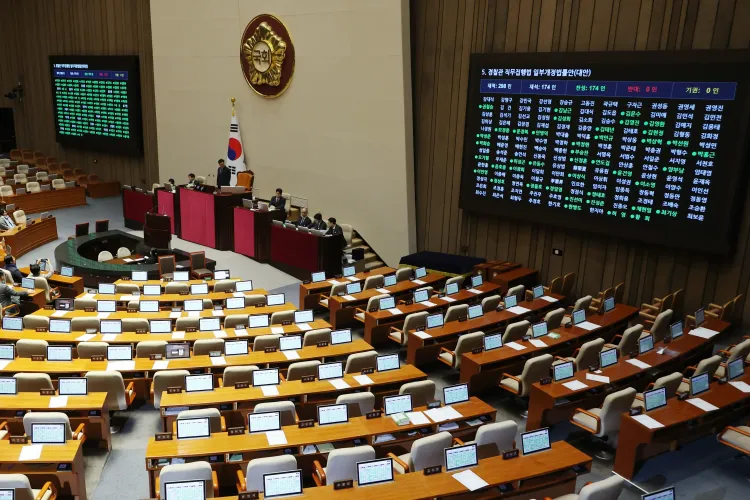
Seoul, Dec 14 (NationPress) The National Assembly of South Korea on Sunday approved a bill championed by the ruling Democratic Party (DP), granting police the legal power to prevent attempts to distribute 'anti-Pyongyang' leaflets in border regions.
This amendment to the Act on the Performance of Duties by Police Officers enables police intervention during leaflet launches near the inter-Korean border, with the intention of mitigating activities that could escalate tensions between the two Koreas, as reported by Yonhap news agency.
The bill was passed during a plenary session, shortly after the main opposition party, the People Power Party (PPP), concluded their filibuster through a vote that took place 24 hours after it started.
The DP asserts that this legislation is essential for safeguarding the residents living near the border and for diminishing military tensions, while the PPP argues that the bill infringes on freedom of expression.
This legislative action follows the recent approval of a revision to the Aviation Safety Act, which prohibits the operation of unmanned aerial vehicles in restricted areas, effectively curtailing the use of drones to disseminate leaflets directed at North Korea.
The bill emerges as the South Korean government aims to alleviate military tensions along the border, aligning with President Lee Jae Myung's commitment to enhance inter-Korean relations and revive dialogue with Pyongyang.
In South Korea, groups composed of North Korean defectors have historically sent balloons carrying leaflets that criticize the Pyongyang regime across the border, which has consistently heightened tensions between the two Koreas.
In 2023, the Constitutional Court ruled that a prior government ban on launching such leaflets violated freedom of expression, determining that certain provisions of the Inter-Korean Relations Development Act imposed undue restrictions on this right.
Earlier this week, South Korean Unification Minister Chung Dong-young mentioned that keeping the possibility of adjusting joint military exercises with the US open for discussion might facilitate the revival of dialogue between the US and North Korea, as the allies seek ways to re-engage with Pyongyang.
Chung's remarks came amid ongoing debates among South Korean policymakers regarding whether to allow for modifications or downsizing of joint military exercises with the US as a strategy to bring North Korea back to the negotiation table.
"South Korea-US combined exercises are merely a tool for achieving peace on the Korean Peninsula, not an end in themselves," Chung stated at a press conference on Saturday.
"Upholding a stance that these exercises could be subject to discussion may help reopen the door for US negotiations with North Korea," Chung reiterated, echoing President Lee Jae Myung's comments made to the media last week.
He emphasized that both Seoul and Washington are actively searching for methods to revive the long-stalled dialogue with North Korea to tackle security concerns arising from Pyongyang's nuclear weapons development.
Point of View
This bill reflects the delicate balance between ensuring national security and upholding democratic values. While the intent to reduce military tensions is commendable, it is essential to carefully consider the implications for freedom of expression. The nation remains at a crossroads, and the decision made by the National Assembly will undoubtedly have lasting effects on South Korea's relationship with North Korea and its own citizens.
NationPress
14/12/2025
Frequently Asked Questions
What does the new bill allow police to do?
The new bill permits police to legally intervene and block attempts to distribute 'anti-Pyongyang' leaflets in border areas, aimed at preventing activities that could escalate tensions.
Why did the People Power Party oppose the bill?
The People Power Party opposed the bill because they believe it infringes on freedom of expression and undermines democratic principles.
What recent legislation preceded this bill?
The recent legislation includes a revision to the Aviation Safety Act, which bans unmanned aerial vehicles in restricted areas, limiting the use of drones for leaflet distribution.
How has the Constitutional Court influenced this situation?
In 2023, the Constitutional Court ruled that previous government bans on launching leaflets violated freedom of expression, affecting the current legislative landscape.
What are the implications for inter-Korean relations?
The passing of this bill is part of a broader strategy by the South Korean government to ease military tensions and improve dialogue with North Korea under President Lee Jae Myung.