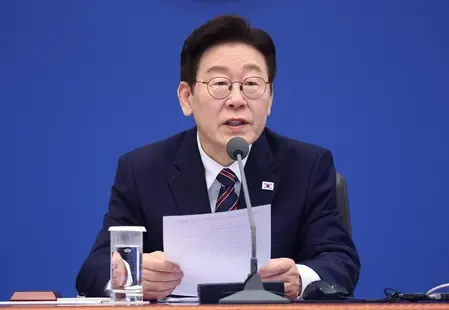
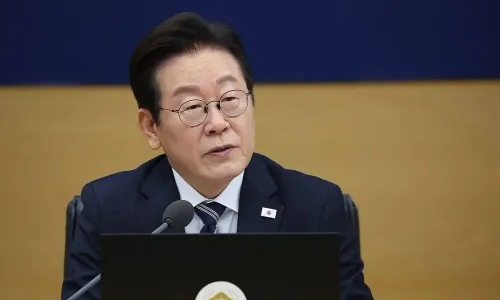
Lee Jae Myung approval rating dips 0.5 pts after two-week rise: Realmeter poll

Synopsis
South Korean President Lee Jae Myung's approval rating slipped to 37.4% last week — ending a two-week recovery — as controversies over new investigative agencies, a DMZ land mine blast, diplomatic friction with Ukraine and rising Seoul rental costs outweighed a welfare policy boost. Meanwhile, his Democratic Party widened its lead over the opposition PPP to 4.1 percentage points in a parallel survey.
Key Takeaways
Lee Jae Myung's approval rating fell 0.5 percentage points to 37.4 per cent last week, per a Realmeter poll of 2,515 adults .
Negative assessments also dipped 0.3 points to 59.8 per cent ; 2.8 per cent were unsure.
Key negative factors: controversy over the new SCIA and Prosecution Service , a DMZ land mine blast , diplomatic friction with Ukraine , and Seoul housing rental concerns.
Lee's prior two-week rise had been driven by his 18 September press conference clarifications on political issues.
In a separate party poll, the ruling Democratic Party rose 3.8 points to 42.5 per cent , while the opposition People Power Party fell 1 point to 38.4 per cent .
Both surveys were commissioned by EKN newspaper ; presidential poll margin of error: ±2 percentage points at 95 per cent confidence.
South Korean President Lee Jae Myung's approval rating edged down last week, snapping a two-consecutive-week upward streak, according to a Realmeter survey released on Monday, 5 October 2025. Positive assessments of his job performance stood at 37.4 per cent, a 0.5 percentage point decline from the previous week, even as negative assessments also dipped marginally.
Key Findings from the Poll
The survey was conducted on 2,515 adults nationwide from Monday through Friday of the preceding week. Negative assessments of Lee's performance fell 0.3 percentage points to 59.8 per cent, while 2.8 per cent of respondents said they were unsure. The poll carried a margin of error of 2 percentage points at a 95 per cent confidence level and was commissioned by EKN newspaper.
What Drove the Rating Down
Realmeter identified several negative factors that outweighed a recent welfare policy boost. Controversies surrounding the establishment of two new investigative bodies — the Serious Crimes Investigation Agency (SCIA) and the Prosecution Service — as well as the appointment of the SCIA chief, weighed on public sentiment. Additionally, a land mine blast inside the Demilitarised Zone (DMZ), diplomatic friction with Ukraine, and public concern over housing rental prices in the Seoul metropolitan area were cited as compounding negative factors.
According to Realmeter, 'The announcement of livelihood and welfare policies using excess tax revenue served as a positive factor this week. But personnel, security and livelihood-related negative factors appear to have had a greater impact.'
The Previous Upswing and Its Catalyst
Lee's approval rating had risen for two straight weeks prior to this dip, buoyed largely by his 18 September press conference, during which he addressed and clarified several key political issues. That brief rally now appears to have stalled amid fresh controversies and security concerns on multiple fronts.
Party Support Shifts in Parallel Poll
A separate survey of 1,009 voters nationwide conducted during the same period showed a notable shift in party preferences. Support for the ruling Democratic Party (DP) rose 3.8 percentage points to 42.5 per cent, while support for the main opposition People Power Party (PPP) dropped 1 percentage point to 38.4 per cent. The party-level poll carried a margin of error of 3.1 percentage points at a 95 per cent confidence level, also commissioned by EKN newspaper.
What to Watch Next
With approval staying well below the majority threshold and multiple overlapping controversies — from investigative agency appointments to DMZ security and diplomatic tensions — the trajectory of Lee's ratings will likely depend on how his administration manages these interlocking crises. The DP's widening lead over the PPP in party-level polling suggests that broader public sentiment has not yet transferred to presidential approval, a gap that analysts are closely monitoring.
Point of View
Diplomatic friction (Ukraine), institutional controversy (SCIA appointments) and bread-and-butter grievances (rental prices) suggests Lee faces a multi-front credibility challenge that no single policy announcement is likely to resolve. How he handles the SCIA's early operations and the DMZ fallout will be the real test of whether his ratings can sustainably recover.
NationPress
5 Oct 2026
Frequently Asked Questions
What is South Korean President Lee Jae Myung's current approval rating?
According to a Realmeter poll released on 5 October 2025, Lee Jae Myung's approval rating stands at 37.4 per cent, down 0.5 percentage points from the previous week. Negative assessments stand at 59.8 per cent, also down marginally by 0.3 points.
Why did Lee Jae Myung's approval rating drop after two weeks of gains?
Realmeter cited several overlapping negative factors: controversy over the establishment of the Serious Crimes Investigation Agency (SCIA) and the Prosecution Service, the appointment of the SCIA chief, a land mine blast inside the Demilitarised Zone (DMZ), diplomatic friction with Ukraine, and public concern over housing rental prices in the Seoul metropolitan area. These outweighed positive sentiment from recently announced welfare policies.
What had driven Lee's two-week approval rating rise before this dip?
Lee's approval had risen for two consecutive weeks, primarily helped by his press conference on 18 September, during which he clarified key political issues. The announcement of livelihood and welfare policies funded by excess tax revenue also provided a short-term boost.
How does the Democratic Party's support compare with the opposition People Power Party?
A separate Realmeter poll of 1,009 voters showed the ruling Democratic Party at 42.5 per cent — up 3.8 percentage points — while the main opposition People Power Party fell 1 percentage point to 38.4 per cent. Both polls were commissioned by EKN newspaper.
What is the Serious Crimes Investigation Agency (SCIA) and why is it controversial?
The Serious Crimes Investigation Agency (SCIA) is a newly established South Korean investigative body whose creation, along with a restructured Prosecution Service, has sparked political controversy. Critics have raised concerns over the appointment of the SCIA's chief, with opponents arguing the process undermines prosecutorial independence. The dispute has emerged as a drag on President Lee's public approval.