Torture persists in Pakistan jails despite 2022 anti-torture law: HRCP
Synopsis
Pakistan passed an anti-torture law in 2022 — but according to the HRCP, little has changed inside the country's detention facilities. With the UN Committee against Torture raising near-identical concerns in both 2017 and 2026, the gap between legislation and practice has become impossible to ignore, and rights groups are now pushing for OPCAT ratification and civilian oversight of internment centres in Khyber Pakhtunkhwa.
Key Takeaways
The Human Rights Commission of Pakistan (HRCP) says torture persists in detention facilities despite the anti-torture law enacted in 2022 .
The UN Committee against Torture (CAT) raised near-identical concerns at Pakistan's reviews in both 2017 and 2026 , signalling structural failure.
In May 2026 , the CAT flagged retaliation against journalists, lawyers, political opponents, and civil society activists in Pakistan.
HRCP Council member Farhatullah Babar called for abolition or civilian oversight of internment centres in Khyber Pakhtunkhwa .
The HRCP has urged Pakistan to ratify the Optional Protocol to the Convention against Torture (OPCAT) to enable unannounced detention inspections.
The HRCP wrote to Prime Minister Shehbaz Sharif last month warning that systematic monitoring of detention conditions remains absent.
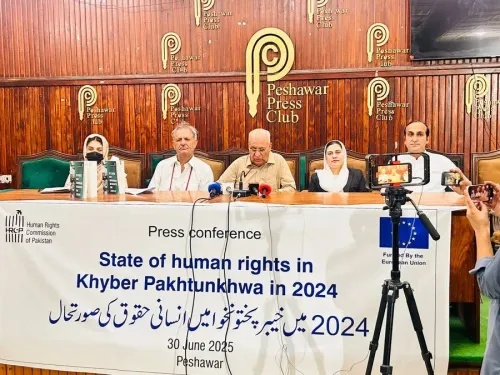
Torture and cruel, inhuman or degrading treatment continue to be reported in Pakistan's detention facilities despite the enactment of the country's anti-torture law in 2022, the Human Rights Commission of Pakistan (HRCP) has said, attributing the persistence of abuse to poor implementation, weak safeguards, and a structural absence of accountability. The findings were presented at a roundtable in Islamabad on 31 July, organised as part of the HRCP's ongoing 'Against Torture' campaign.
What the Roundtable Found
The session brought together legal experts, government representatives, and civil society organisations to assess the state of detention conditions across Pakistan. HRCP Council member and former chairperson Hina Jilani underscored that psychological torture deserved equal attention alongside physical abuse. 'Preventing and addressing other cruel, inhuman or degrading treatment or punishment — including psychological torture — was equally important, given that its consequences could be just as severe and long-lasting as physical torture,' she said.
Jilani further stressed that the law could not be implemented effectively without clear procedures and practical guidance for law enforcement agencies on how to identify, investigate, document, and respond to cases of torture and ill-treatment.
UN Committee's Concerns Echo Across Years
Pakistani lawyer Asad Jamal drew attention to the findings of the UN Committee against Torture (CAT), noting that many of the concerns raised during Pakistan's last review in 2017 were reiterated at the country's 2026 review. In May 2026, the CAT expressed grave concern over reports of 'torture and ill-treatment and other forms of retaliation against human rights defenders, civil society activists, journalists, lawyers, political opponents, protesters and other critics of the government' across Pakistan.
Jamal said this pattern demonstrated that the underlying structural problems enabling torture had yet to be addressed. He called on Pakistan to establish clear protocols against arbitrary detention, amend Prison Rules in line with human rights principles, and align its legal framework with international standards.
Internment Centres and the OPCAT Gap
HRCP Council member Farhatullah Babar raised specific concern over the use of internment centres in Khyber Pakhtunkhwa province, warning that these facilities should either be abolished or brought under the civilian prison system with independent civilian oversight. He also called on Pakistani authorities to ratify the Optional Protocol to the Convention against Torture (OPCAT), which would enable a national preventive mechanism to conduct regular, unannounced inspections of all places of detention.
HRCP's Letter to Prime Minister Sharif
Last month, marking the International Day in Support of Victims of Torture, the HRCP wrote directly to Prime Minister Shehbaz Sharif, warning that Pakistan's legal framework remains inadequate to prevent such acts. The rights body cautioned that the absence of systematic monitoring and reporting has left the scale of torture and ill-treatment in detention facilities largely unknown to policymakers and beyond the reach of civil society and international accountability mechanisms.
What Needs to Change
Experts at the roundtable collectively argued that legislative enactment alone has proven insufficient — implementation requires institutional reform, independent oversight, and a credible complaints mechanism accessible to detainees. With two successive UN reviews raising near-identical concerns, the pressure on Islamabad to move from law on paper to practice on the ground is mounting.
Point of View
And the HRCP roundtable makes clear that law enforcement agencies have received no practical guidance on identifying or documenting abuse. The internment centre question in Khyber Pakhtunkhwa adds a further layer: these facilities operate outside the civilian prison system, which means they are effectively beyond the reach of any oversight mechanism that currently exists. Until Pakistan ratifies OPCAT and establishes an independent national preventive mechanism, the cycle of concern, review, and inaction is likely to repeat at the next UN cycle too.
NationPress
14 Sept 2026
Frequently Asked Questions
What has the HRCP said about torture in Pakistan's detention facilities?
The Human Rights Commission of Pakistan (HRCP) has said that torture and cruel, inhuman or degrading treatment continue to be reported in detention facilities across Pakistan despite the anti-torture law enacted in 2022. It attributes the persistence of abuse to poor implementation, weak safeguards, and a structural lack of accountability.
What did the UN Committee against Torture find in its 2026 review of Pakistan?
In May 2026, the UN Committee against Torture expressed grave concern over reports of torture, ill-treatment, and retaliation against human rights defenders, journalists, lawyers, political opponents, and civil society activists in Pakistan. Notably, these concerns mirrored those raised at Pakistan's previous review in 2017, indicating that structural problems have not been addressed.
What are internment centres in Khyber Pakhtunkhwa, and why are they controversial?
Internment centres in Khyber Pakhtunkhwa are detention facilities that operate outside Pakistan's civilian prison system. HRCP Council member Farhatullah Babar has called for them to be either abolished or brought under the civilian prison system with independent civilian oversight, citing the absence of any meaningful accountability mechanism.
What is OPCAT and why is the HRCP urging Pakistan to ratify it?
The Optional Protocol to the Convention against Torture (OPCAT) is an international treaty that allows a national preventive mechanism to conduct regular, unannounced inspections of all places of detention. The HRCP is urging Pakistan to ratify it because no such independent inspection regime currently exists, leaving detention conditions effectively unmonitored.
Has the HRCP formally approached the Pakistani government on this issue?
Yes. Last month, marking the International Day in Support of Victims of Torture, the HRCP wrote directly to Prime Minister Shehbaz Sharif, warning that Pakistan's legal framework remains inadequate and that the absence of systematic monitoring has left the scale of torture largely unknown to policymakers and inaccessible to international accountability mechanisms.