Trump cites India's 7-8% growth as benchmark for US economy
Synopsis
Trump invoked India's 7-8% GDP growth to argue the US is being held back by an inflation-obsessed Fed — and set a target of 12-13% American GDP growth that mainstream economists would call extraordinary. It is a window into how the White House frames monetary policy as a political constraint, not an economic safeguard.
Key Takeaways
President Donald Trump cited India's 7-8% GDP growth as a benchmark in a CNBC interview on 3 July .
Trump argued the US should target 12-13% GDP growth , calling current constraints a product of Fed over-caution.
He criticised financial markets for developing what he called a 'derangement syndrome about inflation' that treats strong data as a sell signal.
Trump described the US economy as being in a 'Golden Age' , claiming record factory construction, employment, and wages.
India has sustained high growth backed by domestic consumption, infrastructure spending, and supply-chain diversification from China .
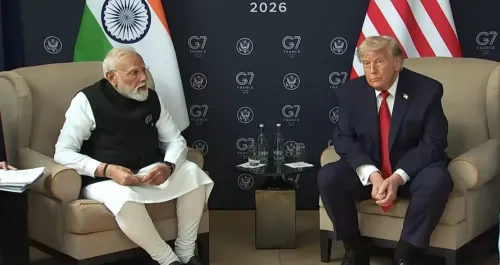
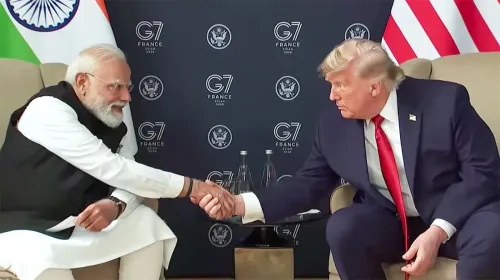
India-US economic ties have expanded across trade, technology, semiconductors, clean energy, and defence over the past decade.
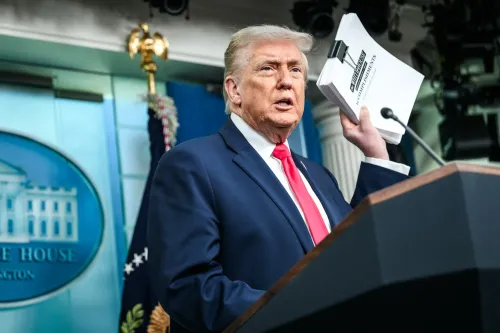
US President Donald Trump on 3 July held up India as a model of rapid economic expansion, arguing that the United States should be targeting far higher growth rates rather than being constrained by inflation fears and the Federal Reserve's cautious monetary stance. Trump made the remarks in an interview with CNBC, following the release of stronger-than-expected US employment data.
What Trump Said About India
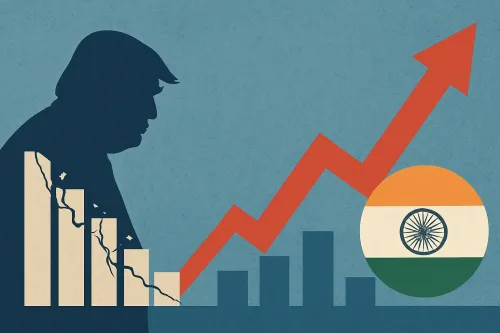
Praising India's economic trajectory, Trump noted that the country was growing at a pace that the US should aspire to match. 'You have a couple of countries, India is one, doing very well, but it's at 7, 8 per cent,' he said. He used this as a springboard to argue that American growth was being artificially suppressed by policymakers wary of inflation.
'We're not allowed to go up. If we go up, they want to kill it,' Trump added, in what amounted to a pointed critique of the Fed's rate-setting framework.
Trump's GDP Ambitions for the US
Going further, Trump set out an ambitious — and by conventional economic standards, extraordinary — growth target for the United States. 'There's no reason we should stop at 4 per cent. We should be at 12 and 13 per cent GDP,' he said. Mainstream economists broadly regard double-digit GDP growth as implausible for a mature, large economy like the US, which has historically averaged well below 4% in peacetime.
Trump also pushed back against what he described as a market psychology that treats positive economic data as a trigger for tighter monetary policy. 'Financial markets have developed this horrible derangement syndrome about inflation,' he said, recalling a time when strong numbers boosted rather than unsettled equity markets. He argued that growth need not be inherently inflationary: 'Growth can be good for inflation, not just bad for inflation.'
Trump's Assessment of the US Economy
The President painted a broadly optimistic picture of the domestic economy under his current administration, describing the country as being in a 'Golden Age.' He claimed that more factories were being built than ever before, that employment had reached historic highs, and that ordinary American workers — 'people that have like normal or normalised jobs' — were earning more than at any previous point. He also said the stock market had repeatedly touched record highs during his presidency.
Comparing his current term with his first, Trump said the economic performance had surpassed his earlier record. 'First term was great financially. This is, I think, blowing it away,' he said.
India-US Economic Context
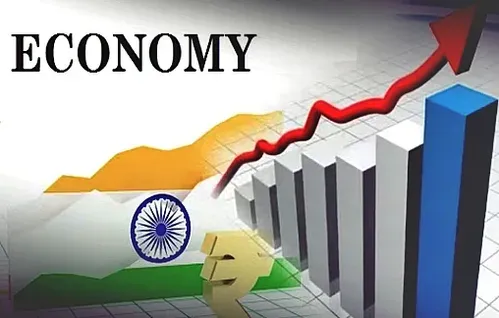
India has remained among the world's fastest-growing major economies in recent years, with expansion underpinned by domestic consumption, infrastructure investment, and a manufacturing push partly driven by global supply-chain diversification away from China. Economic ties between India and the United States have deepened over the past decade, spanning trade, technology, semiconductors, clean energy, and defence cooperation. The two countries are also working to strengthen investment and supply-chain partnerships as part of a broader strategic relationship.
Trump's remarks come at a moment when the Fed's rate trajectory remains a central point of contention between the White House and the central bank. Whether the President's invocation of India's growth story translates into any concrete policy shift remains to be seen.
Point of View
Low per-capita base, and rising formalisation — structural conditions that bear little resemblance to the mature US economy. Targeting 12-13% US GDP growth has no precedent in peacetime American history and sits well outside the range that any mainstream forecaster, left or right, considers achievable. The real story here is not India's growth — it is the sustained White House pressure on the Federal Reserve, which raises legitimate questions about central bank independence at a moment when inflation expectations remain sensitive. Using a friendly India comparison to argue for rate cuts is a political framing, not an economic one.
NationPress
1 Oct 2026
Frequently Asked Questions
Why did Trump cite India's economic growth?
Trump referenced India's 7-8% GDP growth rate during a CNBC interview on 3 July to argue that the United States was capable of far higher economic expansion and was being held back by the Federal Reserve's cautious approach to interest rates. He used India as an example of what rapid growth looks like in practice.
What GDP growth rate did Trump say the US should target?
Trump said the US should be targeting 12-13% GDP growth, arguing there was no reason to stop at 4%. Mainstream economists consider double-digit growth implausible for a large, mature economy like the United States, which has historically grown well below 4% in peacetime.
What did Trump say about the Federal Reserve?
Trump criticised the Fed for what he described as excessive caution on interest rates, arguing that policymakers were suppressing economic momentum by keeping rates too high. He said financial markets had developed a 'derangement syndrome about inflation' that caused strong economic data to be read as a trigger for tighter policy.
What is India's current economic growth rate?
India has been growing at approximately 7-8% annually in recent years, making it one of the world's fastest-growing major economies. Growth has been supported by domestic consumption, government infrastructure spending, and increasing foreign investment as companies diversify supply chains beyond China.
How are India-US economic ties relevant to Trump's remarks?
Economic ties between India and the United States have expanded significantly over the past decade, covering trade, technology, semiconductors, clean energy, and defence. Trump's positive framing of India's growth sits within a broader context of deepening strategic and economic partnership between the two countries.