Trump seeks nuclear talks with Xi, Putin at APEC summit in November
Synopsis
Trump has publicly floated a three-way nuclear summit with Xi and Putin — potentially at APEC in Shenzhen next month — but the proposal faces a fundamental problem: China's arsenal is too small for Beijing to accept equal limits, New START has already expired, and no formal agenda exists. It is the most ambitious arms-control overture in years, and currently the least defined.
Key Takeaways
President Trump said on 20 October he would join a trilateral summit with Xi Jinping and Vladimir Putin to discuss denuclearisation.
The meeting could take place at the APEC summit in Shenzhen in November , though no formal agreement has been confirmed.
Trump said the talks should focus on nuclear arms reductions , not Russia's war in Ukraine.
The New START treaty , which capped deployed warheads at 1,550 per side, expired earlier this year, leaving no legally binding nuclear limits between the US and Russia.
China has rejected trilateral nuclear disarmament proposals, calling them 'neither fair nor realistic' given its smaller arsenal.
Arms-control experts warn that meaningful negotiations will require detailed proposals and sustained diplomatic engagement — neither of which is yet in place.
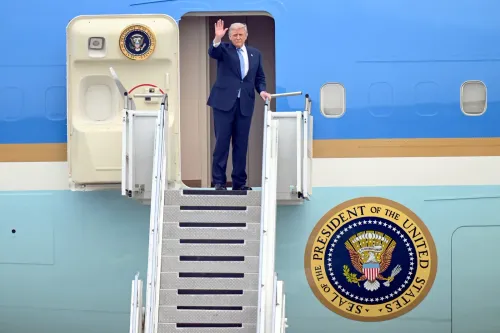
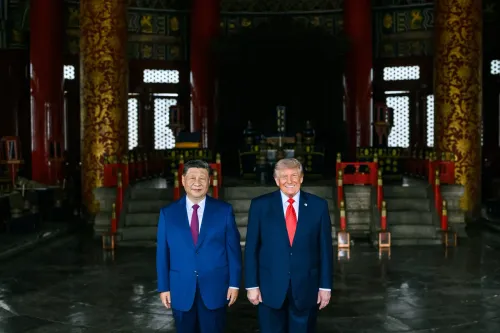
US President Donald Trump has expressed willingness to hold a three-way summit with Chinese President Xi Jinping and Russian President Vladimir Putin to discuss nuclear arms reductions, potentially during his planned visit to China next month. The White House signalled on Monday, 20 October that Washington is seeking to revive arms-control diplomacy among the world's three major nuclear powers.
What Trump Said
Speaking to reporters before departing the White House, Trump indicated he was open to a proposed trilateral meeting, but with a clear condition: nuclear weapons and denuclearisation — not Russia's ongoing war in Ukraine — must be at the centre of any discussions.
'I would do it, not so much for Ukraine, we would have it to talk about denuclearization,' Trump said.
His remarks came days after he stated in an 15 October interview that Washington was already in conversations with both Moscow and Beijing on the subject of denuclearisation.
The APEC Backdrop
The remarks follow reports that President Putin had proposed a leaders' meeting on the sidelines of the Asia-Pacific Economic Cooperation (APEC) summit in Shenzhen in November. No formal agreement for such a summit has been announced, and the three governments have not confirmed a common agenda or timetable for nuclear negotiations.
Notably, Russia has suggested that any Trump-Xi encounter could also address the Ukraine conflict — a framing Trump appeared to resist, preferring to keep the focus on nuclear arsenals.
The Nuclear Arithmetic Problem
The United States and Russia together possess the world's largest nuclear stockpiles. China, while substantially smaller in declared warheads, has been expanding its nuclear capabilities. Trump acknowledged that Beijing remains behind the other two powers but is actively building its arsenal.
This asymmetry is the central obstacle to any trilateral framework. China has long opposed proposals for three-way disarmament talks, arguing that its arsenal is too small relative to those of Washington and Moscow to make equivalent limits either fair or realistic. The Chinese Foreign Ministry reiterated that position last week, stating that expecting Beijing to participate in three-way nuclear disarmament talks 'at the present stage' was 'neither fair nor realistic.'
Trump acknowledged that reaching an agreement would be difficult precisely because of this imbalance, but framed the effort as necessary given the scale of the security challenge.
The New START Vacuum
The push for fresh talks comes against a backdrop of significant arms-control erosion. The New Strategic Arms Reduction Treaty (New START), which had limited each country to 1,550 deployed strategic nuclear warheads and imposed restrictions on delivery systems, expired earlier this year. Washington and Moscow are now without legally binding strategic nuclear limits for the first time in decades.
Arms-control specialists have warned that the absence of a successor agreement could accelerate competition among nuclear powers and erode transparency over strategic arsenals. Daryl Kimball, executive director of the Arms Control Association, said on Monday that meaningful negotiations would require detailed proposals and sustained diplomatic engagement — conditions not yet in place.
Ukraine's Concerns and What Comes Next
Ukrainian officials have expressed concern about any high-level discussions that could affect their country's future without Kyiv's participation. Russia's framing of a potential summit as covering the Ukraine conflict directly contradicts Trump's stated preference for a purely nuclear-focused agenda, leaving the scope of any talks unresolved.
With the APEC summit in Shenzhen approaching in November, the coming weeks will test whether Trump's public overture translates into structured diplomatic engagement or remains an exploratory signal.
Point of View
Yet bridging the US-Russia-China gap requires solving a near-impossible arithmetic: China will not accept parity limits on an arsenal one-tenth the size of Washington's. Without a credible bridging formula — none of which has been floated publicly — this risks becoming performative diplomacy at a moment when the world needs the substantive kind. The APEC framing also conflates a trade forum with a disarmament negotiation, which rarely ends well for either agenda.
NationPress
20 Oct 2026
Frequently Asked Questions
What nuclear talks is Trump proposing with China and Russia?
Trump has expressed willingness to hold a three-way meeting with Chinese President Xi Jinping and Russian President Vladimir Putin focused on nuclear arms reductions and denuclearisation. The talks could potentially take place during Trump's planned visit to China for the APEC summit in Shenzhen in November, though no formal agreement has been announced.
Why has China rejected trilateral nuclear disarmament talks?
China has consistently argued that its nuclear arsenal is substantially smaller than those of the United States and Russia, making equal limitations neither fair nor realistic. The Chinese Foreign Ministry reiterated this position last week, saying participation in three-way nuclear disarmament talks 'at the present stage' was 'neither fair nor realistic.'
What happened to the New START treaty?
The New Strategic Arms Reduction Treaty (New START) expired earlier this year, leaving the United States and Russia without legally binding strategic nuclear limits for the first time in decades. The treaty had capped each country at 1,550 deployed strategic nuclear warheads and restricted delivery systems.
Does Trump's nuclear proposal include Ukraine?
Trump explicitly said he would prefer any trilateral meeting to focus on denuclearisation rather than Russia's war in Ukraine. However, Russia has suggested a meeting could also address the conflict, and Ukrainian officials have expressed concern about high-level discussions affecting their country's future without Kyiv's participation.
What do arms-control experts say about the prospects for a deal?
Daryl Kimball, executive director of the Arms Control Association, said on Monday that meaningful negotiations would require detailed proposals and sustained diplomatic engagement — conditions that are not yet in place. Specialists have also warned that the absence of a New START successor could accelerate nuclear competition among the three powers.