Trump Moves to Restore Smithsonian's Heritage Mission
Synopsis
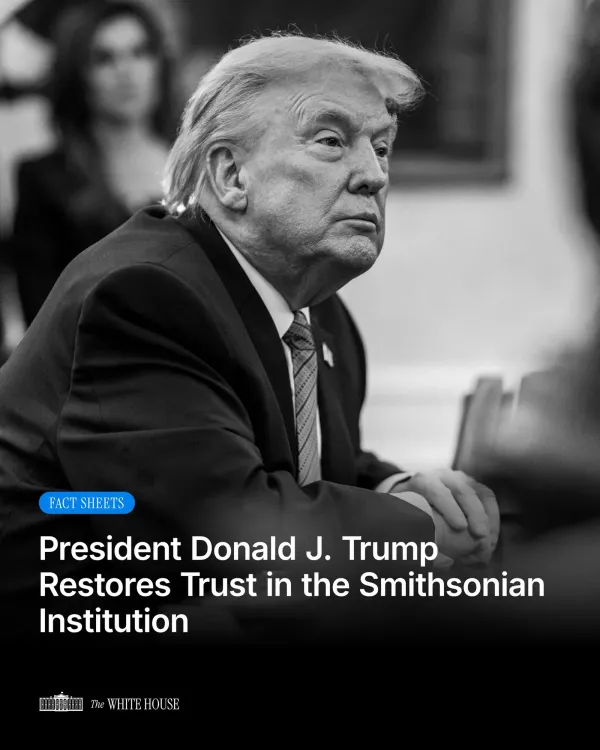
The White House announced on 27 July 2026 that President Trump is moving to restore the Smithsonian Institution's mission of celebrating American heritage, citing a report that accuses its leadership of embracing Marxist ideology and abandoning its founding purpose.
Key Takeaways
The White House posted on 27 July 2026 that President Trump is acting to reestablish confidence in the Smithsonian Institution .
The administration references 'The Report,' which it says shows Smithsonian leadership shifted from heritage celebration to 'extreme political activism rooted in Marxism.' The Smithsonian , founded in 1846 , is a federally funded network of museums and research centres subject to executive and congressional oversight.
During his first term, Trump created the 1776 Commission in 2020 to counter revisionist historical narratives in federally supported institutions.
Full details of 'The Report' and any follow-on executive actions or leadership changes at the Smithsonian remain to be disclosed.
The White House on Sunday, 27 July 2026, announced that President Donald Trump is taking steps to reestablish confidence in the Smithsonian Institution, citing a report that accuses its leadership of shifting from celebrating shared American heritage to what the administration describes as 'extreme political activism rooted in Marxism.'
Context
The White House post states that 'in the last decade, Americans have witnessed a concerted effort to rewrite our history and force a factually baseless ideology that discredits American heroes.' It references a report — referred to simply as 'The Report' — which it says documents how Smithsonian leadership altered the institution's core mission. The administration frames Trump's intervention as a corrective measure to restore the Smithsonian's founding purpose.
The Smithsonian Institution, established in 1846, is a federally administered network of museums, research centres, and cultural institutions. Its statutory mission centres on increasing and diffusing knowledge, with a long-standing emphasis on American heritage and education. It receives significant federal funding, making it directly subject to executive-branch oversight and congressional scrutiny.
Policy Backdrop
This is not the first time the Trump administration has moved to counter what it characterises as revisionist approaches to American history. During his first term, President Trump established the 1776 Commission via executive order in 2020, aimed at promoting a unified account of American founding principles and pushing back against identity-based historical frameworks in federally supported institutions.
Cultural institutions including the Smithsonian have faced recurring criticism from conservative circles for exhibits and programming that emphasise race, gender, and power-based interpretations of history. Successive administrations have alternated between expanding such interpretive frameworks and reasserting traditional, celebratory approaches to national heritage — a cycle the current announcement continues.
Stakeholders and Impact
The immediate stakeholders include the American public, the millions of domestic and international visitors who pass through Smithsonian museums each year, historians, and the institution's own staff and leadership. For Indian observers, the development is significant as a case study in how democratic governments navigate the tension between state funding of cultural institutions and curatorial independence.
Historians and museum professionals have previously argued that broadening historical narratives reflects evolving scholarship rather than political activism. The administration's framing — that such changes 'divide and discourage Americans' — signals a direct challenge to that position and could presage changes to exhibit policies, board appointments, or funding conditions at the Smithsonian.
What's Next
Attention will now turn to the full release or congressional review of 'The Report' cited in the White House post, the specific contents of which have not been independently detailed. Any subsequent executive actions — including leadership changes, revised exhibit guidelines, or adjusted federal appropriations — will be closely watched as indicators of how far the administration intends to push its cultural agenda at the Smithsonian.
The move fits a broader pattern of executive-branch scrutiny of federally supported cultural bodies, and the outcome at the Smithsonian could set a precedent for how other federally funded arts and heritage institutions are evaluated for alignment with statutory missions under the current administration.
Point of View
Targeting one of the United States' most symbolically significant federally funded bodies. By invoking 'Marxism' and 'rewritten history,' the administration is deploying language designed to energise a conservative base while placing the Smithsonian's leadership on the defensive. The reference to an unreleased report suggests a deliberate sequencing strategy — establishing the narrative before the evidence is public. For India and other democracies that fund cultural institutions, the episode raises durable questions about where the line sits between legitimate statutory oversight and political interference in curatorial independence.
NationPress
27 Jul 2026
Frequently Asked Questions
What did the White House say about the Smithsonian in July 2026?
The White House announced on 27 July 2026 that President Trump is reestablishing confidence in the Smithsonian Institution , citing a report that claims its leadership shifted from celebrating American heritage to 'extreme political activism rooted in Marxism.'
What is the Smithsonian Institution and who funds it?
The Smithsonian Institution is a federally administered group of museums, research centres, and cultural institutions established in 1846 . It receives significant federal funding and is subject to both executive-branch oversight and congressional scrutiny.
What was Trump's 1776 Commission?
The 1776 Commission was an advisory body created by President Trump via executive order in 2020 during his first term, aimed at promoting a unified account of American founding principles and countering what the administration described as revisionist history in federally supported institutions.
What is 'The Report' mentioned by the White House?
The White House referenced 'The Report' as the basis for its claims about the Smithsonian 's leadership, but the full contents, authorship, and official release of the document had not been independently detailed as of the announcement.
How does the Smithsonian controversy affect India?
While the dispute is a domestic US policy matter, it is watched internationally — including in India — as a case study in the tension between government funding of cultural institutions and their editorial and curatorial independence.