Trump moves to restore trust in Smithsonian Institution
Synopsis
The White House on July 27, 2026, released a fact sheet outlining President Donald J. Trump's steps to restore public trust in the Smithsonian Institution, the federally funded network of museums and research centres established in 1846. Details of the specific actions are set to emerge through executive orders and board appointments.
Key Takeaways
The White House published a fact sheet on July 27, 2026 , on President Trump's efforts to restore trust in the Smithsonian Institution .
The Smithsonian Institution was established by Congress in 1846 and operates as a federal trust instrumentality.
The institution encompasses dozens of museums, galleries, and research centres, many on the National Mall, Washington D.C.
Presidential engagement with the Smithsonian can include Board of Regents appointments and directives on programming and governance.
Stakeholders including curators, historians, and museum visitors will be closely watching for follow-on executive orders and congressional hearings.
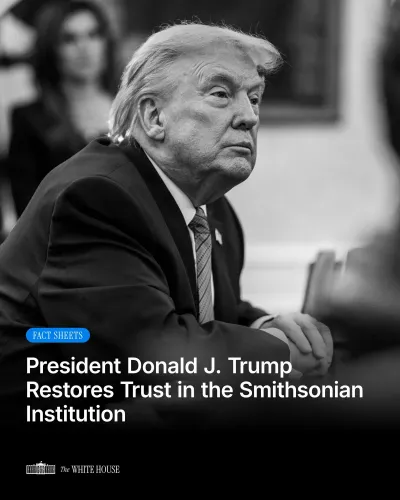
The White House on Sunday, July 27, 2026, shared a fact sheet outlining steps taken by President Donald J. Trump to restore public trust in the Smithsonian Institution, the United States' flagship network of federally funded museums, research centres, and libraries.
Context
The White House post directed followers to read a fact sheet titled 'President Donald J. Trump Restores Trust in the Smithsonian Institution,' signalling a formal executive engagement with the governance and programming of one of America's most prominent cultural bodies. The Smithsonian, established by Congress in 1846, operates as a federal trust instrumentality and encompasses dozens of museums, galleries, and research facilities, many located along the National Mall in Washington, D.C.
The institution draws tens of millions of visitors annually and plays a central role in how the United States preserves and presents its history, science, and culture to both domestic and international audiences.
Policy Backdrop
Presidential administrations have periodically reviewed the governance and programming of federally supported cultural institutions. Questions around historical presentation, board composition, and public confidence in such bodies have surfaced across multiple administrations.
During his first term from 2017 to 2021, Trump engaged with issues of national heritage, including executive actions related to monuments and federal commemorations. Actions targeting the Smithsonian fit within a broader pattern of White House interest in how federally funded institutions shape national narratives. The Smithsonian's Board of Regents, which includes congressional members and citizen regents appointed by joint resolution, is a key lever through which executive influence can be exercised.
Stakeholders and Impact
The move is of direct relevance to museum visitors, curators, historians, and educators who interact with or depend on the Smithsonian's vast collections and research output. Any changes to institutional governance, exhibit curation standards, or funding priorities would have downstream effects on how American history and science are communicated to the public.
For the Indian diaspora and international visitors — a significant segment of Smithsonian's audience — the institution's direction on cultural and scientific programming carries practical importance. Federally appointed board members and senior administrators would be among the first to feel the operational impact of any executive directives.
What's Next
Observers will watch for any follow-on executive orders, new appointments to the Smithsonian Board of Regents, or congressional oversight hearings that may accompany or respond to the White House's stated intent. Legislative action, budget allocations, and public statements from Smithsonian leadership are likely to clarify the scope and pace of any institutional changes.
The broader debate over the federal government's role in shaping cultural institutions — and the standards by which public trust is defined and measured — is expected to continue as details of the administration's plan emerge.
Point of View
Not merely an administrative matter. This fits a broader arc in which executive power is used to reframe how publicly funded bodies curate history and science. For observers of US governance, the move raises substantive questions about the boundary between political accountability and institutional independence at a body that has operated for nearly 180 years. The practical impact will hinge on the specific appointments and directives that follow this announcement.
NationPress
25 Oct 2026
Frequently Asked Questions
What did President Trump do to the Smithsonian Institution in 2026?
The White House released a fact sheet on July 27, 2026, stating that President Trump took steps to restore public trust in the Smithsonian Institution, though the specific executive actions are detailed in the accompanying government document.
What is the Smithsonian Institution and who controls it?
The Smithsonian Institution is a group of museums, research centres, and libraries established by the US Congress in 1846. It is governed by a Board of Regents that includes congressional members and citizen regents, and operates as a federal trust instrumentality.
Why is the White House involved with the Smithsonian?
As a federally funded institution, the Smithsonian falls within the oversight purview of the executive and legislative branches. Presidential administrations can influence the Smithsonian through board appointments, budget proposals, and executive directives on programming.
How does Trump's Smithsonian action affect India or Indian visitors?
The Smithsonian is a major destination for international visitors including the Indian diaspora. Any changes to its cultural programming, exhibit standards, or research priorities could affect how American history and science are presented to global audiences.
What should we watch for next regarding the Smithsonian?
Key developments to follow include new appointments to the Smithsonian Board of Regents, any executive orders related to the institution, congressional oversight hearings, and official responses from Smithsonian leadership.