Trump calls to end daylight saving time, backs Senate action on House bill

Synopsis
Mid-anecdote about his father's Cadillacs, Trump called for scrapping daylight saving time at a Michigan factory visit — and revealed the House has already passed a bill. With the Senate yet to act, the push could lock in a permanent US time standard that would ripple through Indian airline schedules, IT firm working hours, and financial market overlaps.
Key Takeaways
President Donald Trump called for ending daylight saving time on 28 July during remarks at General Motors Milford Proving Ground in Michigan .
Trump said the House of Representatives has already passed a bill and urged the Senate to follow suit.
He did not specify whether he prefers permanent standard time or permanent daylight saving time .
Any change requires legislation to pass both chambers of Congress and receive a presidential signature.
A fixed US time standard would affect the seasonal time gap with India , as well as international airline schedules and cross-border financial market hours.
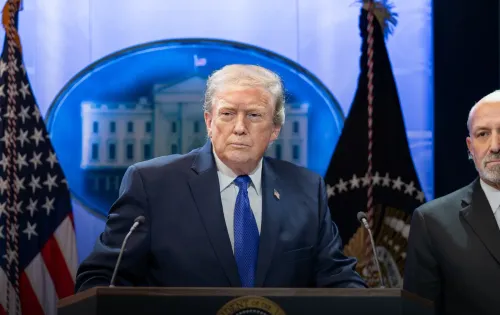
US President Donald Trump on Monday, 28 July publicly called for the abolition of daylight saving time, urging the Senate to pass legislation already approved by the House of Representatives. Trump made the remarks during a visit to workers at the General Motors Milford Proving Ground in Michigan, in what he described as a characteristic digression mid-speech.
How the Call Came About
The president was recounting his father's affection for Cadillac cars — specifically, that his father received a new Cadillac every two years with such regularity that, as Trump put it, 'you could set your clocks by it' — when he pivoted abruptly to the clock-change debate.
'And, by the way, speaking of that, let's get rid of daylight saving time stuff, OK?' Trump said. He then acknowledged the non-sequitur, calling it part of his speaking style: 'You know, it's called the weave, right? I go from — we always get back to the right subject.'
Where the Legislation Stands
Trump indicated that a bill addressing the seasonal clock change is already in play on Capitol Hill. 'We have a bill in. Hopefully, the Senate is going to improve that one. The House approved it, and we're going to get rid of that,' he said. The president did not specify whether he favours making permanent standard time or permanent daylight saving time the law of the land — a distinction that has divided supporters of the reform.
Notably, any change to the federal clock system requires legislation to clear both chambers of Congress and receive a presidential signature. A similar effort — the Sunshine Protection Act — passed the Senate unanimously in 2022 but stalled in the House, illustrating how politically deceptive the issue can appear before it reaches the finish line.
Why This Matters for India and Global Markets
A permanent US time standard would have measurable knock-on effects beyond American borders. The seasonal time difference between the United States and India currently shifts twice a year, affecting international airline schedules, cross-border business communications, and the overlap windows between Indian financial markets and their US counterparts. Eliminating the twice-yearly clock change would lock in a fixed time gap, simplifying scheduling for Indian IT firms, exporters, and airlines that operate on US routes.
The Broader Debate
Most of the United States adjusts its clocks twice annually — forward in spring, back in autumn. Advocates for ending the practice argue the biannual shift disrupts sleep patterns, complicates travel logistics, and imposes costs on businesses. However, consensus on which permanent system to adopt — standard or daylight — remains elusive, with health researchers, energy economists, and industry groups often backing different outcomes.
With the House having already acted and Trump lending his voice to the cause, attention now shifts to whether the Senate will move the bill forward in the current legislative calendar.
Point of View
And a presidential endorsement changes the Senate's political calculus. But the real fault line isn't whether to end the clock change; it's which permanent time to adopt. Health researchers favour standard time; the retail and recreation lobby wants permanent daylight saving. That unresolved split is precisely what killed the Sunshine Protection Act in 2022 after it sailed through the Senate. For India, the stakes are practical: a fixed US time standard would end the twice-yearly scramble for Indian IT firms and airlines to recalibrate schedules, but only if Congress can agree on which clock to freeze.
NationPress
26 Oct 2026
Frequently Asked Questions
What did Trump say about ending daylight saving time?
President Trump called for abolishing daylight saving time during remarks at the General Motors Milford Proving Ground in Michigan on 28 July. He said a bill has already passed the House of Representatives and urged the Senate to approve it as well.
Has Congress already passed a daylight saving time bill?
The House of Representatives has passed a bill addressing the seasonal clock change, according to Trump. The Senate has not yet acted on it, and any final change requires both chambers to pass the legislation and the president to sign it.
Did Trump say whether he wants permanent standard time or permanent daylight saving time?
No. Trump did not specify which permanent time system he prefers. He said only that he wants to 'get rid of' the practice of changing clocks, leaving the question of which time to make permanent unresolved.
How would ending daylight saving time affect India?
A permanent US time standard would fix the time difference between the United States and India, which currently shifts twice a year. This would affect international airline schedules, business communication windows, and the overlap between Indian and US financial markets.
Why has ending daylight saving time been difficult to legislate in the US?
The main obstacle is disagreement over which time to make permanent. Health researchers generally support permanent standard time, while retail and leisure industries favour permanent daylight saving time. A similar bill — the Sunshine Protection Act — passed the US Senate unanimously in 2022 but stalled in the House over this very dispute.