Trump calls Canada 'most difficult' trade partner, warns it cannot survive without US

Synopsis
Trump's broadside against Canada is the sharpest White House statement in the current trade standoff — and Canada isn't blinking. With $27.6 billion in Canadian counter-tariffs set to hit on 8 September and a $7.5 billion domestic relief package already announced, Ottawa is signalling it will absorb pain rather than capitulate, turning one of the world's most integrated trading relationships into an open economic conflict.
Key Takeaways
President Trump called Canada the most 'difficult and unreasonable' US trading partner in a White House statement on 26 August .
The White House cited an average annual goods trade deficit of roughly $50 billion with Canada over the past decade.
Canada reportedly imposed 25 per cent tariffs on US vehicles, contributing to a 22 per cent drop in American automobile exports to Canada in one year.
US alcohol exports to Canada reportedly fell by 81 per cent in a year; over-quota dairy tariffs were said to approach 300 per cent .
Canada announced retaliatory tariffs of 15, 25 and 50 per cent on $27.6 billion of US goods, effective 8 September .
Ottawa unveiled a $7.5 billion assistance package for affected Canadian workers and businesses.
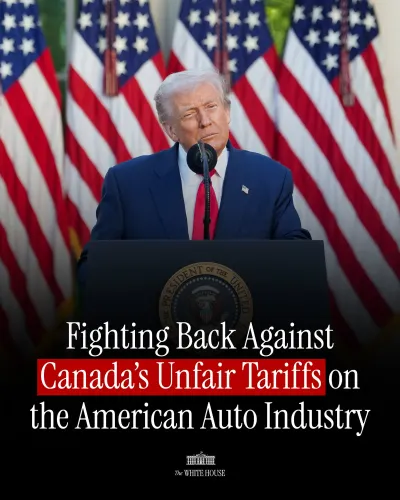
US President Donald Trump sharply escalated his trade confrontation with Canada on Tuesday, 26 August, declaring Ottawa the most 'difficult and unreasonable' trading partner and asserting that Canada could not survive economically without access to the American market. The White House issued a strongly worded statement accusing Canada of having 'been ripping off the United States for decades' and signalling that preferential access would no longer be extended.
What the White House Said
'Canada is easily the most difficult and unreasonable. They feel entitled, but they are not a State, and will be entitled no longer!' Trump said in the official White House statement. The administration framed its position around economic leverage, noting that the US economy is approximately 13 times larger than Canada's and has more than eight times its population.
The White House also pointed to a structural imbalance, citing an average annual goods trade deficit of roughly $50 billion with Canada over the past decade. It further noted that Canada sends approximately three-quarters of its goods exports to the American market — a dependency Washington argued gave it 'the clear leverage.'
Key Grievances: Autos, Dairy, and Alcohol
The administration outlined several specific trade irritants. According to the White House, Canada imposed 25 per cent tariffs and company-specific quotas on American vehicles, contributing to a 22 per cent decline in US automobile exports to Canada over the past year. On dairy, Canada reportedly uses restrictive tariff-rate quotas with over-quota tariffs approaching 300 per cent on certain US dairy products — rates the White House described as effectively blocking American goods from entering the market.
The administration also accused Canadian provinces and territories of restricting American wine, beer and spirits, claiming US alcohol exports to Canada had fallen by 81 per cent in a single year. The White House said it had offered Canada deep tariff reductions covering steel, aluminium, automobiles and lumber, but accused Ottawa of responding with 'unreasonable demands, walk-backs, and flat-out rejection.'
Canada's Response: Dollar-for-Dollar Retaliation
Canada rejected Washington's position outright. The Canadian government announced it would match the new American tariffs 'dollar-for-dollar, rate for rate.' Effective 8 September, Canada will impose tariffs of 15, 25 and 50 per cent on American goods covering $27.6 billion in imports. Targeted sectors include steel, dairy, appliances, agricultural equipment, pulp and paper, electronics, furniture and clothing.
'When the United States asked too much and offered too little, we chose to stand up for Canadians,' Canadian Finance Minister François-Philippe Champagne said. Ottawa also announced a $7.5 billion assistance package for workers and businesses affected by the dispute, encompassing liquidity support, worker-retention programmes, training assistance and diversification investments.
What Is at Stake
Canada and the United States have traded under the US-Mexico-Canada Agreement (USMCA) since July 2020, a pact that replaced the North American Free Trade Agreement (NAFTA) and governs automobiles, agriculture, labour, intellectual property and digital commerce. The two countries share one of the world's largest bilateral trading relationships, with deeply integrated supply chains in automobiles, energy, agriculture and manufacturing — meaning tariff disruptions can affect producers and consumers on both sides of the border, as many products and components cross the frontier multiple times before reaching end markets.
The White House claimed that Canada and China were the only countries to have chosen retaliation over negotiation in their trade disputes with Washington. With Canada's new tariffs set to take effect in under two weeks, the trajectory of the dispute will be closely watched by businesses and policymakers across North America.
Point of View
Not an economic analysis — and Canada's dollar-for-dollar response suggests Ottawa has calculated that backing down would cost more politically than the tariffs themselves. The real risk is structural: the USMCA's integrated supply chains mean both sides will absorb pain, but the White House appears to be betting Canada blinks first given its export dependency. That bet may underestimate how domestically toxic any capitulation would be for any Canadian government right now. The deeper question is what this signals for the USMCA's scheduled 2026 review — if the two sides cannot manage a tariff dispute without open hostility, renegotiating the entire framework looks increasingly fraught.
NationPress
26 Aug 2026
Frequently Asked Questions
Why is Trump escalating trade tensions with Canada?
The Trump administration has accused Canada of maintaining unfair trade practices, including high tariffs on US dairy (approaching 300 per cent over quota), a 25 per cent tariff on American vehicles, and restrictions on US alcohol — contributing to what the White House says is an average annual goods trade deficit of roughly $50 billion. The escalation followed Canada's announcement of additional retaliatory tariffs on American products.
What retaliatory tariffs has Canada announced?
Canada announced tariffs of 15, 25 and 50 per cent on American goods covering $27.6 billion in imports, effective 8 September. Targeted sectors include steel, dairy, appliances, agricultural equipment, pulp and paper, electronics, furniture and clothing.
What did Trump mean by saying Canada cannot survive without the US?
The White House statement pointed to Canada's deep export dependency on the American market, noting that Canada sends roughly three-quarters of its goods exports to the United States. The administration argued this dependency, combined with the US economy being approximately 13 times larger than Canada's, gave Washington 'the clear leverage' in the dispute.
How is Canada supporting its workers and businesses during the trade dispute?
The Canadian government announced a $7.5 billion assistance package for workers and businesses affected by the tariff conflict. The package includes liquidity support, worker-retention programmes, training assistance and investments to help companies diversify away from US markets.
How does this affect the US-Mexico-Canada Agreement (USMCA)?
The US, Canada and Mexico have traded under the USMCA since July 2020, which replaced NAFTA. The current dispute puts significant strain on that framework ahead of its scheduled 2026 review. Because the two countries' supply chains are deeply integrated — with many products crossing the border multiple times — the tariff escalation risks disrupting producers and consumers on both sides.