White House Announces 50% Tariff on Some Canadian Products
Synopsis
The White House announced a 50% tariff on select Canadian products on 21 July 2026, accusing Canada of imposing an unfair tariff scheme on American cars that caused a roughly 22% drop in US automobile imports and cost American industry billions of dollars.
Key Takeaways
The White House announced on 21 July 2026 that the US will impose a 50% tariff on some Canadian products.
The move is a direct response to what the White House calls an 'unfair tariff scheme' by Canada on American automobiles.
Canadian imports of US cars reportedly fell by approximately 22% as a result of Canada's tariff measures, costing American industry billions.
The two countries are bound by the USMCA (2020) , which includes specific auto-sector rules of origin.
A similar tariff confrontation occurred in 2018 when the Trump administration imposed steel and aluminum duties and Canada retaliated.
Possible next steps include USMCA dispute consultations, Canadian counter-tariffs, or US congressional action on the proposed duties.
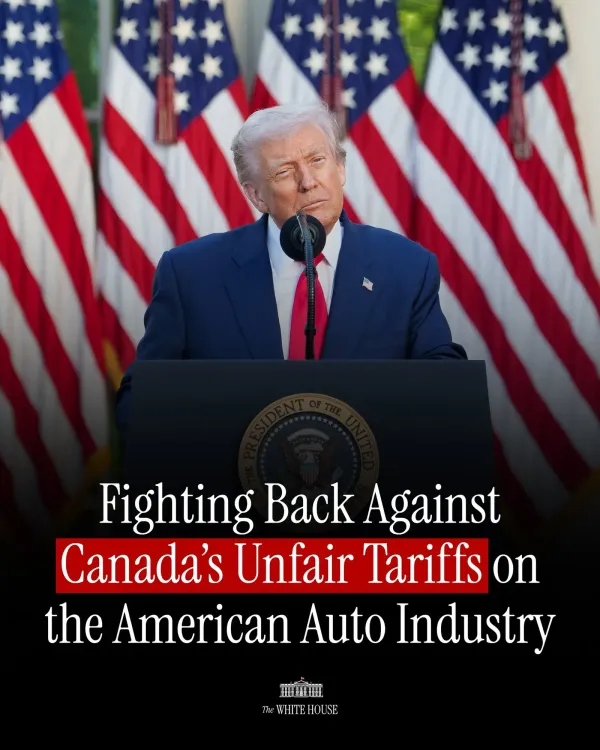
The White House, the official communications account of the Executive Office of the President of the United States, announced on Tuesday, 21 July 2026 that the United States will impose a 50% tariff on select Canadian products, citing what it called an 'unfair tariff scheme' by Canada on American automobiles.
Context
The White House post stated that Canada imposed a tariff scheme on American cars that caused Canadian imports of US automobiles to fall by approximately 22%, costing American industry 'billions' of dollars. The announcement frames the new 50% tariff as a direct response, asserting that President Donald Trump 'won't put up with Canada's trade schemes.'
The retaliatory measure targets 'some Canadian products,' though the specific product categories subject to the new duty were not detailed in the post. The announcement signals a sharp escalation in trade tensions between the two neighbouring economies.
Policy Backdrop
Canada is among the United States' largest trading partners, with the two countries bound by the United States-Mexico-Canada Agreement (USMCA), which came into force in 2020 and replaced the earlier NAFTA framework. The USMCA includes specific rules of origin for the automotive sector, reflecting the deeply integrated cross-border supply chains between the two nations.
This is not the first time tariffs have strained the relationship. In 2018, the Trump administration imposed 25% tariffs on Canadian steel and 10% on Canadian aluminum, prompting Ottawa to apply retaliatory duties on a range of US goods, including automobiles. The current announcement echoes that episode and suggests a return to the same pressure-based trade strategy.
President Trump's broader trade posture has consistently used tariff threats as leverage against bilateral trade imbalances, a pattern applied not only to Canada but also to the European Union, Japan, and China during his first term. The USMCA itself emerged partly from that earlier round of tariff pressure.
Stakeholders and Impact
US auto manufacturers are central to this dispute, with the White House framing the Canadian tariff regime as directly harming American industry to the tune of billions of dollars. A 22% decline in Canadian purchases of American vehicles, if sustained, represents a significant contraction in a key export market for US carmakers.
On the Canadian side, exporters across sectors face the prospect of a steep 50% duty on goods entering the US market. Canada's automotive parts and manufacturing sector, which is tightly interwoven with US production lines, could face particular disruption. Canadian workers and businesses dependent on US-bound exports stand to bear a heavy cost if the tariff is implemented as announced.
Consumers on both sides of the border may also feel the effect through higher prices on goods caught in the crossfire of retaliatory trade measures.
What's Next
Attention will now turn to Ottawa's response — whether Canada seeks formal dispute consultations under the USMCA's resolution mechanisms or moves to impose counter-tariffs on American goods, as it did in 2018. Any congressional action in Washington DC to modify or block the proposed tariff will also be closely watched.
The announcement sets up a potentially prolonged trade confrontation between two economies whose automotive and manufacturing sectors are structurally interdependent — meaning the cost of escalation could be felt on both sides of the border regardless of which government blinks first.
Point of View
Reviving the pressure-tariff playbook that defined President Trump's first term. By framing the 50% duty as a defensive response to Canadian 'schemes' rather than an offensive trade move, the administration is controlling the narrative around economic nationalism ahead of any domestic political scrutiny. For India and other export-oriented economies, the episode is a reminder that the USMCA framework — often cited as a model for managed trade — has not insulated North American partners from unilateral tariff action. The deeper risk is that a tit-for-tat escalation between two structurally integrated economies could ripple through global automotive supply chains, affecting component suppliers far beyond North America.
NationPress
19 Oct 2026
Frequently Asked Questions
Why is the US imposing a 50% tariff on Canada?
The White House says the tariff is a response to Canada imposing an 'unfair tariff scheme' on American cars, which it claims caused Canadian imports of US automobiles to fall by roughly 22%, costing American industry billions of dollars.
Which Canadian products will face the 50% US tariff?
The White House announcement said the tariff will apply to 'some Canadian products' but did not specify the exact product categories subject to the new 50% duty.
How does the US-Canada USMCA agreement affect this tariff dispute?
The USMCA, which replaced NAFTA in 2020, governs trade between the US, Canada, and Mexico and includes automotive rules of origin. Canada could invoke USMCA dispute resolution mechanisms to challenge the new US tariffs.
Has the US imposed tariffs on Canada before?
Yes. In 2018, the Trump administration imposed 25% tariffs on Canadian steel and 10% on Canadian aluminum. Canada retaliated with duties on US goods including automobiles, a pattern that now appears to be repeating.
What could Canada do in response to the new US tariffs?
Canada could seek formal consultations under the USMCA dispute settlement process, impose retaliatory tariffs on American goods, or pursue a combination of diplomatic and legal challenges to the new US measures.