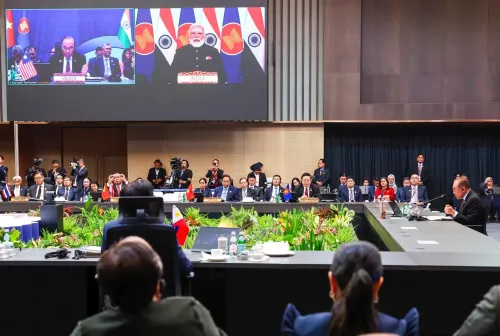
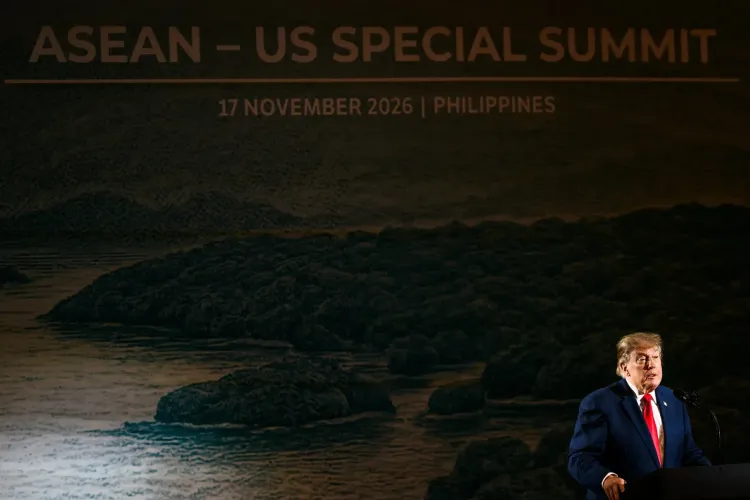
Trump Addresses ASEAN Dinner, Vows Stronger Ties
Synopsis
President Donald J. Trump addressed an ASEAN dinner, vowing to strengthen US-Southeast Asia bonds and work toward 'an incredible future' for people worldwide — a signal of American intent in a region where US-China competition is intensifying.
Key Takeaways
Trump delivered remarks at a formal ASEAN dinner , pledging deeper US-Southeast Asia ties.
Trump quoted directly: 'As we strengthen those bonds even further and work to build an incredible future for our people - the entire world.' ASEAN is a ten-member bloc whose collective economy and maritime geography make it a central arena for US-China strategic competition.
During his first term, Trump attended the ASEAN Summit in Manila in 2017 , prioritising reciprocal trade and countering China's regional influence.
ASEAN member states will watch whether warm dinner-table rhetoric translates into concrete trade deals or security commitments from the administration.
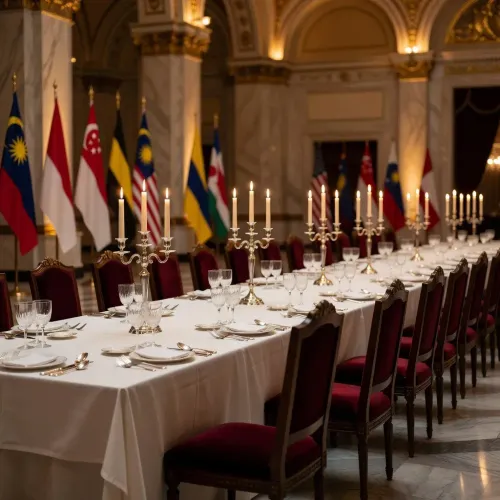
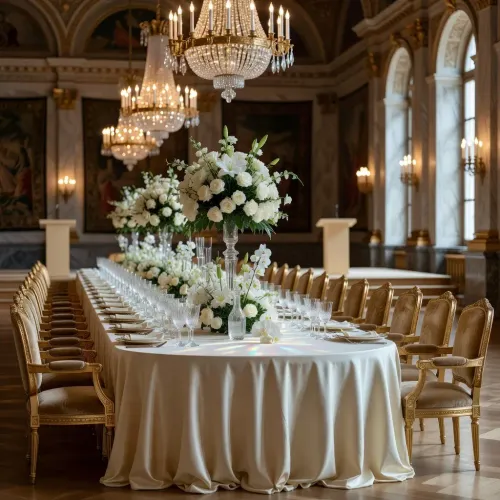
At a formal dinner convened under the ASEAN framework, President Donald J. Trump delivered remarks pledging deeper bonds between the United States and the ten-nation Southeast Asian bloc — framing the relationship as a shared project to build 'an incredible future for our people - the entire world.'
What Trump Said — and Why the Room Was Listening
The White House shared a direct quote from the president: 'As we strengthen those bonds even further and work to build an incredible future for our people - the entire world.' The line is deliberately expansive, casting US-ASEAN engagement not as a narrow bilateral transaction but as a contribution to global stability — a framing designed to resonate with a diverse audience that spans Vietnam, Indonesia, the Philippines, Thailand, and six other economies.
The Association of Southeast Asian Nations represents a collective GDP running into the trillions and sits astride some of the world's most critical maritime trade routes, including the South China Sea. Any US president who shows up — and speaks warmly — signals that Washington still considers Southeast Asia a priority theatre.
Trump and ASEAN: A Pattern of Engagement Under Pressure
Trump's first term set a template of ambivalence: he attended the ASEAN Summit in Manila in 2017, stressing reciprocal trade and the need to counter China's growing regional footprint, but his administration simultaneously pulled back from multilateral frameworks that ASEAN members valued. The result was a relationship defined less by institution-building and more by bilateral leverage.
That pattern shapes how ASEAN diplomats read every Trump speech. The warm dinner-table language is noted — but the bloc's chancelleries will watch closely for what follows: concrete trade deals, security commitments, or a return to tariff pressure on individual members.
The Bigger Stakes: US Influence in a Region China Is Courting Hard
Southeast Asia has become one of the sharpest arenas of US-China competition. China has deepened infrastructure investment across the region through its Belt and Road Initiative, while the US has countered with security partnerships, semiconductor supply-chain diplomacy, and economic frameworks. ASEAN states, practised in the art of strategic hedging, have no interest in choosing sides — but they do calibrate their posture based on which great power shows the greater commitment.
A Trump dinner speech, amplified by the official White House account, is a signal — however symbolic — that Washington intends to stay in the room. Whether that signal is backed by deliverables will define the actual legacy of this engagement.
Point of View
Without locking in the multilateral obligations that his administration has historically resisted. For India, which shares ASEAN's interest in a rules-based Indo-Pacific order, the speech is worth watching — a credible US presence in Southeast Asia reinforces the broader Quad architecture and complicates Beijing's regional calculus. The critical variable, as it was in 2017, is whether the warm rhetoric produces durable commitments or gives way to bilateral tariff leverage once the dinner tables are cleared.
NationPress
18 Nov 2026
Frequently Asked Questions
What did Trump say at the ASEAN dinner?
President Trump pledged to strengthen bonds between the US and ASEAN, saying the goal is to 'build an incredible future for our people - the entire world.' The White House shared the remarks on 17 November 2026 .
What is ASEAN and why does it matter to the US?
ASEAN — the Association of Southeast Asian Nations — is a ten-member regional bloc covering critical maritime trade routes including the South China Sea . Its collective economic weight and strategic location make it a priority for US influence, especially as competition with China intensifies in the Indo-Pacific.
What was Trump's approach to ASEAN in his first term?
Trump attended the ASEAN Summit in Manila in 2017 , emphasising reciprocal trade and countering China's regional influence. His administration preferred bilateral leverage over multilateral institution-building.
How does Trump's ASEAN engagement affect India?
A credible US presence in Southeast Asia reinforces the broader Indo-Pacific security architecture — including the Quad — which India values as a counterweight to Chinese influence. Indian policymakers track US-ASEAN signals closely.
What should we watch for after Trump's ASEAN dinner speech?
The key test is whether the administration follows through with concrete trade deals or security initiatives, or shifts to bilateral pressure on individual ASEAN members — a pattern seen during Trump's first term.