Trump Administration Reinforces ‘America First’ Trade Strategy
Synopsis
The Trump administration's 2026 Trade Policy Agenda emphasizes a return to American manufacturing and aims to address trade deficits through tariffs and renegotiated agreements. Discover the key priorities and strategies shaping America's trade future.
Key Takeaways
America's trade deficits are historically high.
Tariffs and trade laws are central to the new strategy.
Significant drop in U.S. trade deficit with China.
Exports have reached record levels thanks to new agreements.
Focus on reshoring critical industries is a key priority.
Washington, March 2 (NationPress) On Monday, the White House revealed President Donald Trump’s 2026 Trade Policy Agenda, asserting that “America has returned” and pledging to intensify tariffs, uphold trade regulations, and renegotiate crucial agreements to address what it refers to as a national emergency resulting from unprecedented trade deficits.
The 2026 agenda contends that “the United States is currently facing the largest trade deficit in history,” following the outsourcing of 5 million manufacturing jobs and the closure of over 70,000 factories during a phase of “hyper-globalization.” It highlights that the trade deficit in goods and services “surged by 40 percent from 2020 to the conclusion of the Biden Administration.”
Positioning trade as a cornerstone of economic and national security, the document claims: “The United States should manufacture a larger portion of what it consumes.” It emphasizes that “production in manufacturing, agriculture, and related services fosters an economy characterized by higher wages, enhanced innovation, and stronger national security.”
The administration credits its tariff-heavy strategy for early progress. It reports that since April 2025, the goods trade deficit has declined year over year every month through December.
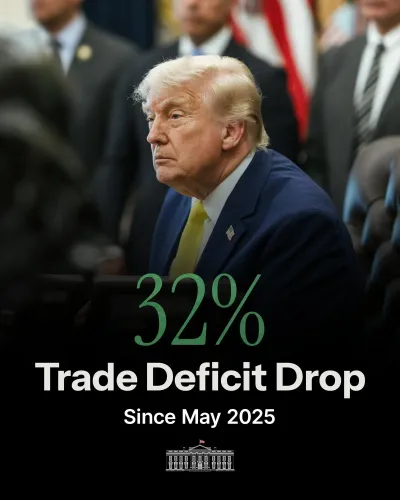
In 2025, the deficit with China dropped by 32 percent, and for the first time since 2000, China is no longer the country with which the U.S. has its largest trade deficit.
Exports also saw a significant increase. Following the initiation of the Agreement on Reciprocal Trade (ART) program, goods and services exports surged by $199.8 billion, or 6.2 percent, reaching a historic $3.4 trillion, according to the document. Capital goods exports rose by 9.9 percent in 2025.
“This isn’t merely talk; the statistics confirm it. America is back,” the agenda asserts.
For 2026, the administration has identified six key priorities: continuing the ART program, enforcing trade laws, securing essential supply chains, reviewing the U.S.–Mexico–Canada Agreement (USMCA), managing relations with China, and advocating for American interests in international settings.
Under the ART program, the U.S. Trade Representative (USTR) has formalized agreements with nations including Argentina, Bangladesh, Cambodia, El Salvador, Guatemala, Indonesia, Malaysia, and Taiwan, while also announcing framework agreements with partners such as India, Japan, South Korea, and the European Union. These agreements necessitate that partners lower tariffs and non-tariff barriers, while the U.S. upholds “a modified tariff on the trading partner.”
The agenda notes that trading partners are eliminating almost all tariffs on U.S. industrial products in some instances, including “India (99 percent for industrial goods)” and the European Union (100 percent for industrial goods).
Regarding China, the document acknowledges “the undeniable costs of over two decades of unrestricted free trade,” stating that the U.S. “lost millions of jobs” following China’s entry into the World Trade Organization in 2001. It mentions that Washington anticipates “ongoing trade with China” but will pursue arrangements “based on reciprocity and balance.” The agreement struck by Trump and President Xi Jinping in Busan in October 2025 is characterized as “the first step in that direction.”
The agenda further calls for reshoring critical industries. Citing Secretary of War Pete Hegseth, it states that the U.S. will orient “our industrial base to a wartime footing” and negotiate a new Agreement on Trade in Critical Minerals with allied partners.
In North America, the administration is set to conduct a 2026 joint review of USMCA, cautioning that renewal will be recommended “only if such resolution can be achieved” on pending disputes.
The document concludes that “our current international economic situation necessitates policy changes and resisting the tendency to revert to the previous status quo,” invoking President Abraham Lincoln’s call to “think anew, and act anew.”
Point of View
This trade policy reflects a decisive shift towards prioritizing domestic manufacturing and ensuring economic stability. The administration's focus on tariffs and renegotiated agreements seeks to restore balance in international trade, emphasizing a nation-first approach that resonates with many Americans.
NationPress
20 Sept 2026
Frequently Asked Questions
What is the main goal of the 2026 Trade Policy Agenda?
The main goal is to reduce America’s trade deficit through increased tariffs, enforcement of trade laws, and renegotiation of key agreements.
How has the trade deficit changed recently?
The goods trade deficit has decreased year over year since April 2025, with a notable 32% reduction in the deficit with China in 2025.
What are the six priorities outlined for 2026?
The six priorities include continuing the ART program, enforcing trade laws, securing supply chains, reviewing USMCA, managing trade with China, and promoting American interests internationally.
What is the ART program?
The Agreement on Reciprocal Trade (ART) program facilitates agreements with various countries to lower tariffs and barriers while maintaining modified tariffs on U.S. goods.
What does the agenda say about trade with China?
The agenda acknowledges the costs of past free trade with China and emphasizes a future approach based on reciprocity and balance.