Trump Maintains Military Strike Readiness Against Iran as Deadline Approaches
Synopsis
US President Donald Trump remains resolute about a potential military strike on Iran, setting a critical deadline for negotiations. With only hours left, tensions escalate as diplomatic efforts appear stalled, raising concerns about significant geopolitical consequences.
Key Takeaways
Trump is maintaining a firm stance on potential military action against Iran.
A critical deadline has been set for negotiations.
There are mixed signals regarding diplomatic engagement.
Military momentum is affecting the US administration's posture.
The situation remains fluid and dynamic.
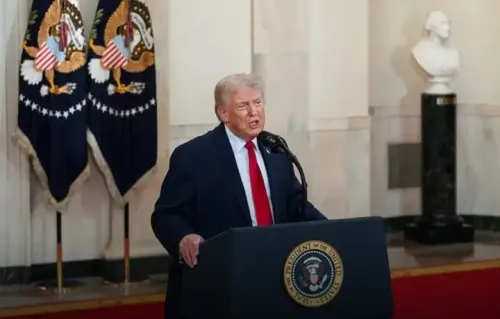
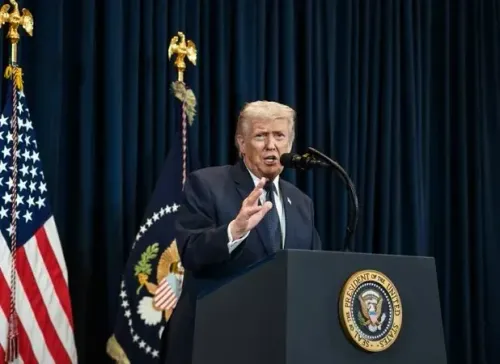
Washington, April 8 (NationPress) US President Donald Trump is firmly committed to plans for a possible military strike against Iran if negotiations fail to progress before a self-imposed deadline. The White House has cautioned that Tehran has mere hours to respond.
Fox News anchor Bret Baier, referencing a direct dialogue with Trump, reported on Tuesday that the President emphasized that "8 p.m. (Eastern Time) is crucial," and warned that if discussions do not lead to results, "there will be an attack like they've never experienced before."
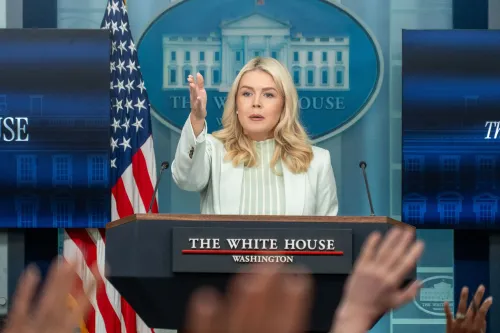
Previously, White House spokesperson Karoline Leavitt informed IANS: "The Iranian regime must reach an agreement with the United States by 8 p.m. Eastern Time. Only the President understands the current state of affairs and what actions he may take."
The dual messages from Trump and the White House highlight a significant escalation in the ongoing crisis surrounding the Strait of Hormuz.
Baier indicated that the US President stated that while a breakthrough in negotiations could change the trajectory, "at this moment, he remains steadfast in his plans."
Previously, US forces had already targeted military locations in Iran, and Trump intensified his rhetoric with a stark caution of severe consequences.
Trump warned that "a whole civilization could perish tonight, never to return" if further actions are taken against vital infrastructure.
The US administration has not ruled out diplomatic avenues.
Baier mentioned that Trump suggested, "If negotiations advance today and yield something concrete, that could lead to a change."
Nonetheless, uncertainty persists regarding whether genuine engagement is occurring.
While some US officials noted ongoing discussions, reports suggested that Iran may have ceased negotiations.
According to information shared during the broadcast, Iran had "terminated diplomacy with the United States," although the situation remains dynamic.
Trump himself highlighted the importance of the moment, stating that "we will discover the outcome tonight," and described Iran's decision on negotiations as "one of the most significant moments in the long and intricate history of the world."
The developments have sparked intense reactions across US media and policy discussions.
The threat dominated cable news, with some analysts cautioning about the implications of such rhetoric. One commentator labeled the US President as "threatening a war crime" and referred to the statement as "a remarkable escalation."
Concurrently, there were tentative indications of diplomatic movement.
Reports suggested that Iran had released two French nationals who had been detained for years, raising hopes that backchannel discussions could still yield results.
Baier pointed out internal uncertainty within Iran's leadership as a complicating factor.
"There is a significant question: who is in control and making decisions in Iran?" he remarked, emphasizing challenges in communication and authority.
He added that military momentum, including a recent rescue operation, might be influencing the administration's stance.
"There is a sentiment that military momentum is building. The US President senses that," Baier concluded.
Point of View
The current situation underscores the precarious balance between military readiness and diplomatic negotiations. With influential figures at the helm, the stakes are high, and the potential for conflict is palpable. As developments unfold, the focus must remain on achieving a peaceful resolution.
NationPress
19 Sept 2026
Frequently Asked Questions
What is the deadline set by Trump for Iran?
President Trump has set a deadline of 8 p.m. Eastern Time for Iran to engage in negotiations.
What are the potential consequences if Iran does not respond?
Trump has warned of a military strike that could have unprecedented consequences for Iran.
Have there been any recent developments in US-Iran negotiations?
While there were hopes of diplomatic movement, reports suggest that Iran may have halted negotiations.
What did Trump say about the implications of this situation?
Trump described Iran's decision on negotiations as one of the most significant moments in history.
What reactions have emerged within US media regarding Trump's statements?
Reactions have varied, with some commentators warning that Trump's rhetoric could lead to severe implications.