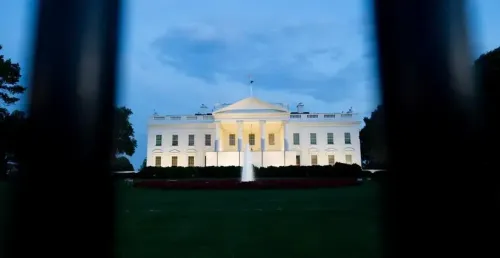
US and Thailand Sign Reciprocal Trade Agreement
Synopsis
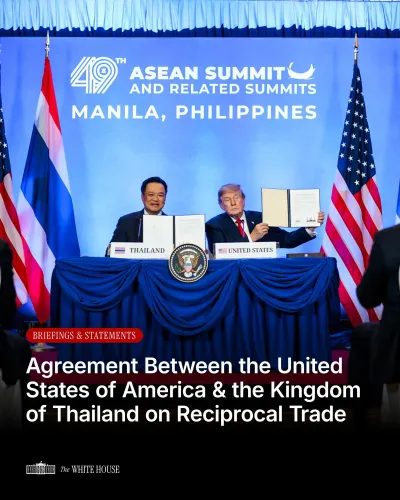
The United States and the Kingdom of Thailand formalised a reciprocal trade agreement on November 17, 2026, as announced in a White House joint statement — reviving talks stalled since 2006 and targeting tariff imbalances in one of Washington's key Southeast Asian alliances.
Key Takeaways
The United States and the Kingdom of Thailand signed a reciprocal trade agreement on November 17, 2026 , formalised through a White House joint statement.
US-Thailand free trade negotiations were originally launched in 2004 and suspended in 2006 without a concluded deal.
Thailand is a major US trading partner in ASEAN , with key exports including electronics, automobiles, and agricultural products.
The 'reciprocal' framework targets symmetrical tariff concessions and market-access improvements for both US exporters and Thai manufacturers .
Implementation timelines, specific tariff schedules, and potential US Congressional or Thai parliamentary approval requirements remain to be detailed.
The deal fits a broader US pattern of reinforcing bilateral economic ties across Southeast Asia to deepen supply-chain resilience and strategic presence.
A new chapter in US-Thailand economic ties opened on Tuesday, November 17, 2026, as the two countries formalised a bilateral reciprocal trade agreement — a deal that closes a negotiation arc stretching back more than two decades and reshapes commercial access across one of Southeast Asia's most dynamic corridors.
Two Decades in the Making
The road to this agreement was anything but straight. The United States and the Kingdom of Thailand first launched free trade agreement talks in 2004, only to suspend them in 2006 without a deal. What was left behind was a framework of goodwill, an existing treaty-ally relationship, and a trade relationship that kept growing in the absence of a formal pact. The November 2026 joint statement, published on the White House briefings portal, signals that both governments decided the gap was finally worth closing.
Thailand is no peripheral partner. As a central node in ASEAN, it exports electronics, automobiles, and agricultural goods to the US in significant volumes, while American manufacturers have long eyed the Thai market for greater access. A reciprocal arrangement directly targets the tariff imbalances and market-access barriers that have frustrated exporters on both sides.
What 'Reciprocal' Actually Means Here
The word 'reciprocal' carries deliberate political weight in the current Washington trade vocabulary. It signals a move away from one-sided concessions toward symmetrical commitments — lower tariffs in exchange for lower tariffs, open shelves for open shelves. For US exporters in agriculture and manufactured goods, that framing promises concrete gains. For Thai manufacturers — particularly in electronics and auto parts — it offers more predictable access to the world's largest consumer market.
The specific tariff schedules, phase-in timelines, and any carve-outs will be the real measure of ambition. Watch closely for whether the agreement requires ratification by the US Congress or Thailand's parliament, a step that historically introduces delay and amendment risk.
Southeast Asia's Strategic Calculus
The timing is not incidental. The United States has been systematically reinforcing bilateral economic architecture across Southeast Asia, partly to deepen supply-chain resilience and partly to maintain strategic relevance in a region where other large economies compete for influence. Thailand's geography — bridging mainland and maritime Southeast Asia — makes it a logical anchor for such a strategy. A functioning reciprocal trade deal with Bangkok adds economic mortar to an alliance that has sometimes been more symbolic than substantive.
For India, watching from the other side of the Bay of Bengal, the US-Thailand deal is a data point in a broader pattern: Washington is willing to do bilateral deals when the political moment aligns, and New Delhi's own trade negotiations with the US remain an open question on that same ledger.
The joint statement is the starting gun — the sprint through implementation details, legislative calendars, and business adaptation begins now.
Point of View
Closing a negotiating gap that opened two decades ago. By framing the deal as 'reciprocal,' the White House signals a continued preference for symmetrical market-access arrangements over traditional preferential trade models — a posture with direct implications for other pending Asian trade negotiations. For the broader Indo-Pacific economic architecture, the deal adds a bilateral building block at a moment when multilateral frameworks have struggled to gain traction. India, with its own unresolved trade dialogue with Washington, will be watching the ambition and speed of implementation as a benchmark.
NationPress
17 Nov 2026
Frequently Asked Questions
What is the US-Thailand reciprocal trade agreement?
It is a bilateral trade agreement between the United States and the Kingdom of Thailand, announced on November 17, 2026, designed to create symmetrical tariff concessions and improved market access for exporters and manufacturers on both sides.
When did US-Thailand trade negotiations begin?
The United States and Thailand first launched free trade agreement negotiations in 2004, but those talks were suspended in 2006 without a concluded deal, leaving the two countries without a formal trade pact for two decades.
What goods does Thailand export to the United States?
Thailand is a significant exporter of electronics, automobiles and auto parts, and agricultural products to the United States, making it one of Washington's most important trading partners within ASEAN.
Will the US-Thailand trade deal need approval from the US Congress?
The specific legislative pathway has not yet been detailed. Bilateral trade agreements of this scope typically require congressional authorisation or ratification in the United States, a process that can introduce delays and amendments.
What does the US-Thailand deal mean for India?
For India, the agreement is a signal that Washington is prepared to finalise bilateral reciprocal trade deals with Asian partners when political conditions align, adding urgency to India's own ongoing trade dialogue with the United States.