US and Japan Initiate $100 Billion Strategic Partnership
Synopsis
The United States and Japan are launching a transformative $100 billion investment initiative aimed at enhancing energy, infrastructure, and defense cooperation, marking a pivotal moment in their strategic alliance within the Indo-Pacific region.
Key Takeaways
US and Japan unveil a $100 billion investment initiative.
Focus on energy, infrastructure, and defense cooperation.
Significant Japanese investments in US energy projects.
Joint research on critical minerals and technology collaboration.
Commitment to regional security and stability in the Indo-Pacific .
Washington, March 20 (NationPress) The United States and Japan have unveiled a significant initiative, committing over $100 billion towards energy and infrastructure enhancements, in addition to new defensive and supply chain strategies. This move signals a more pronounced strategic partnership in the Indo-Pacific region.
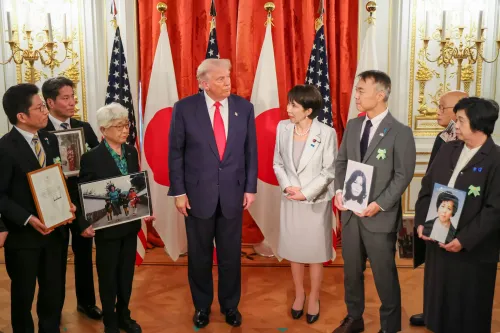
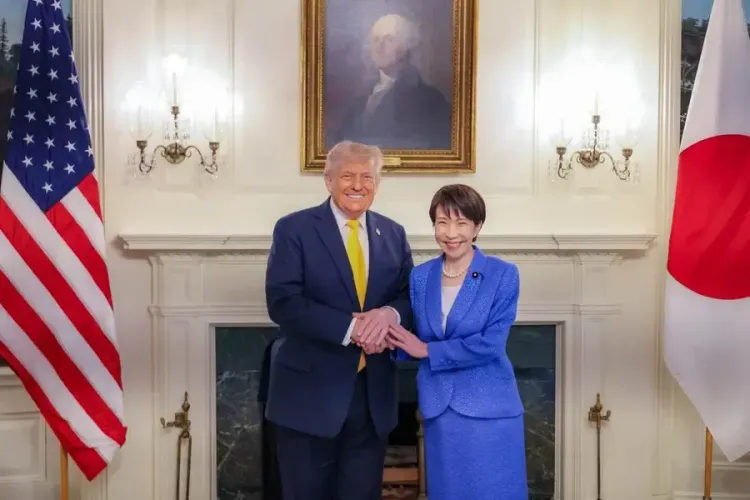
In a meeting at the White House, President Donald Trump and Prime Minister Sanae Takaichi outlined a comprehensive array of initiatives aimed at fortifying the US-Japan alliance, enhancing economic security, and strengthening deterrence across the region.
A central element of this announcement is the substantial increase in Japanese investments within the United States. Following an earlier investment of $36 billion, a new phase includes up to $40 billion for small modular reactor projects in Tennessee and Alabama, as well as up to $33 billion for natural gas generation facilities in Pennsylvania and Texas.
The joint statement emphasized that deploying advanced reactors would act as a “next-generation stable power source,” helping to stabilize electricity prices for Americans while bolstering Japan-US leadership in global technological competition.
Furthermore, both nations agreed to enhance cooperation on supply chains, particularly concerning critical minerals. A new action plan has been established to boost production and diversify sources for essential inputs in strategic industries.
Ambassador Jamieson Greer remarked that this initiative would “broaden the production and diversity of critical minerals, establishing the groundwork for a binding plurilateral agreement supported by price floors and additional measures.”
Both countries will also expedite joint research on deep-sea mineral resources, including rare-earth deposits located near Japan’s Minamitorishima Island, which could fulfill long-term industrial needs.
On the economic front, the United States will enhance market access for agricultural exports to Japan and will prioritize visa processing for business travelers who “make substantial investments, train American workers, or transfer vital skills, techniques, or expertise.”
Technology and innovation were key themes during the discussions. Agreements were made to augment collaboration in artificial intelligence, quantum technologies, and high-performance computing, involving both government entities and private sector partners.
In the realm of space exploration, Japan is set to support NASA’s Artemis programme through the provision of a crewed lunar rover. Additionally, both sides intend to broaden their collaboration in low Earth orbit and future lunar missions.
Defense cooperation was another major emphasis of the talks. The United States welcomed Japan’s pledge to increase defense expenditures and enhance its military capabilities. Both nations will expand missile defense collaboration and boost production of critical systems.
They will also build on the deployment of advanced capabilities within Japan to support what they termed a “strong denial defense posture.” Plans include increasing production of Standard Missile-3 systems and exploring co-production of advanced air-to-air missiles.
Regarding regional security, the leaders reaffirmed their commitment to “peace and stability across the Taiwan Strait” and opposed any unilateral attempts to alter the status quo. They reiterated their dedication to the “complete denuclearization of North Korea.”
Separately, a bipartisan group of US senators introduced a resolution welcoming Takaichi’s visit. Senator Jeanne Shaheen emphasized that the alliance remains “a cornerstone of peace, stability, and economic prosperity in the Indo-Pacific,” while Senator Bill Hagerty described the partnership as entering a “new ‘golden age’ of national security, economic security, and energy security.”
Point of View
I view this announcement as a crucial step towards strengthening alliances in the Indo-Pacific. The commitment of over $100 billion reflects a proactive approach to enhancing both economic and security dynamics, crucial for maintaining stability in a rapidly evolving geopolitical landscape.
NationPress
22 Sept 2026
Frequently Asked Questions
What is the main focus of the US-Japan partnership?
The partnership mainly focuses on energy and infrastructure investments, defense cooperation, and supply chain security.
How much investment is being made by Japan in the US?
Japan is committing over $100 billion, which includes significant investments in energy projects and infrastructure.
What technologies will the US and Japan collaborate on?
They will collaborate on artificial intelligence, quantum technologies, and high-performance computing.
What are the implications for regional security?
The partnership aims to enhance peace and stability in the Indo-Pacific, particularly concerning the Taiwan Strait and North Korea.
How will this partnership affect agricultural exports?
The United States plans to improve market access for agricultural exports to Japan as part of the partnership.