White House marks 43rd anniversary of 1983 Beirut bombing
Synopsis
The White House marked the 43rd anniversary of the October 23, 1983 Beirut barracks bombing that killed 241 Americans, honouring the fallen while drawing a direct line between Hezbollah's Iran-backed attack and the Trump administration's ongoing confrontation with Tehran.
Key Takeaways
On October 23, 1983 , a Hezbollah suicide bombing killed 241 U.S. service members in Beirut — the deadliest terror attack against Americans before 9/11.
The White House marked the 43rd anniversary on October 23, 2026, honouring the sacrifice and calling the attack 'directed, financed and ordered' by Iran.
U.S. policy has consistently attributed Hezbollah operations to Iranian state sponsorship since the 1980s, backed by federal court rulings.
The Trump administration pursued a 'maximum-pressure' sanctions campaign against Iran, including withdrawal from the JCPOA in 2018 and the 2020 Soleimani strike.
The post links a four-decade-old attack to contemporary U.S.-Iran tensions, framing current Iran policy as a continuation of the same confrontation.
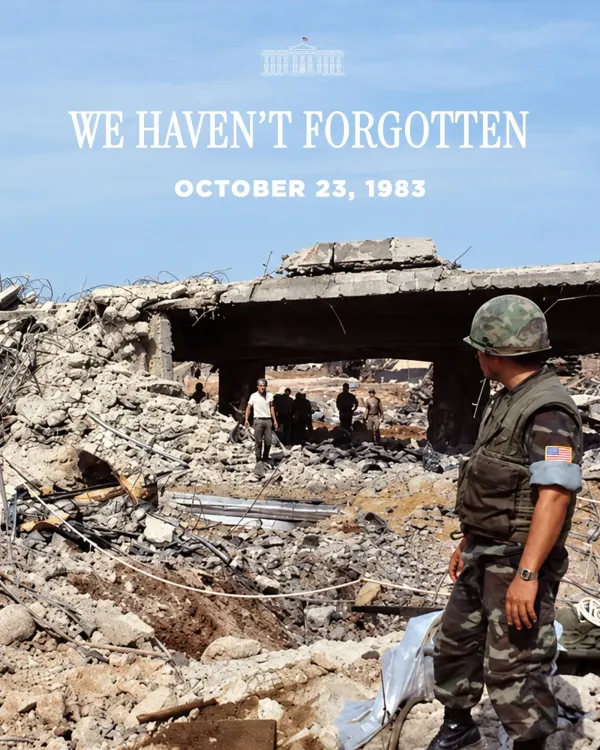
Forty-three years after a suicide truck bomb tore through the U.S. Marine barracks in Beirut, Lebanon, the White House paused on Friday, October 23, 2026 to honour the 241 Americans killed in what remains one of the deadliest single-day losses for U.S. forces since World War II — and used the anniversary to draw a direct line between that 1983 massacre and the Iranian regime it holds responsible today.
The morning of October 23, 1983 — what happened in Beirut
Shortly before dawn on October 23, 1983, a Mercedes truck loaded with explosives equivalent to roughly 12,000 pounds of TNT drove into the lobby of the building housing the 24th Marine Amphibious Unit at Beirut International Airport. The blast collapsed the four-storey structure, killing 241 U.S. service members — 220 Marines, 18 Navy sailors, and 3 Army soldiers — who were deployed as part of the Multinational Force in Lebanon peacekeeping mission amid a grinding civil war. A near-simultaneous bombing struck the French paratroopers' barracks, killing 58 French soldiers. It was the single deadliest terrorist attack against Americans until September 11, 2001.
The White House post stated plainly: 'The attack was directed, financed and ordered by the same evil Iranian regime that President Trump is fighting today.' U.S. intelligence assessments and federal court rulings have for decades attributed the bombing to Hezbollah — the Lebanese Shia militant organisation founded in the early 1980s — acting with Iranian direction and financing. The Islamic Republic of Iran has consistently denied direct involvement.
Hezbollah, Iran, and four decades of U.S. attribution
The United States designated Hezbollah a foreign terrorist organisation and has maintained that Iran's Islamic Revolutionary Guard Corps provided the operational direction and resources behind the 1983 attack. Federal courts in the U.S. have upheld lawsuits by survivors and families, finding Iran liable and awarding billions of dollars in judgements — judgements that have largely gone uncollected.
The broader pattern of U.S. policy treating Hezbollah as an Iranian proxy has persisted across administrations of both parties. During President Trump's first term (2017–2021), Washington withdrew from the Joint Comprehensive Plan of Action (JCPOA) in 2018 and reimposed sweeping economic sanctions on Tehran under a 'maximum-pressure' strategy. The January 2020 strike that killed IRGC Quds Force commander Qassem Soleimani was framed in the same Iran-accountability doctrine the White House invoked again on Friday.
Why this anniversary carries weight in 2026
Tribute posts on significant military anniversaries are routine — but the language chosen here is not. By explicitly linking a 43-year-old attack to ongoing U.S. confrontation with Iran, the White House is doing two things at once: honouring fallen service members and publicly framing current Iran policy as the continuation of a fight that began in the Reagan era. For the families of the 241 Americans lost that Sunday morning in Beirut, the acknowledgement is a solemn ritual; for Washington's Iran policy architects, it is a statement of continuity.
The sacrifice of those Marines, sailors, and soldiers in Beirut reshaped U.S. force-protection doctrine, accelerated the debate over peacekeeping commitments in the Middle East, and set the template for how America frames state-sponsored terrorism. Their names — carved into a memorial at Camp Lejeune, North Carolina — are read aloud every year on this date.
Point of View
Signalling that the administration views its confrontation with Tehran as a long arc stretching back to 1983 rather than a product of recent tensions. This framing serves both domestic and diplomatic audiences: it grounds maximum-pressure Iran policy in bipartisan historical memory and reinforces the designation of Hezbollah as an instrument of Iranian statecraft. For U.S. allies in the Gulf and Israel, the message is one of strategic continuity; for Tehran, it is a reminder that the accountability framing has not softened. The anniversary ritual, weaponised as a policy signal, is a well-worn tool in Washington's Iran playbook.
NationPress
24 Oct 2026
Frequently Asked Questions
What happened in the 1983 Beirut barracks bombing?
On October 23, 1983, a Hezbollah suicide truck bomber drove into the U.S. Marine barracks at Beirut International Airport, killing 241 American service members — 220 Marines, 18 Navy sailors, and 3 Army soldiers — who were deployed as peacekeepers during Lebanon's civil war.
Who was responsible for the 1983 Beirut bombing?
U.S. intelligence agencies and federal courts have attributed the bombing to Hezbollah, acting under the direction and financing of Iran's government. Iran has consistently denied direct involvement.
Why did the White House post about the Beirut bombing in 2026?
October 23, 2026 marks the 43rd anniversary of the attack. The White House used the occasion to honour the 241 Americans killed while also connecting the historical attack to its current confrontation with the Iranian regime.
What is the U.S. maximum-pressure policy on Iran?
Maximum pressure is the Trump administration's Iran strategy, centred on sweeping economic sanctions reimposed after the U.S. withdrew from the JCPOA nuclear deal in 2018, combined with financial and diplomatic measures aimed at curbing Iran's regional influence and missile programme.
How has the 1983 Beirut bombing shaped U.S. military policy?
The bombing fundamentally changed U.S. force-protection doctrine, accelerated a debate about peacekeeping commitments in the Middle East, and established the framework for how the U.S. legally and politically classifies state-sponsored terrorism — a framework still invoked today.