White House Backs $4.2B Nuclear Boost for Ohio, Pennsylvania
Synopsis
The White House has amplified a U.S. Department of Energy announcement committing $4.2 billion to boost three nuclear power plants in Ohio and Pennsylvania, reinforcing Washington's bet on existing large reactors as a clean, reliable energy backbone amid surging electricity demand.
Key Takeaways
Department of Energy announced $4.2 billion in funding directed at three nuclear power plants in Ohio and Pennsylvania .
The White House officially amplified the announcement on October 6, 2026 , signalling executive-level priority for the investment.
The funding is aimed at sustaining or upgrading existing large reactors — not waiting for next-generation technology — to protect carbon-free baseload electricity supply.
Ohio and Pennsylvania are among the most energy-intensive industrial states in the U.S., making nuclear reliability a high-stakes economic and political issue in both.
The move reflects a broader federal pivot toward keeping ageing nuclear fleets operational as AI-driven data-centre demand and extreme weather strain power grids.
For global nuclear markets, including U.S.-India civilian nuclear cooperation, a reinvigorated American nuclear sector carries diplomatic and commercial significance.
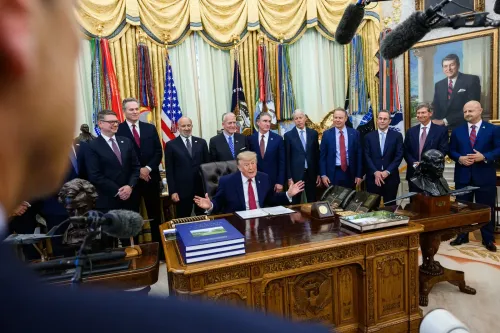
America's nuclear future just got a multibillion-dollar injection. The White House on Tuesday, October 6, 2026, amplified an announcement by the U.S. Department of Energy confirming a $4.2 billion commitment to sustain and strengthen three nuclear power plants in Ohio and Pennsylvania — two of the country's most energy-intensive industrial states.
$4.2 Billion for Nuclear Lifelines in the Rust Belt
The Department of Energy's announcement targets existing nuclear facilities in Ohio and Pennsylvania, two states that together host some of the largest concentrations of industrial energy demand in the United States. At $4.2 billion, the funding represents one of the most significant single federal interventions in civilian nuclear infrastructure in recent memory. Nuclear plants in these states supply reliable, carbon-free baseload power to millions of homes and businesses — the kind of round-the-clock electricity that wind and solar alone cannot yet guarantee.
The investment is framed as a 'boost' — language suggesting the funds are aimed at extending the operational lives of existing reactors, upgrading safety and efficiency systems, or rescuing plants that face economic pressures in competitive electricity markets. Older nuclear units across the Midwest have historically struggled to compete on price against cheap natural gas, making federal support a recurring policy question in Washington.
Why Ohio and Pennsylvania Are the Chosen Battleground
Ohio and Pennsylvania are not incidental choices. Both states sit at the heart of America's manufacturing and energy corridor, and both have seen fierce political battles over nuclear subsidies in the past. Pennsylvania is home to some of the most productive nuclear capacity in the nation. Ohio has a complicated history with nuclear support legislation that drew national scrutiny years ago. Picking these two states signals a deliberate federal effort to anchor nuclear power in precisely the regions where the energy transition debate is most acute and politically consequential.
For Indian observers, the announcement carries significance beyond U.S. borders. American investment in civilian nuclear capacity — particularly in large, established reactor fleets — shapes global nuclear technology norms, fuel cycle markets, and the diplomatic leverage Washington brings to nuclear cooperation agreements, including with partners like India. A more confident U.S. nuclear sector is also a more active one in international markets.
The Bigger Signal: Washington Doubles Down on Existing Reactors
This announcement fits a broader pattern of the U.S. federal government pivoting back toward nuclear as a cornerstone of its clean energy and energy security strategy. Rather than waiting solely for next-generation small modular reactors to come online, policymakers are betting that keeping existing large reactors running is the fastest, cheapest way to protect carbon-free baseload supply. $4.2 billion for three plants is a muscular statement of that bet.
The grid reliability argument is increasingly hard to ignore: as extreme weather strains electricity networks and data-centre demand surges — driven partly by the AI infrastructure boom — dispatchable, always-on power sources like nuclear are being re-evaluated at every level of government.
Three plants. Two states. Four-point-two billion dollars. Washington has placed its chips on the nuclear table — and the clock on those reactors just got reset.
Point of View
The choice of Ohio and Pennsylvania, two swing-state industrial heartlands, is unlikely to be accidental, blending energy security logic with electoral geography. For India, which has long pursued deeper civilian nuclear ties with the United States, a more financially robust and politically confident American nuclear sector could translate into stronger technology-sharing frameworks and more active U.S. participation in India's nuclear expansion plans. The announcement also quietly reinforces the global narrative that nuclear power is no longer a liability to be managed but an asset to be funded.
NationPress
6 Oct 2026
Frequently Asked Questions
Why is the US giving $4.2 billion to nuclear plants in Ohio and Pennsylvania?
The U.S. Department of Energy is directing $4.2 billion to boost three nuclear plants in Ohio and Pennsylvania to extend their operational lives and preserve reliable, carbon-free baseload electricity in two of the country's most energy-intensive states.
Which nuclear plants in Ohio and Pennsylvania are getting the funding?
The White House post does not name the specific plants; the announcement identifies three nuclear facilities across Ohio and Pennsylvania without listing them individually.
What does the US nuclear investment mean for India?
A stronger, better-funded American nuclear sector can accelerate technology-sharing under existing U.S.-India civilian nuclear cooperation agreements and open commercial opportunities for Indian energy planners watching global reactor markets.
Is the US moving away from renewable energy toward nuclear?
The investment signals a complementary strategy — not an either/or choice. Washington is betting that keeping large existing reactors running is the fastest way to secure always-on, carbon-free power while renewables scale up.
How significant is $4.2 billion in U.S. nuclear funding?
For civilian nuclear infrastructure, $4.2 billion directed at just three plants is one of the largest single federal interventions in existing U.S. reactor operations in recent years, underscoring how seriously Washington now treats nuclear energy security.