White House Backs Emmer Push for Minnesota Tax Cut Benefits
Synopsis
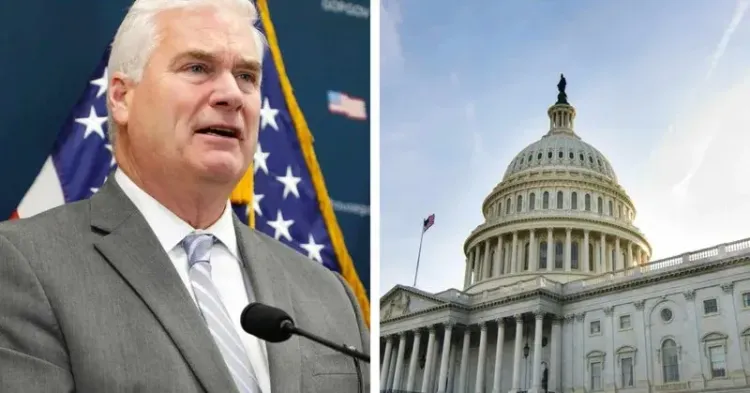
The White House amplified House Majority Whip Tom Emmer's argument that Minnesotans deserve the full benefits of the 'Working Families Tax Cuts' — the individual and family provisions of the 2017 Tax Cuts and Jobs Act — as Congress faces pressure to extend provisions that expired after 2025.
Key Takeaways
The White House reposted House Majority Whip Tom Emmer's statement on 4 July 2026 backing tax-cut benefits for Minnesota residents.
The 'Working Families Tax Cuts' refers to individual provisions of the Tax Cuts and Jobs Act (TCJA) , signed in December 2017 .
Key TCJA individual provisions — including a doubled child tax credit and lower income-tax brackets — were set to expire after 2025 .
Republican lawmakers, including Emmer , have consistently argued that allowing these provisions to lapse amounts to a tax increase on middle-income households.
The White House's amplification signals executive-legislative alignment on pushing for an extension or permanent renewal of the provisions.
Any resolution is expected to come through tax-extension legislation or a Congressional budget reconciliation measure.
The White House on Friday, 4 July 2026 amplified a call by House Majority Whip Tom Emmer arguing that residents of Minnesota deserve the full benefits of what Republicans call the 'Working Families Tax Cuts' — the individual and family provisions of the 2017 Tax Cuts and Jobs Act (TCJA).
Context
Tom Emmer, a Republican congressman representing Minnesota and currently serving as House Majority Whip, has been a consistent advocate for extending the individual tax provisions set in motion by the TCJA. The White House reposted his statement, lending the executive office's platform to the argument that Minnesotans are entitled to the 'full benefits' of those cuts.
The phrase 'Working Families Tax Cuts' refers broadly to TCJA provisions that doubled the child tax credit and lowered individual income-tax brackets — measures that were designed as temporary and are scheduled to expire after 2025, making their extension a live legislative question in 2026.
Policy Backdrop
The Tax Cuts and Jobs Act was signed into law in December 2017 and represented the most sweeping overhaul of the United States federal tax code in decades. Its corporate rate reductions were made permanent, but its individual and family provisions — including expanded child tax credits and lower marginal rates for most income brackets — were written with a sunset clause, expiring after 2025.
With that deadline now passed, Republican lawmakers have framed any failure to extend these provisions as an effective tax increase on middle-income households. Emmer's statement, and the White House's decision to amplify it, fits squarely within that messaging strategy, which has been a recurring Republican position whenever tax-reform or budget reconciliation debates arise in Congress.
Stakeholders and Impact
The primary beneficiaries cited in the post are Minnesotans — a state with a significant middle-income working population — and 'working families' more broadly, the demographic Republicans have consistently highlighted when making the case for the TCJA's individual provisions. A lapse in these provisions would, according to Republican arguments, raise tax burdens for households that benefited from the doubled child tax credit and lower brackets introduced in 2017.
The White House's amplification of Emmer's position signals alignment between the executive and House Republican leadership on the urgency of addressing the post-2025 expiration, and gives the push a higher-profile platform ahead of any legislative action.
What's Next
The central question now is whether Congress will advance tax-extension legislation or include TCJA individual-provision renewals in a budget reconciliation package. House Majority Whip Emmer's public advocacy, backed by the White House, suggests Republican leadership is actively building political pressure for such a move.
If the provisions are not extended or made permanent, millions of American households — including those in Minnesota — could face higher effective tax rates, a scenario both Emmer and the White House appear determined to prevent. The coming months in Washington DC will determine whether that political pressure translates into legislative action.
Point of View
The post personalises what is otherwise an abstract fiscal debate. This fits a broader Republican pattern of framing tax-cut extensions as a defence of working families rather than a policy choice with distributional trade-offs. The move also puts pressure on any wavering lawmakers by making the political cost of inaction visible at the state level.
NationPress
4 Jul 2026
Frequently Asked Questions
What are the Working Families Tax Cuts mentioned by the White House?
The 'Working Families Tax Cuts' is a Republican shorthand for the individual and family provisions of the 2017 Tax Cuts and Jobs Act (TCJA) , which doubled the child tax credit and lowered income-tax brackets for most households. These provisions were temporary and were set to expire after 2025 .
Who is Tom Emmer and why is he pushing for these tax cuts?
Tom Emmer is a Republican U.S. Representative from Minnesota serving as House Majority Whip . He has been a consistent advocate for extending the TCJA's individual provisions, arguing they benefit middle-income families in his state and across the country.
Why did the TCJA individual provisions expire after 2025?
When the Tax Cuts and Jobs Act was passed in December 2017 , its corporate tax rate cuts were made permanent, but its individual and family provisions were written with a sunset clause to limit the legislation's projected long-term cost, causing them to expire after 2025 .
What happens if the Working Families Tax Cuts are not extended?
If Congress does not extend or make permanent the TCJA's individual provisions, households that benefited from the doubled child tax credit and lower income-tax brackets — including those in Minnesota — would effectively face higher federal tax burdens.
What is the White House's role in the tax-cut extension debate?
By reposting Emmer's statement, the White House is lending the executive office's platform to Republican calls for extending the TCJA's individual provisions, signalling alignment between the administration and House Republican leadership ahead of potential legislative action.