White House Touts Historic Defense Industrial Base Investments
Synopsis
The White House on 16 July 2026 invoked Reagan's 'Peace Through Strength' doctrine to announce historic investments in America's defense industrial base, pledging to keep the country strong and protected for generations. The move signals a major push to onshore military production amid competition with China and global supply-chain pressures.
Key Takeaways
The White House on 16 July 2026 announced 'historic investments' to expand the US Defense Industrial Base .
The announcement invokes the Reagan-era 'Peace Through Strength' doctrine, signalling ideological continuity with Cold War-era deterrence strategy.
The Defense Industrial Base is the domestic network of manufacturers and suppliers producing military equipment; successive administrations have flagged critical vulnerabilities in it.
Key sectors expected to benefit include munitions production, shipbuilding, and hypersonic component manufacturing .
For India , a closer US defence industrial base could strengthen co-production and technology-transfer pipelines under existing bilateral frameworks.
Congressional markups of the next NDAA will determine whether the announced investments translate into funded, binding programmes.
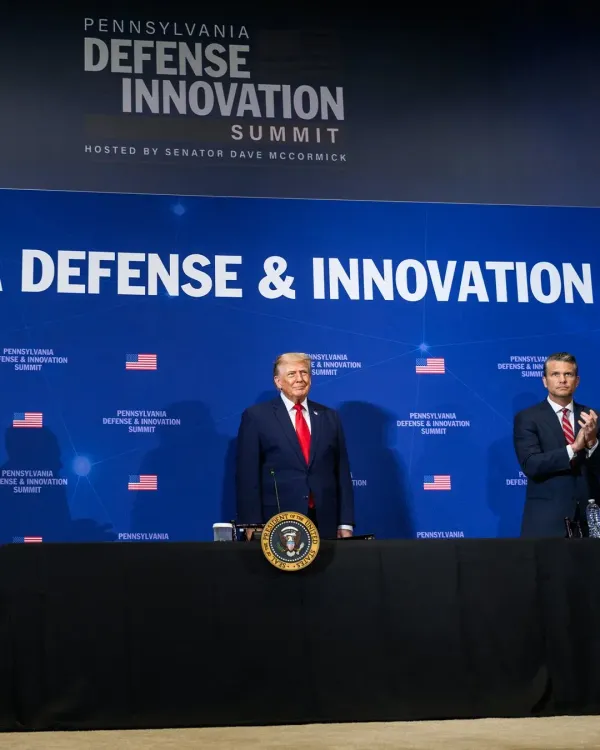
The White House on Thursday, 16 July 2026 announced what it described as 'historic investments' to expand America's defense industrial base, framing the push under the Reagan-era doctrine of 'Peace Through Strength' and pledging to keep the country 'strong, safe, and protected for generations to come.'
Context
The phrase 'Peace Through Strength' carries deep ideological weight in American conservative politics. It was the central pillar of President Ronald Reagan's military build-up during the 1980s, when Washington sharply increased defence spending to deter Soviet influence during the Cold War. Its invocation now signals a deliberate continuity with that tradition of deterrence-through-capability.
The Defense Industrial Base (DIB) refers to the domestic network of manufacturers, suppliers, and facilities that produce military equipment — from munitions and warships to semiconductors and aircraft. Successive administrations have flagged vulnerabilities in this network, particularly as supply-chain disruptions and competition with China exposed dependencies on foreign production.
Policy Backdrop
Since the 2010s, US policy has placed renewed emphasis on 'onshoring' defence production — rebuilding domestic capacity that eroded after the post-Cold War drawdown. Annual National Defense Authorization Acts (NDAAs) have repeatedly included provisions directing investment in manufacturing resilience, munitions stockpiles, and shipbuilding yards.
The US Department of Defense has in recent years flagged critical shortfalls in artillery shell production, hypersonic components, and naval vessel construction — gaps that have become more visible in the context of sustained military-aid commitments abroad. The investments referenced in the 16 July 2026 announcement appear aimed at addressing precisely these structural gaps, though specific programme details have not been independently confirmed.
Stakeholders and Impact
The primary beneficiaries of any DIB expansion are US defence contractors — large primes as well as smaller sub-tier suppliers — alongside the US Armed Forces, which depend on a robust industrial base for sustained readiness. Workers in manufacturing-heavy states with major defence facilities also stand to gain from expanded production orders.
For India, a major defence partner of the United States under frameworks such as the Defence Technology and Trade Initiative (DTTI) and the iCET technology partnership, a stronger American industrial base can translate into more reliable co-production pipelines and technology-transfer arrangements. Indian defence planners watch shifts in Washington's industrial posture closely, given New Delhi's own push to reduce import dependence under the 'Atmanirbhar Bharat' defence manufacturing drive.
What's Next
Congressional markups of the next NDAA and the FY defence budget will be the key legislative tests for whether the announced investments translate into funded programmes, new contracting authorities, or tax incentives targeting munitions and shipbuilding sectors. Analysts will also watch for executive orders or procurement directives that operationalise the 'historic investments' language used in the post.
As Washington deepens its industrial-base commitments, allied nations — including India — may find both new co-production opportunities and heightened expectations to contribute to collective deterrence. The trajectory of this build-up will shape the global defence supply chain well into the next decade.
Point of View
The announcement places defence industrial policy at the heart of national-security strategy, a posture that echoes the Reagan build-up but is calibrated for a multipolar world defined by US-China competition. For India, this matters: a more robust American industrial base is both a potential co-production opportunity and a signal that Washington expects partners to raise their own defence-manufacturing ambitions. The broader arc points toward a prolonged period of allied industrial alignment, with procurement, supply chains, and technology-sharing becoming as strategically important as troop deployments.
NationPress
15 Oct 2026
Frequently Asked Questions
What is 'Peace Through Strength' and why is the White House using it?
'Peace Through Strength' is a doctrine associated with President Ronald Reagan , who used it to justify a major US military build-up in the 1980s to deter the Soviet Union. The White House is invoking it in 2026 to signal that robust military capacity — including a strong domestic defence industrial base — is the surest guarantee of national security and global stability.
What is the US Defense Industrial Base?
The US Defense Industrial Base (DIB) is the domestic network of manufacturers, suppliers, and facilities that produce military hardware and technology — from warships and aircraft to munitions and semiconductors. It is overseen in coordination with the US Department of Defense and has been a focus of policy attention due to supply-chain vulnerabilities exposed by global disruptions and competition with China .
How does the US defense industrial base expansion affect India?
India is a major US defence partner under frameworks such as the Defence Technology and Trade Initiative and the iCET technology partnership. A stronger American industrial base can open new co-production and technology-transfer opportunities for Indian defence manufacturers, and may also raise expectations for India to deepen its own 'Atmanirbhar Bharat' defence manufacturing capacity.
What legislation governs US defense industrial base investment?
The primary legislative vehicle is the annual National Defense Authorization Act (NDAA) , which sets policy and funding authorities for the US Department of Defense . Recent NDAAs have included specific provisions to boost domestic munitions production, shipbuilding, and supply-chain resilience.
What should I watch for next on US defense industrial investment?
The key indicators to watch are Congressional markups of the next NDAA , the FY defence budget request , and any executive orders or procurement directives that translate the 'historic investments' announcement into specific funded programmes — particularly in munitions, shipbuilding, and advanced technology sectors.