Punjab CM Mann extends ₹80,000 subsidy for mushroom units
Synopsis
The Punjab Government under CM Bhagwant Mann is subsidising up to ₹80,000 of a ₹2 lakh mushroom production unit cost for farmers, aiming to drive crop diversification, conserve groundwater and boost rural incomes through a low-land, low-water enterprise.
Key Takeaways
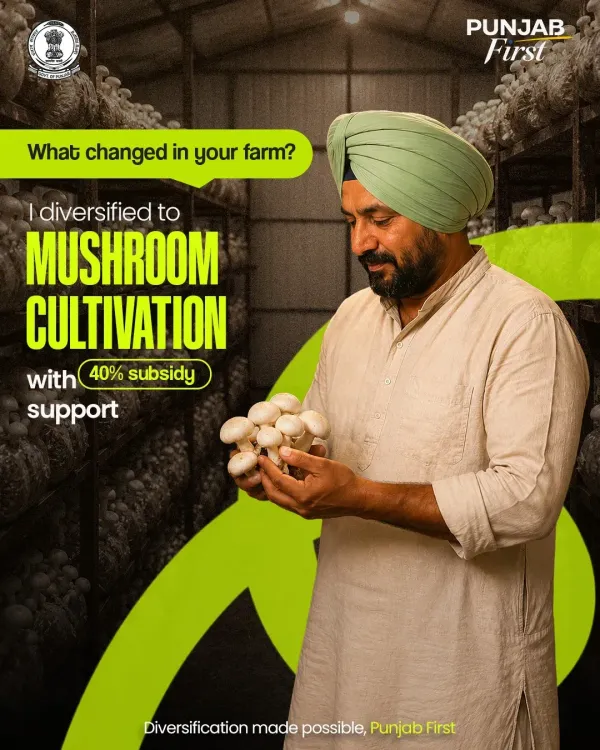
The Punjab Government is offering a subsidy of up to ₹80,000 per mushroom production unit, covering 40 per cent of the ₹2 lakh benchmark investment.
The scheme targets crop diversification away from the water-intensive wheat-paddy rotation that strains Punjab 's groundwater reserves.
Mushroom cultivation is highlighted for requiring limited land and water, making it viable for small and marginal farmers.
The initiative is part of a broader series of alternative-crop subsidies introduced by the Aam Aadmi Party government since March 2022 .
Impact will depend on the agriculture department's ability to process applications and disburse funds efficiently.
State budget allocations and unit-commissioning data in the next fiscal year will indicate the programme's early scale and success.
The Chief Minister's Office of Punjab announced on Thursday, 16 July 2026 that the Punjab Government, under the leadership of Chief Minister Bhagwant Mann, is offering a subsidy of up to ₹80,000 to farmers who establish mushroom production units requiring a total investment of ₹2 lakh.
Context
The announcement positions mushroom cultivation as a low-input, high-return alternative to the wheat-paddy rotation that dominates Punjab's agricultural landscape. The official post noted that mushroom farming 'requires limited land and water resources,' making it accessible even to small and marginal landholders who lack the acreage or groundwater access needed for conventional crops.
The subsidy effectively covers 40 per cent of the benchmark unit cost, lowering the financial threshold for farmers willing to diversify. The government framed the scheme as enabling 'higher returns with minimal investment.'
Policy Backdrop
Punjab has grappled for over a decade with acute groundwater depletion driven by paddy cultivation, which is heavily water-intensive. Successive state governments have introduced crop-diversification incentives since the early 2010s, but adoption of alternative crops has remained limited, partly because entry costs and market uncertainties deter risk-averse farmers.
Since coming to power in March 2022, the Aam Aadmi Party government led by Bhagwant Mann has rolled out a series of input subsidies and alternative-crop incentives aimed at reducing the state's dependence on the paddy-wheat cycle. Mushroom cultivation fits within a broader basket of low-water enterprises — alongside beekeeping and horticulture — that state policy has sought to promote in alignment with central crop-diversification guidelines.
The scheme aligns with a structural imperative: stagnant farmer incomes and dwindling water tables have made the status quo increasingly unsustainable for Punjab's agricultural economy.
Stakeholders and Impact
The primary beneficiaries are Punjab's small and marginal farmers, for whom a subsidy of ₹80,000 on a ₹2 lakh unit can meaningfully reduce the capital barrier to entry. Mushroom cultivation does not require large tracts of land, which makes it particularly suited to households with fragmented or small landholdings.
Agricultural economists have long argued that diversification away from paddy is essential not just for farmer incomes but for the long-term viability of Punjab's water table. A successful uptake of this scheme could reduce pressure on groundwater while opening new income streams for rural households.
The state agriculture department will be a key implementing agency, and the scale of actual impact will depend on how effectively it reaches intended beneficiaries, processes applications and disburses funds.
What's Next
Observers will watch for the agriculture department's reports on applications received and production units commissioned in the coming months. Any supplementary budget allocation in the next fiscal year would signal the government's assessment of the scheme's early traction.
If uptake is strong, the Punjab Government may be expected to scale the programme or extend similar subsidies to other low-water horticultural enterprises, deepening its agricultural diversification push ahead of the next state budget cycle.
Point of View
A politically safer route than coercive restrictions on paddy. For the AAP government, the scheme serves a dual purpose: it addresses the structural groundwater crisis while generating a visible, farmer-friendly welfare narrative ahead of future electoral cycles. The 40 per cent subsidy rate is calibrated to be meaningful without fully eliminating market risk, which in theory encourages only those farmers with genuine intent to diversify. Whether this translates into measurable acreage shifts away from paddy will be the real test of the policy's depth beyond its announcement value.
NationPress
16 Jul 2026
Frequently Asked Questions
What is the Punjab mushroom farming subsidy in 2026?
The Punjab Government is offering farmers a subsidy of up to ₹80,000 to establish a mushroom production unit that costs ₹2 lakh in total investment, effectively covering 40 per cent of the unit cost.
Who is eligible for the Punjab mushroom cultivation subsidy?
The scheme targets Punjab farmers, particularly small and marginal landholders. Exact eligibility conditions and the application process are to be confirmed through the state agriculture department, as detailed disbursement rules have not been publicly specified.
Why is Punjab promoting mushroom farming?
Punjab's agriculture is heavily dependent on water-intensive paddy cultivation, which has led to serious groundwater depletion. Mushroom farming requires limited land and water, making it an attractive low-input alternative that can also improve farmer incomes.
How does the mushroom subsidy fit into Punjab's crop diversification policy?
It is part of a broader push by the Aam Aadmi Party government since 2022 to reduce paddy area and encourage low-water crops such as mushrooms, beekeeping and horticulture through targeted input subsidies aligned with central diversification guidelines.
What is the total investment needed to set up a mushroom unit in Punjab?
According to the Chief Minister's Office, the benchmark investment for establishing a mushroom production unit is ₹2 lakh, of which the state government subsidises up to ₹80,000.