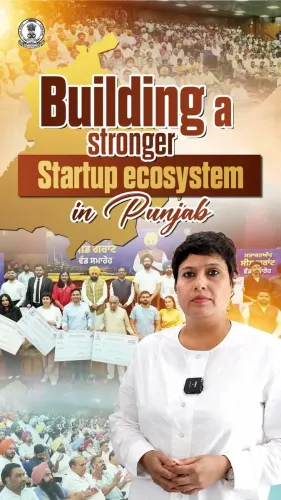
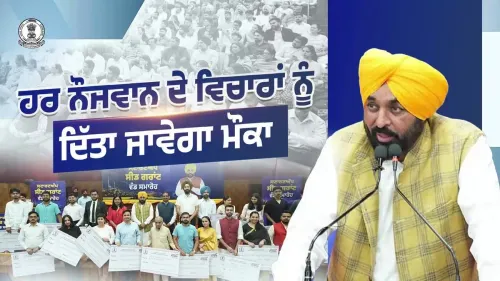
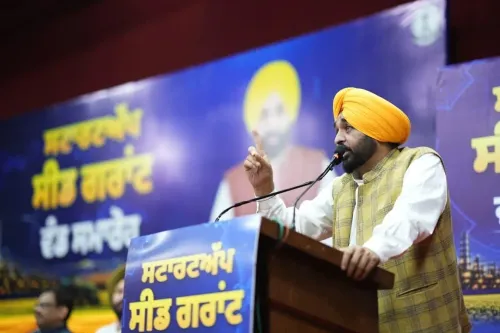
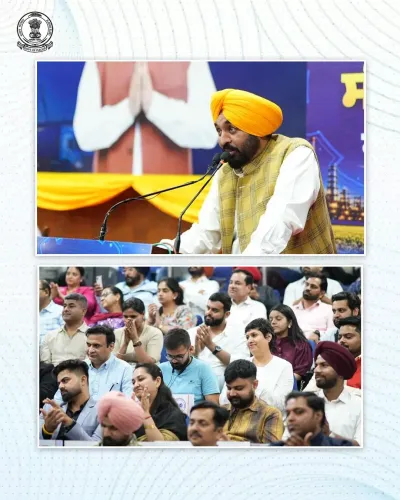
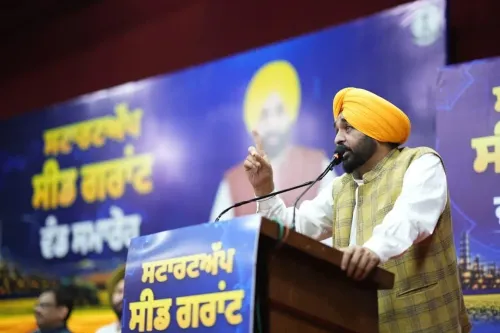
CM Bhagwant Mann Distributes ₹1.07 Cr Seed Grants to 31 Punjab Startups
Synopsis
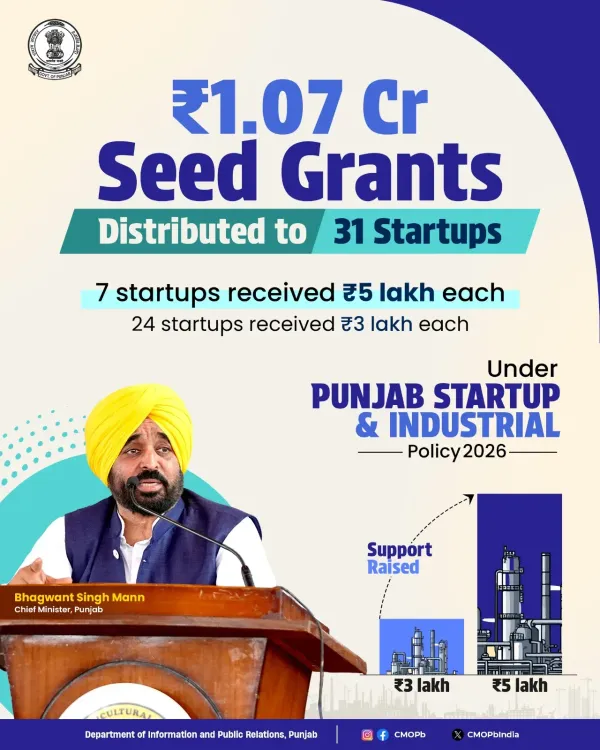
Chief Minister Bhagwant Mann on June 9, 2026 distributed seed grants worth ₹1.07 crore to 31 startups under the Startup Punjab initiative, urging founders to build and grow their companies within the state to generate local employment and wealth.
Key Takeaways
₹1.07 crore in seed grants was distributed to 31 startups and their founders by CM Bhagwant Mann on June 9, 2026 .
The grants were disbursed under the Startup Punjab initiative, the state's flagship entrepreneurship support programme.
CM Mann urged founders to build their companies within Punjab to create jobs and wealth locally, not just originate from the state.
The government stated it is committed to ensuring no promising idea fails due to lack of financial support.
The initiative is part of Punjab's broader economic diversification strategy away from dependence on agriculture.
The programme builds on the national Startup India framework launched in 2016 , adapted to state-level priorities.
The Chief Minister's Office of Punjab announced on Tuesday, June 9, 2026, that Chief Minister Bhagwant Mann distributed seed grants worth ₹1.07 crore to 31 startups and their founders, reinforcing the state government's push to establish Punjab as a leading destination for youth-led entrepreneurship. The move signals a concrete step in the state's broader effort to diversify its economy beyond agriculture and retain skilled talent within its borders.
Context
CM Bhagwant Mann asserted during the distribution that Punjab's next generation of successful entrepreneurs should not only come from the state but also build their companies within it, creating jobs and wealth locally. He described startups as 'a key pillar of Punjab's future economic growth' and stated that the government is committed to ensuring no promising idea is abandoned due to lack of financial support. The seed grants were disbursed under the state's Startup Punjab initiative, which aims to provide funding, mentorship, and institutional backing to early-stage ventures.
Policy Backdrop
The Startup Punjab programme sits within a wider national framework that traces its lineage to the Startup India initiative launched by the Government of India in 2016, which established a foundational ecosystem of tax benefits, funding support, and regulatory easing for new enterprises. State governments across the country have since built upon that framework with targeted seed-funding and incubation schemes tailored to local economic conditions. For Punjab, a state historically anchored in agriculture, the pivot toward technology, services, and innovation-driven enterprise has become an explicit policy priority under the current Aam Aadmi Party government, which took office in March 2022.
The emphasis on local company formation directly addresses a persistent structural concern: the outward migration of educated and skilled youth from Punjab to other states and abroad in search of opportunity. By linking seed capital to the expectation of building and operating within the state, the government is attempting to use financial incentives to anchor talent and capital at home.
Stakeholders and Impact
The immediate beneficiaries are the 31 startup founders who received grants from this tranche, gaining early-stage capital that can be critical in moving from idea to minimum viable product. Seed funding at this stage typically helps founders cover initial operational costs, prototype development, and early hiring — resources that are otherwise difficult to access without a track record. Beyond the direct recipients, the programme signals to the broader youth entrepreneurship community in Punjab that institutional backing is available, potentially encouraging more early-stage ventures to formalise and seek support.
The wider economic stake involves Punjab's long-term employment landscape. With agricultural employment under structural pressure and manufacturing growth uneven, a thriving startup ecosystem could generate diversified, urban and semi-urban jobs that absorb the state's educated workforce. Local job and wealth creation — explicitly invoked by CM Mann — would also strengthen the state's own revenue base over time.
What's Next
Attention will now turn to whether subsequent funding tranches are announced, and whether the Startup Punjab programme expands its incubation infrastructure to tier-2 cities and districts beyond Chandigarh. The state budget cycle will be a key indicator of how much fiscal priority the government assigns to scaling this initiative. Sustained momentum will also depend on whether early grantees demonstrate measurable outcomes — in hiring, revenue, or follow-on investment — that can be cited to build political and public confidence in the programme's design.
Point of View
Quantifiable action that allows the AAP government in Punjab to demonstrate economic activism beyond its core governance narrative — particularly relevant as the state seeks to counter perceptions that its economic agenda is limited to welfare transfers. By framing startups as a 'key pillar' of future growth, CM Mann is attempting to shift Punjab's economic identity from agrarian to innovation-led, a rebranding that carries both policy and electoral logic. The explicit demand that founders build within Punjab — not merely originate from it — reflects a broader pattern among state governments trying to prevent capital and talent flight, a challenge that is especially acute in Punjab given its historically high emigration rates. Whether this programme achieves lasting impact will depend on follow-through: incubation infrastructure, mentorship quality, and whether subsequent budget cycles sustain or scale the funding commitment.
NationPress
25 Oct 2026
Frequently Asked Questions
How much seed funding did CM Bhagwant Mann distribute to Punjab startups?
CM Bhagwant Mann distributed seed grants worth ₹1.07 crore to 31 startups and their founders on June 9, 2026 , under the Startup Punjab initiative.
What is Startup Punjab and how does it help entrepreneurs?
Startup Punjab is a state government initiative designed to support early-stage entrepreneurs through seed funding, mentorship, and institutional backing, with the goal of positioning Punjab as a leading startup destination and reducing the state's economic dependence on agriculture.
How can startups apply for seed grants under the Punjab government scheme?
Startups seeking support under Startup Punjab can approach the state's startup and innovation promotion channels. The government has indicated it is committed to ensuring no viable idea is turned away due to lack of financial support, though specific application details are announced through official state portals.
Why is Punjab focusing on startups and entrepreneurship?
Punjab is pursuing startup development to diversify its economy beyond agriculture, create urban and semi-urban employment for educated youth, and retain skilled talent within the state rather than losing it to migration abroad or to other Indian states.
Is the Punjab startup scheme connected to the central government's Startup India programme?
Yes. The Startup Punjab initiative builds on the national Startup India framework launched by the Government of India in 2016 , which created foundational support structures that state governments have since adapted into their own targeted programmes.