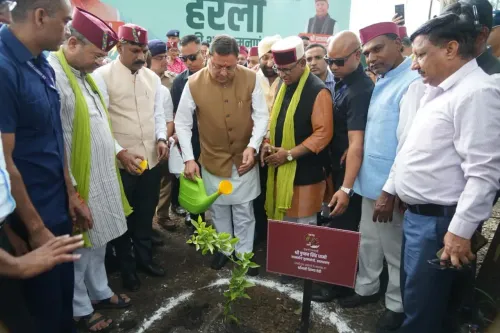
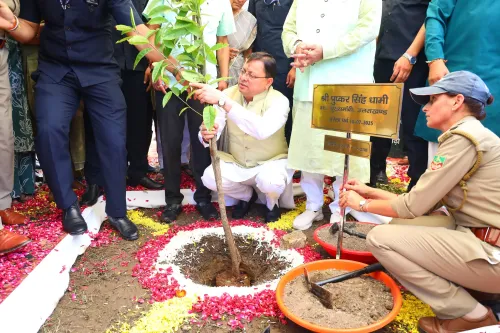
CM Dhami Plants Trees at Harela Utsav, Renews 10-Lakh Sapling Pledge
Synopsis
Uttarakhand CM Pushkar Singh Dhami joined the Harela Utsav at Dehradun's Parade Ground on 16 July 2026, reaffirming a 10-lakh tree pledge and calling on residents to join PM Modi's 'Ek Ped Maa Ke Naam' campaign. Over 1.15 crore of the state's 2-crore sapling target have been planted so far.
Key Takeaways
CM Pushkar Singh Dhami participated in the Harela Utsav at Parade Ground, Dehradun on 16 July 2026 and planted saplings.
The state renewed its pledge to plant 10 lakh trees across Uttarakhand on the occasion of Harela.
Under PM Modi's ' Ek Ped Maa Ke Naam ' campaign, Uttarakhand's target is 2 crore saplings .
More than 1 crore 15 lakh saplings have already been planted under the campaign in Uttarakhand, leaving roughly 85 lakh to go.
CM Dhami called on all Uttarakhand residents to join the national campaign and commit to planting and protecting trees.
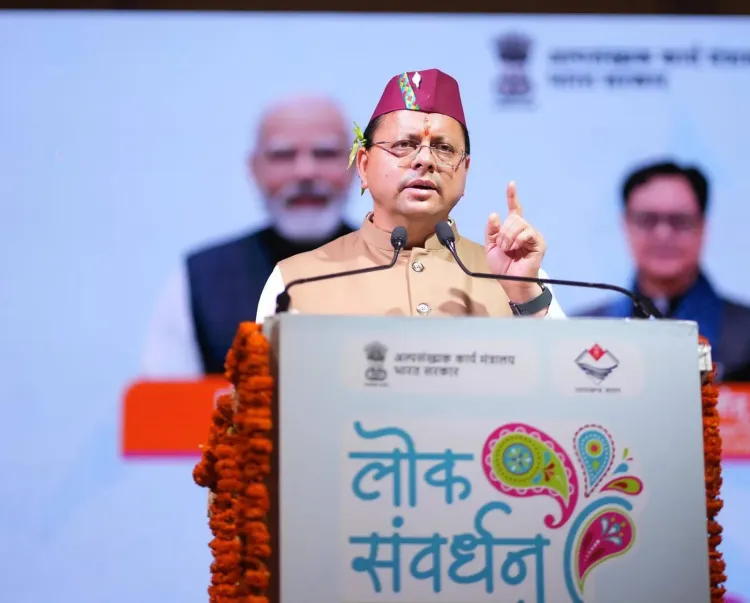
The event was held under the broader Lok Samvardhan Parv (People's Enrichment Festival) framework.
Uttarakhand Chief Minister Pushkar Singh Dhami participated in the Harela Utsav held at Parade Ground, Dehradun, on 16 July 2026, planting saplings as part of the Lok Samvardhan Parv (People's Enrichment Festival) and reaffirming the state's pledge to plant 10 lakh trees across Uttarakhand on the occasion of the traditional monsoon festival.
Context
Harela is an annual monsoon festival rooted in the Kumaoni and Garhwali traditions of Uttarakhand, historically marked by community tree planting as a symbol of prosperity and ecological harmony. The Dhami government has used the festival as an anchor for large-scale afforestation drives since at least 2021, institutionalising it within the state's environmental calendar. This year's event at Parade Ground brought together residents, officials, and cultural groups under the broader Lok Samvardhan Parv umbrella.
At the event, CM Dhami called upon all residents of Uttarakhand to join Prime Minister Narendra Modi's 'Ek Ped Maa Ke Naam' (One Tree in Mother's Name) campaign — urging citizens to plant saplings and commit to their long-term protection. The appeal directly linked the state's cultural observance to a nationally promoted environmental mission.
Policy Backdrop
The 'Ek Ped Maa Ke Naam' campaign was launched by Prime Minister Narendra Modi in June 2024 on World Environment Day, encouraging every Indian to plant at least one tree in honour of their mother. The initiative sits within India's broader commitments under the National Action Plan on Climate Change and its target to bring 33 per cent of the country's geographical area under forest and tree cover.
Uttarakhand's participation carries particular weight given the state's Himalayan geography, where deforestation, soil erosion, and biodiversity loss pose acute risks. Under the national campaign, Uttarakhand has set a target of planting 2 crore saplings, of which more than 1 crore 15 lakh have already been planted, according to figures cited by CM Dhami in his post.
Stakeholders and Impact
The drive directly engages Uttarakhand's resident communities, who are both the primary participants in Harela plantation events and the long-term stewards of the saplings. Community ownership is considered critical in the Himalayan context, where survival rates of planted saplings depend heavily on local monitoring and protection.
Indian states have increasingly integrated traditional festivals with centrally sponsored afforestation schemes, creating a model where cultural participation reinforces policy targets. For Uttarakhand, the convergence of Harela and 'Ek Ped Maa Ke Naam' strengthens both the symbolic resonance of the drive and its administrative reach across hill districts that are otherwise difficult to mobilise at scale.
What's Next
With more than 1 crore 15 lakh of the 2 crore sapling target already achieved, the state must plant roughly 85 lakh more to meet its goal under the national campaign. The monsoon season — which coincides with Harela — is the optimal window for plantation activity, making the weeks immediately following the festival a critical execution period.
How effectively Uttarakhand tracks sapling survival rates, and whether community participation translates into sustained tree cover rather than one-day symbolic planting, will determine the ecological impact of the state's ambitious numerical targets. Progress is likely to be reviewed on the next World Environment Day and during the 2027 Harela Mahotsav.
Point of View
CM Dhami is pursuing a dual objective: delivering on Uttarakhand's environmental commitments while reinforcing the BJP's image as a party that governs through cultural continuity rather than purely technocratic mandates. The explicit invocation of PM Modi's 'Ek Ped Maa Ke Naam' campaign signals deliberate vertical alignment between state and central leadership ahead of any future electoral cycle. Uttarakhand's Himalayan geography gives such plantation drives outsized symbolic weight in national climate discourse, even as ecologists caution that sapling survival rates — not headline numbers — are the true measure of success. The 85-lakh gap remaining in the 2-crore target will test whether the festival momentum translates into sustained, ground-level follow-through.
NationPress
15 Oct 2026
Frequently Asked Questions
What is Harela festival and why is tree planting done on it?
Harela is a traditional monsoon festival celebrated in Uttarakhand, particularly in the Kumaon and Garhwal regions, marking the onset of the rainy season and the sowing of seeds. Tree planting is a customary part of the festival symbolising prosperity, ecological renewal, and community well-being.
What is the 'Ek Ped Maa Ke Naam' campaign?
'Ek Ped Maa Ke Naam' (One Tree in Mother's Name) is a national tree plantation campaign launched by Prime Minister Narendra Modi in June 2024 on World Environment Day, urging every Indian to plant at least one tree as a tribute to their mother.
How many trees has Uttarakhand planted under 'Ek Ped Maa Ke Naam'?
According to CM Pushkar Singh Dhami's post on 16 July 2026, Uttarakhand has planted more than 1 crore 15 lakh saplings under the campaign against a state target of 2 crore saplings.
Where was the Harela Utsav 2026 event held?
The Harela Utsav 2026 was held at Parade Ground in Dehradun, the capital of Uttarakhand, as part of the Lok Samvardhan Parv organised by the state government.
What is Uttarakhand's tree plantation target for Harela 2026?
Chief Minister Pushkar Singh Dhami reaffirmed a pledge to plant 10 lakh (one million) trees across Uttarakhand on the occasion of Harela 2026.