White House Backs Trump Accounts to Build Young Americans' Wealth
Synopsis
The White House on 23 July 2026 promoted Trump Accounts, a federal savings initiative framed as giving young Americans a fair shot at the American dream after decades of debt accumulation by Washington politicians.
Key Takeaways
The White House officially promoted Trump Accounts on 23 July 2026 via its official X account.
The post accuses 'Washington politicians' of leaving young Americans with debt rather than opportunity over several decades.
The initiative is framed as ensuring young Americans receive 'a fair shot at the American dream.' U.S. national debt exceeded $20 trillion by the late 2010s, underpinning the administration's fiscal critique.
Congressional action on related legislation and programme rollout timelines remain the key variables to watch.
The messaging continues a White House pattern of branding new economic programmes as corrections to prior bipartisan fiscal failures.
The White House on Thursday, 23 July 2026, promoted a new federal savings initiative called Trump Accounts, arguing that Washington's political class had spent decades saddling younger generations with debt rather than building their financial futures.
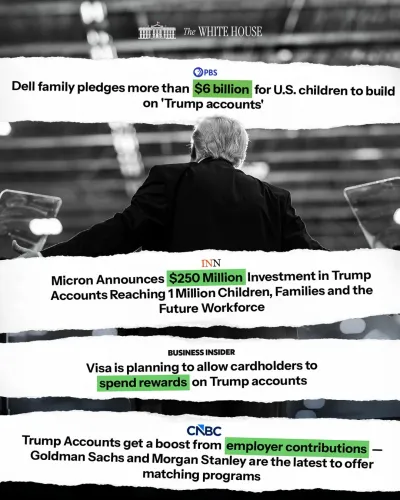
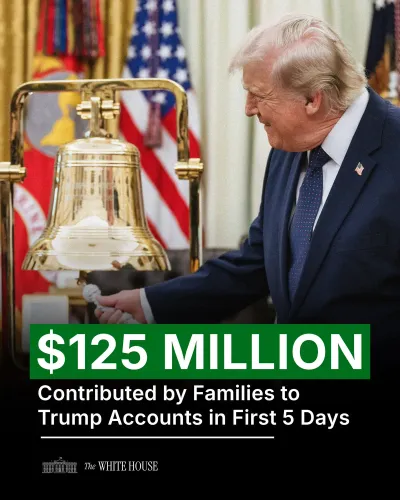
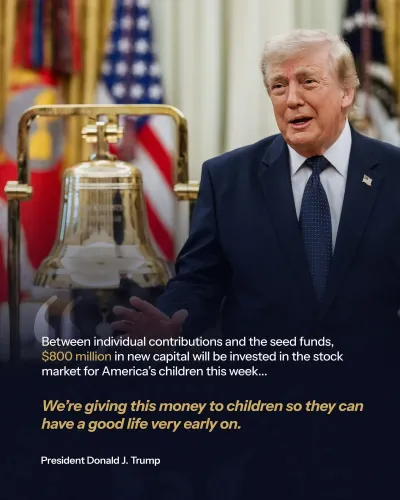
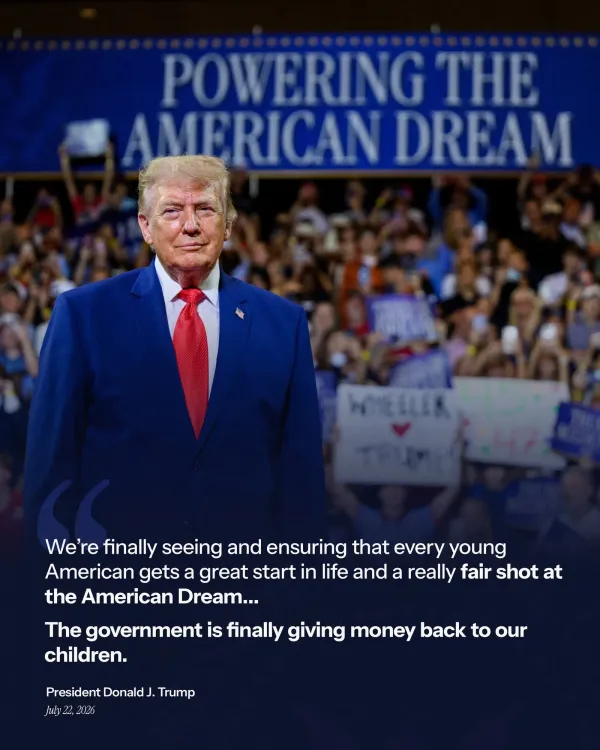
The official White House account posted: 'For decades, Washington politicians gave our children absolutely nothing but debt. Trump Accounts ensure young Americans get a fair shot at the American dream.' The post, accompanied by an image, frames the programme as a direct corrective to bipartisan fiscal failures of the past.
Context
The United States has grappled with rising national debt for several decades, a burden that fiscal hawks across the political spectrum have long described as an intergenerational injustice. By the late 2010s, U.S. national debt had surpassed $20 trillion, fuelling persistent debates in Congress over deficit spending and long-term economic sustainability.
The White House's messaging positions Trump Accounts as a structural answer to this pattern — shifting the policy conversation from what government has failed to do toward what it now proposes to deliver for young Americans.
Policy Backdrop
White House communications under the current administration have consistently framed new economic programmes as corrections to prior spending patterns that deepened the national debt. This approach mirrors a broader partisan narrative around fiscal responsibility, one that contrasts deficit accumulation with targeted, asset-building measures aimed at younger cohorts.
Donald Trump's first administration (2017–2021) was marked by significant tax reform and deregulation, with the administration frequently critiquing federal spending trajectories. The Trump Accounts initiative appears to continue that ideological thread — using individual savings vehicles as an alternative to broad government expenditure.
Stakeholders and Impact
The primary beneficiaries identified in the White House post are young Americans — a demographic that has faced compounding economic pressures including student debt, housing affordability challenges, and wage stagnation in recent years. If implemented at scale, a federally backed savings or investment account programme could represent a meaningful shift in how the government supports early-life wealth accumulation.
The framing also carries political weight: by blaming 'Washington politicians' broadly, the administration appeals to voters across party lines who are frustrated with the federal government's fiscal track record, while simultaneously branding the solution under the Trump name.
What's Next
Attention will now turn to Capitol Hill, where any legislation or appropriation required to operationalise Trump Accounts must pass congressional scrutiny. Key questions include eligibility criteria, contribution limits, federal funding mechanisms, and rollout timelines for the programme.
How the initiative is received by both Republican fiscal conservatives and Democratic critics of branded federal programmes will shape its legislative path. For Indian-Americans and global observers watching U.S. economic policy, the programme signals a continued White House emphasis on individual asset-building over broad welfare spending as the administration's preferred model for economic equity.
Point of View
Individualistic alternative to what it characterises as decades of irresponsible deficit spending. The 'debt versus opportunity' framing is designed to resonate across generational lines, positioning the initiative as a moral as much as a fiscal corrective. Whether the programme delivers substantive policy change or remains primarily a communications strategy will depend heavily on its legislative architecture and funding commitments. For now, it reinforces the administration's broader arc of framing government's role as enabling individual wealth-building rather than expanding collective spending programmes.
NationPress
23 Jul 2026
Frequently Asked Questions
What are Trump Accounts?
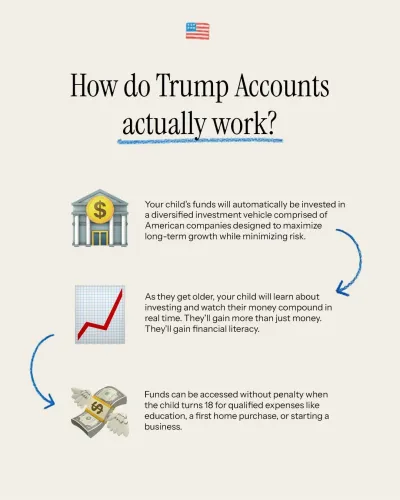
Trump Accounts are a federal savings initiative promoted by the White House, designed to give young Americans access to financial assets and a path toward the American dream, positioned as an alternative to the debt burden previous administrations left younger generations.
Why is the White House criticising Washington politicians over debt?
The White House post argues that decades of spending by politicians across parties resulted in mounting national debt with no corresponding benefit for children or young Americans, framing Trump Accounts as a direct remedy to that failure.
How does U.S. national debt affect young Americans?
The U.S. national debt, which surpassed $20 trillion by the late 2010s, represents a long-term fiscal burden that future generations are expected to service through taxes, reducing public resources available for education, housing, and other priorities that affect young people.
Will Trump Accounts require approval from Congress?
Any federal programme requiring new appropriations or legislative authority would need congressional approval. Observers are watching Capitol Hill for related savings or account legislation and details on rollout timelines.
What was Donald Trump's economic policy focus in his first term?
During his first term from 2017 to 2021, Donald Trump's administration prioritised tax reform, deregulation, and critiques of federal deficit spending, themes that the current White House messaging on Trump Accounts continues.