White House Shares Opinion Piece on Trump Economy
Synopsis
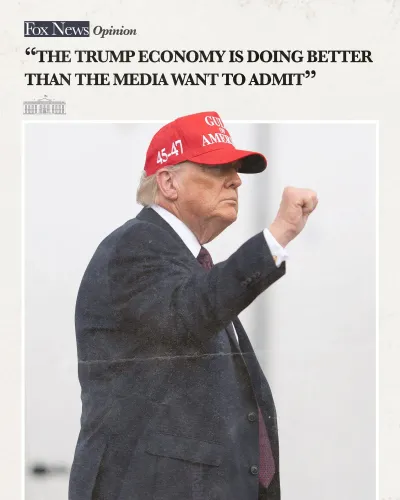
The White House on 22 July 2026 amplified a Fox News opinion column by Liz Peek arguing the Trump administration's economic record is stronger than media coverage reflects, reigniting debate over U.S. economic performance, tax policy, and the gap between headline data and public sentiment.
Key Takeaways
The White House shared a Fox News opinion piece by columnist Liz Peek on 22 July 2026 , endorsing its argument about the Trump economy.
The column argues the Trump administration's economic performance is better than mainstream media coverage acknowledges.
The Tax Cuts and Jobs Act of 2017 — which cut the corporate tax rate from 35% to 21% — remains the centrepiece of the administration's economic legacy claims.
Amplifying favourable opinion content via official social-media accounts is a recurring White House communications strategy across administrations.
Key upcoming data points include quarterly GDP figures , monthly jobs reports , and any Federal Reserve guidance on interest rates.
A strong U.S. economy has direct downstream effects on Indian exports, IT services, and pharmaceutical trade with the United States.
The White House, the official communications account of the Executive Office of the President of the United States, on Wednesday, 22 July 2026, shared a link to an opinion article arguing that the Trump administration's economic record is stronger than mainstream media coverage suggests.
Context
The post, directed at the White House's own followers, pointed readers to a commentary by financial columnist Liz Peek published on Fox News, headlined 'Trump economy doing better than media admit.' The White House accompanied the share with a downward-pointing arrow emoji, signalling an endorsement of the piece's argument.
Amplifying opinion content that frames economic conditions favourably is a well-established social-media communications tactic used by White Houses across administrations. By re-sharing rather than publishing original data, the account invites readers to engage with a third-party framing of economic performance.
Policy Backdrop
The broader debate around the Trump economy traces its roots to signature legislative and executive actions, most notably the Tax Cuts and Jobs Act of 2017, which reduced the federal corporate tax rate from 35 per cent to 21 per cent. Proponents argued the measure would stimulate business investment and job creation; critics contended the benefits flowed disproportionately to corporations and high-income households.
Deregulation drives and renegotiated trade agreements — including the replacement of NAFTA with the United States-Mexico-Canada Agreement (USMCA) — are also central to how the administration has characterised its economic legacy. These policies continue to animate debate over indicators such as GDP growth, unemployment rates, and real wage trends.
Stakeholders and Impact
The primary stakeholders in this narrative are American workers and businesses, whose lived economic experience — wages, job availability, cost of living — often diverges from aggregate headline figures. The gap between top-line economic data and household-level sentiment has been a persistent tension in U.S. political discourse.
For Indian observers and businesses with exposure to the United States, the state of the American economy carries direct implications: a robust U.S. economy typically sustains demand for Indian exports, IT services, and pharmaceutical products, while also influencing the trajectory of the US dollar and global capital flows.
What's Next
Attention will now turn to the release of the next quarterly GDP figures and monthly jobs reports, which will either substantiate or complicate the White House's preferred economic narrative. Any statement from the Federal Reserve on monetary policy — particularly around interest rates — will also shape how economic performance is assessed in the months ahead.
As the administration continues to use its official social-media presence to steer the economic conversation, the contrast between curated opinion amplification and independently verified data is likely to remain a flashpoint in U.S. political media.
Point of View
Blurring the line between official communication and political messaging. For observers tracking U.S. economic policy, the more consequential signals will come from hard data releases — GDP, payrolls, and Federal Reserve guidance — rather than opinion amplification. The post nonetheless underscores that the battle over economic perception remains as politically charged as the underlying policy debate.
NationPress
20 Oct 2026
Frequently Asked Questions
Why did the White House share a Fox News opinion article about the economy?
The White House shared the piece to amplify a favourable narrative about the Trump administration's economic record, a common social-media communications tactic used by executive offices to shape public perception around economic performance.
What is the Trump economy and why is it debated?
The 'Trump economy' refers to U.S. economic conditions shaped by policies such as the Tax Cuts and Jobs Act of 2017 , deregulation, and trade renegotiations. It is debated because aggregate indicators like GDP and unemployment often diverge from household-level experiences of wages and cost of living.
Who is Liz Peek and what did she write?
Liz Peek is a U.S. financial columnist and commentator. Her opinion piece, published on Fox News , argues that the Trump administration's economic performance is stronger than mainstream media coverage suggests.
How does the U.S. economy affect India?
A strong U.S. economy sustains demand for Indian exports, IT services, and pharmaceuticals. It also influences the strength of the US dollar and global capital flows, both of which have direct implications for Indian businesses and markets.
What economic data should I watch to assess the Trump economy?
Key indicators include quarterly U.S. GDP growth figures , monthly non-farm payrolls (jobs reports) , and any policy statements from the Federal Reserve on interest rates and monetary outlook.