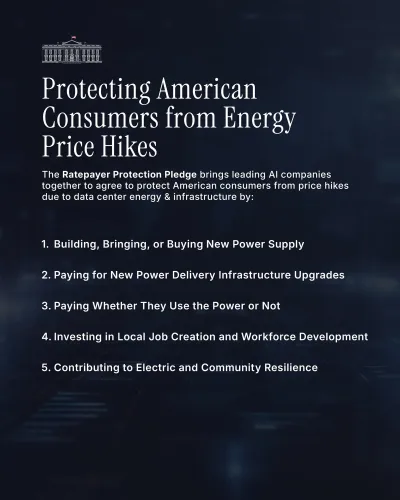
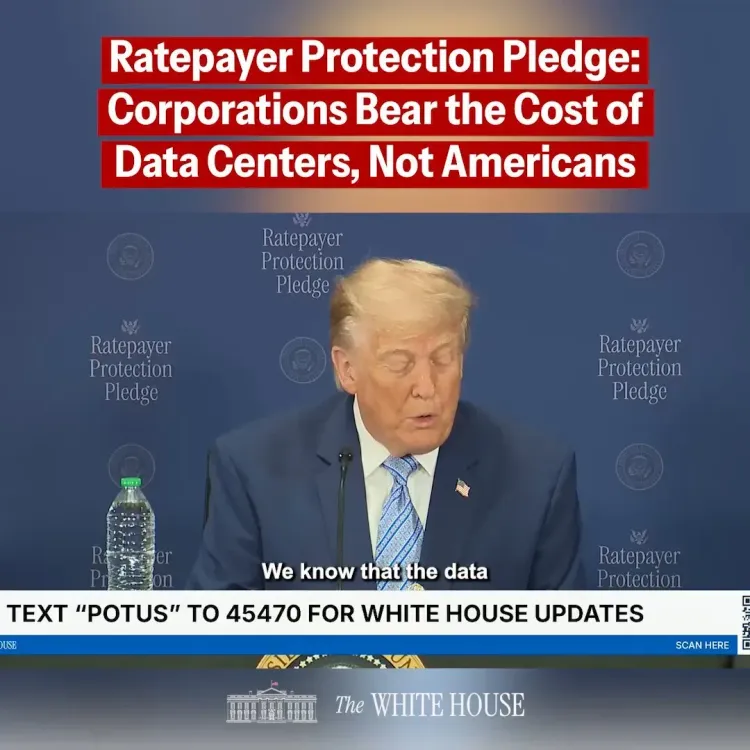
White House: Big Corporations, Not Citizens, to Pay for US Grid
Synopsis
The White House announced on 24 July 2026 that surging American energy production will require grid maintenance funded by large corporations, not citizens. The statement signals a policy stance on cost allocation that could shape upcoming regulatory and legislative action on US transmission infrastructure.
Key Takeaways
The White House posted on 24 July 2026 that America is producing 'incredible amounts of energy.' The administration stated that 'massive corporations' — not American citizens — will bear the cost of maintaining the electrical grid.
The Inflation Reduction Act (2022) previously directed federal support toward grid modernisation but left cost-allocation rules unresolved.
FERC and Congress are the key bodies that would need to act to make this cost-allocation position legally binding.
American households could see protection from grid-related rate increases if the policy is formalised through regulation or legislation.
Global energy markets, including India's import costs, may be indirectly affected by sustained high US domestic energy output.
The White House declared on Thursday, 24 July 2026 that America is producing record levels of energy and that the cost of maintaining and upgrading the electrical grid will fall on large corporations — not on ordinary American citizens.
Context
The official White House account posted that 'America is producing incredible amounts of energy' and emphasised that 'massive corporations will pay — not American citizens' for grid upkeep. The statement frames cost allocation as a matter of protecting household consumers from bearing infrastructure expenses tied to surging domestic energy output.
The post comes as the United States has seen sustained growth in domestic energy production across oil, natural gas, and renewables, placing new demands on an aging national transmission grid that requires significant capital investment to remain stable and efficient.
Policy Backdrop
The debate over who pays for grid upgrades has a long legislative history in Washington DC. The Inflation Reduction Act of 2022 directed federal support toward grid modernisation and domestic energy expansion, but left open the question of how transmission upgrade costs would be allocated between utilities, large commercial users, and end consumers.
Regulatory bodies such as the Federal Energy Regulatory Commission (FERC) have periodically revisited cost-allocation rules for transmission infrastructure. US administrations across party lines have generally sought to direct a larger share of system-upgrade costs toward utilities and large commercial users through rate structures, rather than through direct federal appropriations funded by individual taxpayers.
The White House statement appears to signal a policy position favouring this model — shielding residential consumers while placing the financial burden of grid maintenance on large corporate energy users or utilities.
Stakeholders and Impact
American households stand to benefit most directly if the policy position translates into binding regulatory or legislative action, as it would insulate them from rate increases tied to grid infrastructure spending. Consumer advocacy groups have long argued that transmission costs are disproportionately passed on to residential customers through utility bills.
Large energy corporations and utilities, by contrast, could face higher compliance costs or revised rate structures under such a framework. The framing of 'massive corporations' paying — rather than citizens — suggests the administration is positioning this as a populist economic safeguard alongside its energy expansion agenda.
For India and other energy-importing nations, sustained high US domestic energy production can influence global oil and gas prices, with downstream effects on import bills and inflation management.
What's Next
Analysts will watch for concrete follow-through: whether Congress moves on cost-allocation legislation, whether FERC issues new guidance on utility rate design, or whether the White House releases an executive order codifying this position. Without a regulatory or statutory mechanism, the statement remains a policy signal rather than an enforceable directive.
The administration's ability to deliver on this promise will depend heavily on the legislative calendar and the degree of pushback from the energy industry, which has significant lobbying influence on Capitol Hill.
Point of View
Positioning the administration as a guardian of household economic interests amid an energy production boom. This echoes a broader pattern in US energy policy of using rate-structure mechanisms to shield residential consumers — a politically popular stance that sidesteps the harder legislative work of actually codifying cost allocation. The real test lies ahead: without FERC rulemaking or Congressional action, the statement is aspirational rather than operative. Observers in India and other energy-dependent economies will watch whether this translates into sustained high US output, which carries significant implications for global commodity pricing.
NationPress
24 Jul 2026
Frequently Asked Questions
What did the White House say about the US energy grid?
The White House stated on 24 July 2026 that America is producing record energy and that large corporations — not ordinary citizens — will pay for maintaining the electrical grid.
Why are corporations being asked to pay for the US grid?
The administration's position is that the cost of grid upgrades driven by surging domestic energy production should fall on large commercial users and utilities rather than on residential consumers, a model supported by existing rate-structure frameworks.
What is FERC and why does it matter here?
The Federal Energy Regulatory Commission (FERC) is the US body that oversees electricity transmission and wholesale markets. Any binding cost-allocation rule shifting grid expenses to corporations would likely require a FERC rulemaking or Congressional legislation.
How does the Inflation Reduction Act relate to US grid costs?
The Inflation Reduction Act of 2022 directed federal investment toward grid modernisation and domestic energy expansion, but it did not definitively resolve how ongoing transmission upgrade costs should be split between corporations, utilities, and consumers.
How does US energy policy affect India?
High US domestic energy production can depress global oil and gas prices, which benefits India as a major energy importer by reducing its import bill and easing inflationary pressure on fuel prices.