White House Claims 2.3M Drop in Illegal Immigrant Population
Synopsis
The White House says the US undocumented immigrant population has dropped by more than 2.3 million since President Trump's return to office, crediting expanded ICE enforcement and executive-order-driven border security measures for the decline.
Key Takeaways
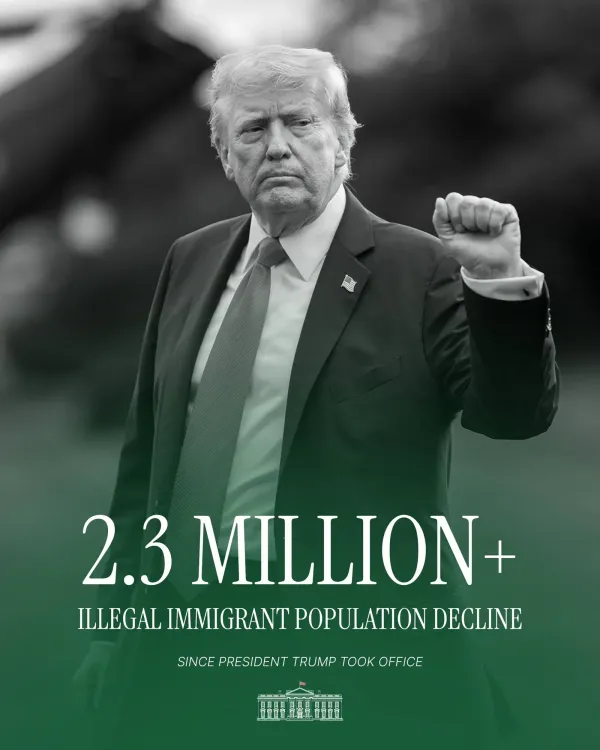
The White House announced on October 25, 2026 that the illegal immigrant population in the US has fallen by over 2.3 million since President Trump took office.
President Trump made reducing unauthorised immigration a central priority, reinstating and expanding enforcement executive orders upon returning to office.
Immigration and Customs Enforcement (ICE) has intensified both border and interior enforcement operations under the second-term policy framework.
The specific 2.3 million figure has not yet been independently verified; measuring undocumented populations relies on estimation methods with inherent margins of uncertainty.
Congressional appropriations for expanded ICE detention capacity and expedited removal procedures remain active legislative debates.
The administration is using the population-level claim to build a political case linking its enforcement strategy to concrete, measurable outcomes.
The number of undocumented immigrants in the United States has fallen by more than 2.3 million since President Donald Trump returned to office, the White House declared on Sunday, October 25, 2026 — framing the decline as a defining achievement of the administration's hardline enforcement agenda.
The 2.3 Million Figure and What It Signals
The White House post states the 'illegal immigrant population is collapsing,' attributing the fall directly to policy decisions made since Trump took office. The administration has not, in this post, specified the precise data source or methodology behind the 2.3 million-plus figure. Such population estimates have historically drawn on Department of Homeland Security modelling, which cross-references border encounter data, visa overstay tallies, and periodic survey-based household estimates — all carrying their own methodological uncertainties.
What is not in dispute is the policy architecture driving the trend. On returning to office, President Trump reinstated and expanded the executive orders from his first term, directing the Department of Homeland Security and Immigration and Customs Enforcement (ICE) to intensify both interior enforcement and border security operations. That framework set the operational tempo for what the administration now characterises as a population-level shift.
ICE's Expanding Operational Footprint
Immigration and Customs Enforcement, the federal agency mandated to identify, detain, and remove undocumented individuals, has been the primary instrument of this policy push. Expanded detention capacity, prioritisation of interior enforcement operations beyond border-adjacent counties, and accelerated use of expedited removal procedures have all featured in the second-term enforcement posture. Congressional appropriations for ICE detention infrastructure remain an active legislative pressure point, with further funding debates expected.
The administration's claim fits a consistent communication pattern: using aggregate population-level data to validate the enforcement strategy politically, contrasting current figures against the baseline inherited from the prior administration. Whether independent demographic researchers will corroborate the specific 2.3 million figure is a question that will sharpen as DHS releases its own periodic estimates.
Why the Number — and the Method — Both Matter
Measuring undocumented populations is, by definition, an exercise in estimation. No census directly counts individuals who are present unlawfully, so researchers and government agencies rely on residual methods, survey data, and border statistics — each producing ranges rather than hard counts. A claimed decline of 2.3 million would represent a substantial share of the estimated total unauthorised population, making it among the most significant reported shifts in recent American immigration history if independently verified.
For the Trump White House, the number is also a political instrument — a metric that connects the administration's policy identity to a measurable real-world outcome ahead of ongoing budget and legislative battles over immigration enforcement. The next test is whether DHS or an independent body publishes data that places that figure in verifiable context.
Point of View
If substantiated by independent DHS data, would represent one of the largest documented shifts in unauthorised population in American history and would significantly strengthen the enforcement-first coalition's legislative hand on detention funding. However, the administration's choice not to name its data source in the post is notable: undocumented population estimates are inherently contested, and rival methodologies frequently produce divergent conclusions. The real political test comes when Congress reconvenes on ICE appropriations — a number this large, if challenged, becomes a liability; if verified, it becomes a mandate.
NationPress
26 Oct 2026
Frequently Asked Questions
How many illegal immigrants have left the US under Trump?
The White House stated on October 25, 2026 that the unauthorised immigrant population has declined by more than 2.3 million since President Trump took office. The specific data source for this figure has not been publicly named in the post.
How does the US measure the undocumented immigrant population?
There is no direct census of undocumented individuals. Researchers and the Department of Homeland Security use 'residual methods' — combining legal population counts, border encounter data, and visa overstay records — to produce estimates that carry ranges of uncertainty.
What is ICE's role in Trump's immigration enforcement?
Immigration and Customs Enforcement (ICE) is the federal agency responsible for identifying, detaining, and removing individuals present unlawfully in the US. Under the second Trump administration, ICE has expanded interior enforcement operations and used expedited removal procedures more broadly.
What executive actions did Trump take on immigration when he returned to office?
President Trump reinstated and expanded the executive orders from his first term, directing the Department of Homeland Security and ICE to intensify border security and interior enforcement operations as a foundational priority of his return to office.
What comes next on US immigration policy?
Congressional debates over appropriations for expanded ICE detention capacity and potential regulatory changes to expedited removal procedures are the immediate legislative battlegrounds. Independent publication of DHS population estimates will determine whether the 2.3 million figure holds up to scrutiny.