White House Hails Ford's Lincoln Shift to US, Away From China
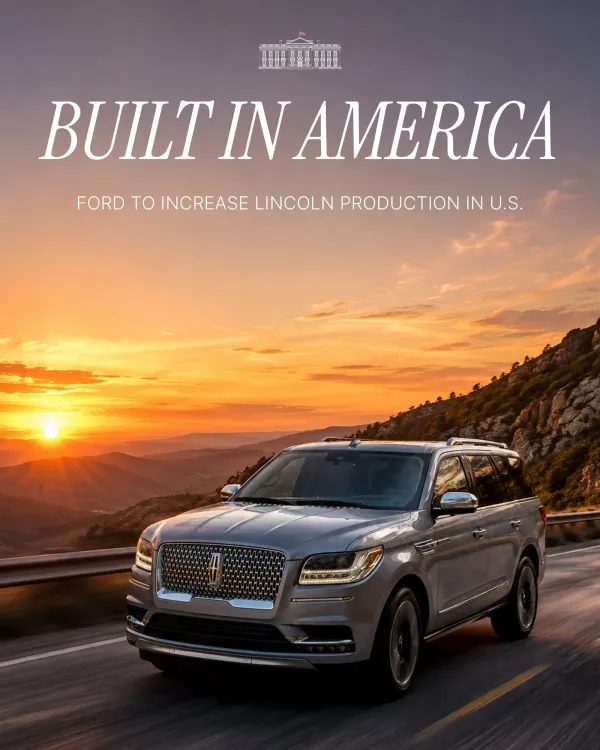
Synopsis
The White House announced on August 20, 2026 that Ford Motor Company is building Lincoln vehicles in the United States and phasing out China, framing the move as a direct result of President Trump's 'Made in America' economic agenda and projecting thousands of new U.S. jobs.
Key Takeaways
The White House announced on August 20, 2026 that Ford Motor Company is shifting Lincoln production to the United States .
Ford is simultaneously phasing out its China manufacturing operations, per the White House post.
The administration claims the move will generate thousands of U.S. jobs , though no precise figure was specified.
The announcement is framed as a product of President Trump 's 'Made in America' agenda and tariff-based trade architecture dating to 2018 .
U.S. autoworkers and domestic auto suppliers are the most direct stakeholders in any new domestic production capacity.
Follow-on announcements on factory capacity, supplier contracts, and production timelines will determine the concrete scale of the shift.
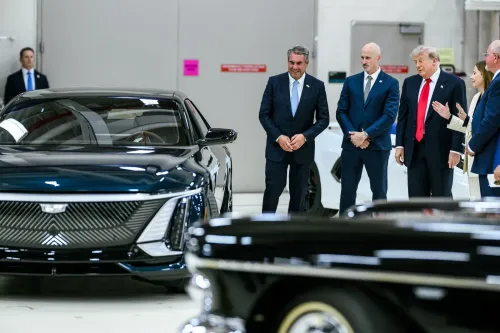
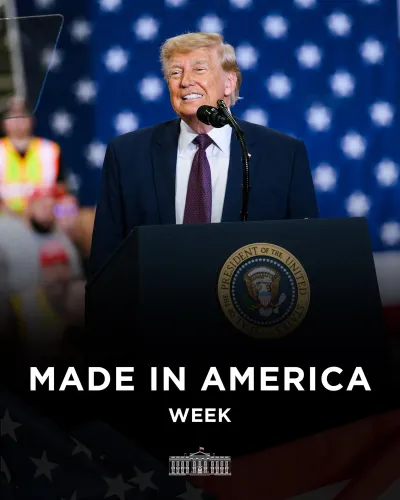
The White House is putting a corporate name to its reshoring agenda — and this time, it is one of America's most storied automakers. On Thursday, August 20, 2026, the official White House account on X announced that Ford Motor Company is moving Lincoln production to the United States while phasing out its China operations, a move the administration says will generate thousands of American jobs.
The post, framed around President Donald Trump's 'Made in America' push, declared: 'Ford is helping grow American auto manufacturing, building Lincolns in the United States and phasing out China. This action will generate thousands of U.S. jobs, as President Trump continues to fight for Americans over foreign manufacturing.'
Lincoln's Homecoming and What It Signals
Ford's Lincoln brand had expanded its footprint in China in prior years, targeting the country's premium vehicle market — a strategy common among U.S. automakers seeking volume growth in Asia. The White House's framing positions the reversal of that trajectory as a direct win for Trump's economic doctrine, which has consistently treated final assembly location as a proxy for patriotism and industrial strength.
The administration's trade architecture — built on Section 232 steel and aluminum tariffs and Section 301 levies on Chinese goods, first imposed in 2018 — was designed precisely to make this kind of supply-chain pivot economically rational for manufacturers. The Lincoln announcement, as presented, is the policy thesis walking off the page and onto the factory floor.
Autoworkers, Suppliers, and the Jobs Claim
The White House did not specify a precise job-creation number in its post, citing only 'thousands.' U.S. autoworkers and domestic auto suppliers stand as the most direct beneficiaries if new assembly capacity is genuinely added on American soil. The auto sector has long occupied a symbolic centre of gravity in American manufacturing politics — both as an employment engine and as a national-security-adjacent industry where domestic capacity is treated as strategically non-negotiable.
The messaging pattern itself is not new. Since at least the early 2010s, successive administrations have spotlighted specific company investment decisions as validation of broader economic strategy. What distinguishes the current moment is the explicit pairing of a brand-name action — Ford and Lincoln — with a named adversary — China — in a single, declarative White House communication.
The Broader 'America First' Manufacturing Arc
Trump's Buy American and Hire American executive order, signed in 2017, directed federal agencies to prioritise domestic goods and reduce offshoring. Nearly a decade on, the White House is pointing to Ford's move as evidence that the policy architecture is producing tangible corporate behaviour change — not just regulatory compliance, but strategic realignment away from Chinese manufacturing dependence.
Whether Congress advances complementary domestic-content legislation, and whether Ford follows the announcement with specific capacity numbers, supplier contracts, or a production timeline, will determine how durable this headline moment proves to be.
For now, the White House has a name, a brand, and a flag to plant — and it is planting all three at once.
Point of View
But the explicit China-exit framing sharpens the geopolitical edge considerably. For India, the story is a data point in the ongoing US-China economic decoupling that is reshaping global supply chains — and creating openings for alternative manufacturing hubs. The durability of the narrative depends entirely on whether Ford's production and hiring numbers materialise at the scale the messaging implies.
NationPress
20 Aug 2026
Frequently Asked Questions
Why is Ford moving Lincoln production to the United States?
The White House stated on August 20, 2026 that Ford is building Lincolns in the US and phasing out China as part of President Trump's 'Made in America' manufacturing push, driven by tariff policies and reshoring incentives.
How many jobs will Ford's US manufacturing move create?
The White House cited 'thousands' of new U.S. jobs but did not specify an exact figure in its announcement. Precise numbers are expected to emerge in follow-on statements from Ford.
What is Trump's 'Made in America' policy?
'Made in America' is a central pillar of President Trump's economic agenda, rooted in the 2017 Buy American and Hire American executive order and reinforced by tariffs on Chinese goods under Section 232 and Section 301 trade laws.
What is the Lincoln brand and why was it in China?
Lincoln is Ford Motor Company's luxury vehicle brand. It had expanded into China to capture the country's growing premium car market, a common strategy for US automakers seeking volume growth in Asia.
What should I watch for next in Ford's US manufacturing story?
Key developments to track include Ford's official announcements on new US plant capacity, supplier contracts, a Lincoln production timeline, and any related domestic-content legislation moving through the US Congress.