White House Hails Harley-Davidson US Production Return
Synopsis
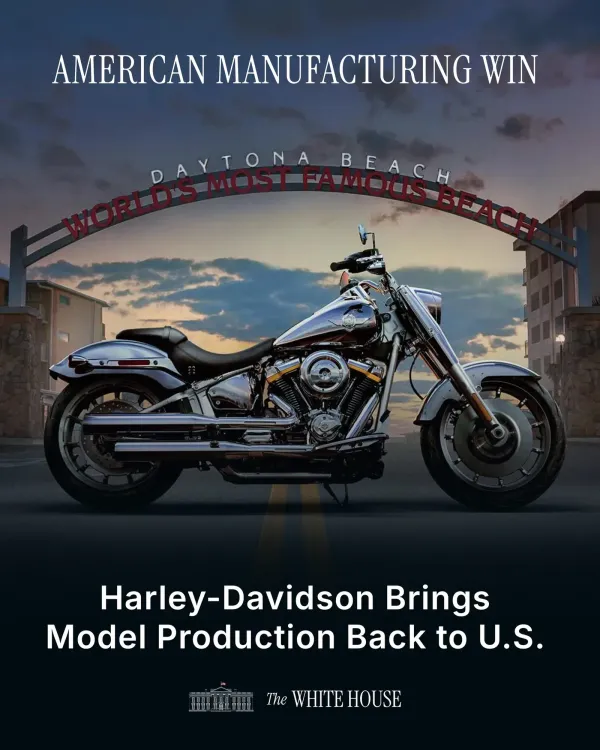
The White House on June 9, 2026, declared an 'American manufacturing win' as Harley-Davidson announced it is bringing production of certain motorcycle models back to the United States, reversing a 2018 offshoring decision triggered by retaliatory EU tariffs.
Key Takeaways
The White House on June 9, 2026 , announced that Harley-Davidson is returning production of certain models to the United States .
Harley-Davidson had shifted some overseas production in 2018 after the European Union imposed retaliatory tariffs on US motorcycles in response to American steel and aluminium duties.
The specific models, number of jobs, and timeline for the production return have not been officially detailed in the White House post.
US policy has used tariffs, tax incentives, and trade agreements to encourage manufacturing reshoring across multiple sectors since 2010 .
Future US-EU tariff negotiations and Harley-Davidson earnings reports will be key indicators of the move's scope and sustainability.
The White House on Tuesday, June 9, 2026, announced that Harley-Davidson is bringing the production of certain motorcycle models back to the United States, calling it an 'American manufacturing win' and signalling a reversal of the iconic brand's earlier decision to shift some output overseas.
Context
The official White House account posted on X: 'AMERICAN MANUFACTURING WIN! Harley-Davidson is bringing the production of certain models BACK to the U.S. More American jobs. More American manufacturing. More bikes Made in America.' The announcement frames the move as a direct policy dividend, though the specific models, job numbers, and timeline have not been officially detailed in the post.
Harley-Davidson, founded in 1903, is one of America's most recognised industrial brands. Its fortunes have long been intertwined with US trade policy, making any production shift — inward or outward — a politically charged moment.
Policy Backdrop
The announcement echoes a years-long trade dispute that began in 2018, when the United States imposed Section 232 tariffs on steel and aluminium imports. The European Union responded with retaliatory tariffs specifically targeting American motorcycles, raising the cost of Harley-Davidson bikes sold in Europe.
Facing higher costs on European exports, Harley-Davidson announced in 2018 that it would shift production of certain motorcycles destined for Europe to overseas facilities. The move drew sharp public criticism at the time, with calls to keep manufacturing on American soil. The current reversal, if it follows through at scale, would mark a significant turn in that trajectory.
US policy over the past decade has repeatedly leaned on tariffs, tax incentives, and renegotiated trade agreements to encourage reshoring of manufacturing — a trend that intensified as supply-chain vulnerabilities became apparent. Harley-Davidson's arc from offshoring to potential reshoring illustrates how individual firms recalibrate when trade conditions shift.
Stakeholders and Impact
The primary beneficiaries of a production return would be US factory workers in states where Harley-Davidson operates assembly and manufacturing plants, including Wisconsin, the company's home state. Broader domestic suppliers of steel, components, and logistics services could also see increased demand.
For the White House, the announcement serves as a tangible data point in its broader narrative of reviving American industrial capacity. Motorcycle manufacturing, while a niche sector, carries outsized symbolic weight as a marker of working-class industrial identity in the United States.
The move also carries implications for US-EU trade relations. If retaliatory tariffs on American motorcycles remain in place, the economics of producing in the US for the European market remain challenging — meaning the scope and sustainability of the reshoring will depend partly on any future tariff adjustments between Washington and Brussels.
What's Next
Analysts and policymakers will watch Harley-Davidson's forthcoming earnings disclosures and any official company statements for specifics on which models are returning, how many jobs will be created, and over what timeline. US Labor Department manufacturing employment data will offer a broader gauge of whether this move is part of a wider reshoring trend.
Any response from the European Union regarding tariff adjustments on American motorcycles will also be a key indicator of whether the trade environment that originally prompted the offshoring has materially changed. If the reshoring holds and expands, it could become a centrepiece example in the ongoing debate over the effectiveness of tariff-led industrial policy.
Point of View
Making it an ideal vehicle — literally and politically — for reshoring narratives. However, the absence of specifics on job numbers and models means the announcement is, for now, more political branding than verifiable economic milestone. The durability of the move will ultimately hinge on whether the broader trade environment — particularly US-EU tariff dynamics — shifts enough to make domestic production economically sustainable at scale.
NationPress
23 Oct 2026
Frequently Asked Questions
Why is Harley-Davidson bringing production back to the US?
Harley-Davidson is returning production of certain models to the United States, a move the White House has attributed to its manufacturing and trade policies. The company had moved some production overseas in 2018 after the EU imposed retaliatory tariffs on American motorcycles.
What happened to Harley-Davidson production in 2018?
In 2018, Harley-Davidson announced it would shift production of motorcycles destined for European markets to overseas plants to offset retaliatory tariffs imposed by the European Union in response to US steel and aluminium duties.
How many jobs will Harley-Davidson create by returning to the US?
The White House announcement on June 9, 2026, did not specify the number of jobs that will be created. Exact figures are expected to emerge from official company statements and future earnings disclosures.
Which Harley-Davidson models are coming back to US production?
The White House post referred to 'certain models' without specifying which ones. The company has not publicly detailed the specific models involved as of the announcement date.
What is the US policy behind manufacturing reshoring?
The United States has used Section 232 tariffs on steel and aluminium, tax incentives, and renegotiated trade agreements to encourage companies to bring manufacturing back to domestic facilities, a policy trend that has intensified since around 2010.