White House Unveils Ratepayer Protection Pledge for Power Costs

Synopsis
The White House has unveiled a five-point Ratepayer Protection Pledge committing large energy consumers to fund new power supply, delivery infrastructure, and local workforce development — shielding ordinary electricity users from rising grid costs driven by surging industrial and technology demand.
Key Takeaways
The White House published the Ratepayer Protection Pledge on 24 July 2026 , outlining five voluntary commitments for large energy consumers.
Signatories are expected to fund new power supply, pay for delivery infrastructure, and cover costs even when power is not actively used.
The pledge includes commitments to local job creation, workforce development, and grid and community resilience .
The initiative builds on the Bipartisan Infrastructure Law (2021) and the Inflation Reduction Act (2022) , which directed investment into grid modernisation.
Rising electricity demand from data centres and technology infrastructure is the primary driver behind the push to shift infrastructure costs away from residential ratepayers.
Follow-on actions at FERC on cost-allocation rules and sign-on announcements from major technology or manufacturing firms are the key developments to watch.
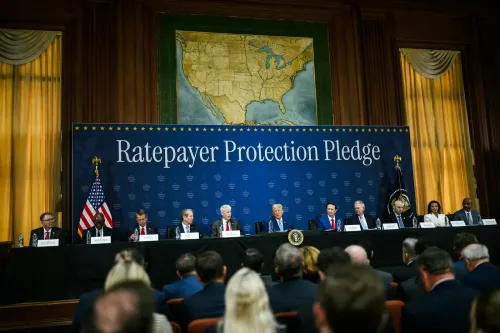
The White House on Thursday, 24 July 2026 published a five-point 'Ratepayer Protection Pledge,' outlining voluntary commitments that large energy consumers are expected to make to shield ordinary electricity users from rising infrastructure costs driven by surging power demand.
Context
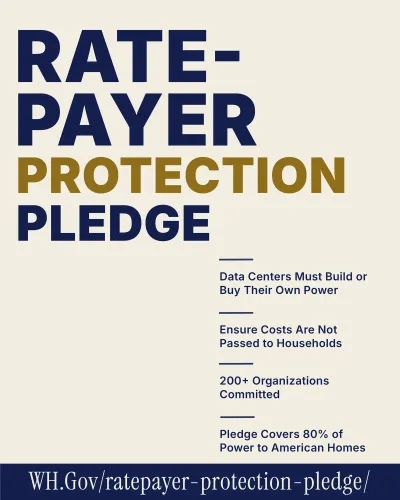
The pledge, shared via the official White House account and linked to Whitehouse.gov/ratepayer-protection-pledge/, lists five core commitments: building, bringing, or buying new power supply; paying for new power delivery infrastructure; paying whether or not the power is actually used; investing in local job creation and workforce development; and contributing to grid and community resilience.
The announcement comes amid a sharp rise in electricity demand, driven in large part by the explosive growth of data centres and other technology infrastructure across the United States. Residential and small commercial ratepayers have historically borne the cost of grid upgrades, even when those upgrades are necessitated by large industrial or technology users.
Policy Backdrop
The pledge builds on a policy lineage stretching back to the Bipartisan Infrastructure Law of 2021, which directed federal investment into grid modernisation and transmission capacity expansion to address ageing infrastructure and growing demand. The Inflation Reduction Act of 2022 further layered in tax credits and incentives for clean energy deployment and grid resilience.
Despite these legislative efforts, the question of who pays for new transmission lines and substations has remained contentious. Federal regulators at the Federal Energy Regulatory Commission (FERC) have faced sustained pressure to update cost-allocation rules so that large users — rather than everyday consumers — bear a proportionate share of infrastructure expenses.
The Ratepayer Protection Pledge appears to be a voluntary framework designed to encourage large energy consumers to pre-commit to covering these costs, potentially reducing the regulatory and legislative friction involved in mandating such obligations.
Stakeholders and Impact
The primary beneficiaries of the pledge, if widely adopted, would be residential electricity ratepayers and small businesses, who currently risk seeing higher utility bills as utilities pass through the cost of grid upgrades to their customer base.
Utility companies stand to gain greater financial certainty for infrastructure projects, while large energy consumers — particularly technology firms operating data centres — would be expected to take on explicit financial commitments in exchange for guaranteed power access and grid priority.
The pledge's fifth point, on local job creation and workforce development, signals an effort to build community support for new energy infrastructure, a dimension that has grown increasingly important as siting disputes delay transmission and generation projects across the country.
What's Next
Attention will now turn to which major technology or manufacturing firms formally sign on to the pledge, and whether the White House follows up with any executive action or regulatory guidance directing FERC to align cost-allocation rules with the pledge's principles.
If large consumers adopt these commitments at scale, it could set a new precedent for how the United States funds its next generation of electricity infrastructure — shifting the burden away from ordinary households and toward the industrial users whose demand is driving grid expansion in the first place.
Point of View
Rather than households, the financial backstop for infrastructure growth. By framing this as a voluntary pledge rather than a regulatory mandate, the administration sidesteps a potentially bruising battle at FERC while still signalling clear expectations to the private sector. The inclusion of local job creation and community resilience points suggests the White House is also trying to neutralise grassroots opposition to new transmission and generation projects. Whether voluntary commitments translate into durable, enforceable obligations will be the defining question for this policy's legacy.
NationPress
22 Oct 2026
Frequently Asked Questions
What is the White House Ratepayer Protection Pledge?
The Ratepayer Protection Pledge is a five-point voluntary framework released by the White House on 24 July 2026, asking large energy consumers to fund new power supply and delivery infrastructure, pay for power whether or not they use it, invest in local jobs, and support grid resilience — so that ordinary electricity ratepayers are not burdened with those costs.
Why is the US government concerned about electricity ratepayers?
Surging electricity demand from data centres and industrial users is driving the need for expensive grid upgrades. Historically, utilities have passed these costs on to residential and small commercial customers through higher bills, which the pledge aims to prevent.
Who is expected to sign the Ratepayer Protection Pledge?
The pledge targets large energy consumers, particularly technology companies operating data centres and major manufacturing firms, whose growing power needs are a primary driver of new infrastructure investment.
How does this pledge relate to existing US energy laws?
It builds on the Bipartisan Infrastructure Law of 2021 and the Inflation Reduction Act of 2022, both of which directed federal funding and incentives toward grid modernisation and clean energy deployment, but did not fully resolve how new infrastructure costs should be allocated.
What role does FERC play in the Ratepayer Protection Pledge?
The Federal Energy Regulatory Commission (FERC) sets rules on how transmission costs are allocated among utilities and consumers. Analysts are watching whether the White House will push FERC to update those rules to align with the pledge's principles, giving voluntary commitments a regulatory backbone.