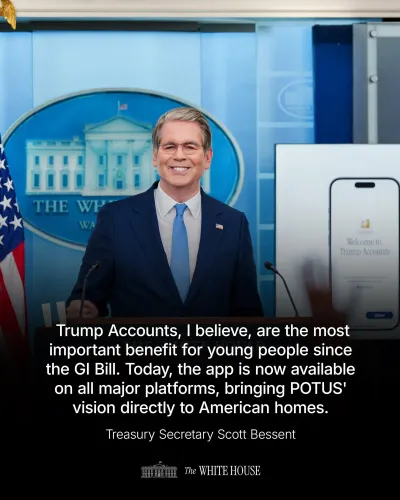
White House Urges Americans to Open 529 Education Savings Accounts

Synopsis
The White House on 29 May 2026 called on American families to open 529 tax-advantaged education savings accounts for their children. The social-media push directs users to online resources and highlights a long-standing federal mechanism to encourage private preparation for rising education costs.
Key Takeaways
The White House posted on 29 May 2026 urging Americans to open 529 education savings accounts for their children.
529 plans are tax-advantaged vehicles authorised under Section 529 of the Internal Revenue Code, with roots in the Small Business Job Protection Act of 1996 .
Withdrawals for qualified education expenses are federally tax-free , covering costs from K-12 through higher education .
The Tax Cuts and Jobs Act of 2017 expanded eligible uses to include up to $10,000 per year in K-12 tuition.
The White House post links to online resources rather than announcing a new statutory programme.
Potential future changes to contribution limits and eligible expenses may follow from Treasury or Education Department guidance.
The White House on Friday, 29 May 2026 called on American families to open tax-advantaged education savings accounts for their children, directing followers to online resources as part of a social-media push to promote financial preparation for schooling costs.
Context
The post urged Americans to 'join the millions of Americans setting up their children for success,' linking to two online resources. The message centres on 529 plans — tax-advantaged savings vehicles that allow families to set aside money for a beneficiary's future education expenses, from kindergarten through college.
529 plans take their name from Section 529 of the Internal Revenue Code. Funds contributed grow free of federal tax, and withdrawals used for qualified education expenses are not subject to federal income tax, making them one of the most widely used private education-savings tools in the United States.
Policy Backdrop
The legislative foundation for 529 plans was laid by the Small Business Job Protection Act of 1996, which authorised states to establish qualified tuition programmes. Over the following decades, Congress expanded the framework: the Tax Cuts and Jobs Act of 2017 broadened allowable uses to include K-12 tuition of up to $10,000 per year, supplementing the original focus on higher education.
Federal promotion of these accounts has continued across successive administrations as a mechanism to encourage private preparation for rising college costs rather than relying solely on public aid programmes. The White House's social-media outreach in this instance directs users to existing tools rather than announcing any new statutory programme.
Stakeholders and Impact
The primary beneficiaries of 529 plans are parents and guardians of school-age and pre-school children who have the financial capacity to make regular contributions. Account owners retain control of the funds and can change the beneficiary to another family member if the original beneficiary does not use the savings.
For Indian-American families and other immigrant households in the United States, 529 plans are equally accessible and have grown in popularity as a structured way to manage the high cost of American higher education. Millions of accounts are already active across all 50 states, each of which administers its own version of the plan with varying state-tax incentives.
What's Next
Observers will watch for any follow-up guidance from the Treasury Department or the Department of Education on potential changes to contribution limits, eligible expenses, or portability rules. Legislative proposals to further expand 529 uses — including to apprenticeship programmes and student-loan repayments — have circulated in Congress in recent sessions and could resurface. The White House's renewed public emphasis on the accounts may signal broader messaging around education-affordability ahead of the legislative calendar.
Point of View
High-reach policy-communication tactic that costs the federal government nothing while reinforcing a private-savings-first approach to education affordability. By amplifying an existing, bipartisan mechanism rather than proposing new spending, the administration signals fiscal conservatism on education while still appearing action-oriented. For Indian and other immigrant communities in the United States, the nudge carries practical weight given the disproportionately high value placed on higher education and the steep tuition costs at American universities. The post fits a broader pattern of executive-branch outreach that uses social media to drive uptake of existing programmes rather than legislate new ones.
NationPress
19 Sept 2026
Frequently Asked Questions
What is a 529 plan and how does it work?
A 529 plan is a tax-advantaged savings account designed to help families pay for education expenses. Contributions grow free of federal tax, and withdrawals for qualified expenses — including K-12 tuition up to $10,000 per year and higher-education costs — are not subject to federal income tax.
Why is the White House promoting 529 plans?
The White House posted on 29 May 2026 encouraging Americans to open 529 accounts as part of a social-media push to promote private preparation for education costs. The post links to online resources and reflects a long-standing federal policy of encouraging families to save rather than rely solely on public aid.
Can Indian Americans or immigrants in the US open a 529 plan?
Yes. 529 plans are available to any US resident regardless of national origin. Account owners can open a plan in any state, and many states offer additional state-tax deductions on contributions.
What changes have been made to 529 plans in recent years?
The Tax Cuts and Jobs Act of 2017 expanded 529 plans to cover K-12 tuition of up to $10,000 per year per beneficiary, in addition to the original focus on higher-education expenses. Further legislative changes to contribution limits or eligible expenses remain under congressional discussion.
What should families watch for regarding 529 plans in 2026?
Families should monitor any guidance from the Treasury Department or the Department of Education on potential changes to contribution limits, eligible expenses, or portability rules, as well as any new legislation that could broaden or restrict the plans.