White House Reaffirms: US Elections Are for Citizens Only
Synopsis
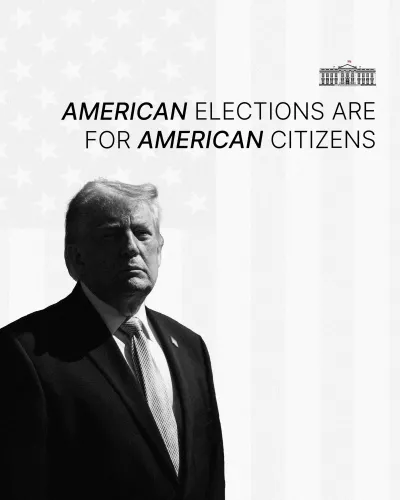
The White House on July 17, 2026, posted a direct statement on X declaring that American elections are for U.S. citizens only, reinforcing longstanding federal law ahead of the 2026 midterm elections and reigniting debate over citizenship verification standards.
Key Takeaways
The White House posted on July 17, 2026 : 'American elections are for American citizens only.' Non-citizen voting in federal elections has been a criminal offense under the Illegal Immigration Reform and Immigrant Responsibility Act of 1996 .
The Help America Vote Act of 2002 requires citizenship affirmations on federal voter registration forms under penalty of perjury.
Election Assistance Commission provides bipartisan guidance to states on voter eligibility standards.
The statement arrives ahead of the 2026 US midterm elections , a cycle marked by active debate over proof-of-citizenship mandates.
Congressional proposals on citizenship verification and related state-level litigation are expected to escalate in the coming months.
The White House, the official communications account of the Executive Office of the President of the United States, posted a pointed message on X on Friday, July 17, 2026, stating: 'Good morning, American elections are for American citizens only.'
Context
The post, brief and unambiguous, arrives ahead of the 2026 United States midterm elections, a cycle that has drawn renewed attention to voter eligibility rules and citizenship verification requirements. The statement does not reference a specific policy trigger, but its timing places it squarely within an ongoing national debate about who is entitled to participate in American democratic processes.
Under existing federal law, voting in national elections by non-citizens is already prohibited. The Illegal Immigration Reform and Immigrant Responsibility Act of 1996 established criminal penalties for any non-citizen who casts a ballot in a federal election. This statute has been in force for nearly three decades.
Policy Backdrop
The legislative framework governing voter eligibility is layered. The Help America Vote Act of 2002 required citizenship affirmations on federal voter registration forms, meaning applicants must attest to their citizenship status under penalty of perjury. The U.S. Election Assistance Commission, a bipartisan agency created under the same 2002 law, provides guidance to states on election administration standards and voter eligibility.
Federal statutes have consistently limited voting in national elections to U.S. citizens, while leaving limited room for local jurisdictions to experiment with non-citizen participation in certain municipal contests. Periodic legislative and court debates have centred on proof-of-citizenship mandates and the maintenance of accurate interstate voter rolls.
Congressional proposals focused on tightening citizenship verification standards have gained traction in recent sessions, and related litigation at the state level has kept the issue in the public eye heading into the midterm cycle.
Stakeholders and Impact
American voters and state election officials are the primary stakeholders in any shift to citizenship verification protocols. States bear the administrative burden of maintaining accurate voter rolls and implementing any new federal mandates that may emerge from Congress.
For the estimated millions of non-citizen legal residents in the United States — including green card holders and visa holders — the White House's message underscores that participation in federal and state elections remains outside their legal rights, regardless of how long they have lived or worked in the country.
The statement also carries symbolic weight for Indian-Americans and the broader South Asian diaspora, a significant and politically engaged community in the United States, many of whom are permanent residents on a path to citizenship but not yet eligible to vote.
What's Next
Congressional activity around citizenship verification legislation and any related court rulings are expected to intensify as the 2026 midterm elections approach. State-level rule changes on voter registration and eligibility checks will be closely watched by both election administrators and advocacy groups.
The White House's public restatement of a foundational electoral principle signals that voter eligibility is likely to remain a prominent theme in the administration's communications in the months ahead.
Point of View
The administration aligns itself with congressional efforts to tighten proof-of-citizenship requirements ahead of the midterms, lending executive-branch weight to a legislative push. For Indian and South Asian audiences, the message is a reminder of the sharp legal line between permanent residency and full civic participation in the United States. The post's brevity is its own kind of strategy: it invites broad agreement on a legal baseline while leaving room to escalate the debate toward more contested enforcement questions.
NationPress
17 Jul 2026
Frequently Asked Questions
Can non-citizens vote in US elections?
No. Non-citizens are legally barred from voting in federal and state elections in the United States. The Illegal Immigration Reform and Immigrant Responsibility Act of 1996 makes it a criminal offense for any non-citizen to cast a ballot in a federal election.
What did the White House post about elections on July 17, 2026?
The White House posted on X: 'Good morning, American elections are for American citizens only,' reaffirming the longstanding legal restriction on non-citizen voting ahead of the 2026 midterm elections.
What is the Help America Vote Act?
The Help America Vote Act of 2002 is a federal law that requires citizenship affirmations on federal voter registration forms and mandates that states maintain accurate voter rolls. Applicants must attest to their citizenship under penalty of perjury.
Can Indian green card holders vote in the US?
No. Green card holders — including Indian nationals who are lawful permanent residents — are not U.S. citizens and are therefore not permitted to vote in federal or state elections. Voting rights are reserved for naturalised or birthright U.S. citizens.
What are the 2026 US midterm elections?
The 2026 US midterm elections are scheduled congressional elections in which all 435 seats in the House of Representatives and approximately one-third of Senate seats are contested. They are a major test of the sitting administration's political standing.